






Egypt wants mining to rise from below one per cent of GDP to about 6 per cent. Reaching that target depends less on how much rock is dug than on how much of the value stays in the country.
In economics, it’s all about the value chain. What really matters is how such a chain maximises national wealth.
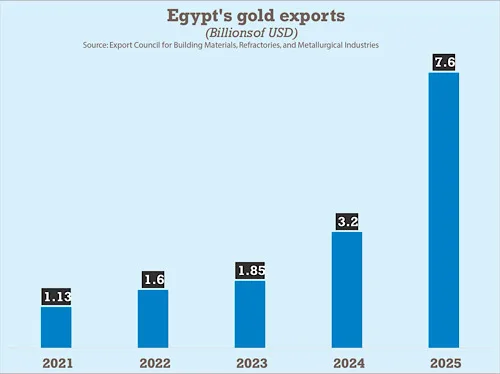
Egypt’s gold exports more than doubled to $7.6 billion in 2025, up from $3.2 billion in 2024, according to government foreign-trade data. Gold now sits alongside the Suez Canal and remittances as a major source of dollars, which explains the government’s enthusiasm.
Yet the leap says little about how large the mining sector is. Part of it probably reflects a stronger gold price rather than new tonnage. And an export figure measures gross revenue, not the value a sector adds to the economy.
The GDP question
The official ambition is to lift mining’s contribution to GDP from below 1 per cent to roughly six per cent. Read as a production target, it is a story about ounces and tonnes. Read as a GDP target, it is a story about domestic value added, a much harder test.
The scale is large. On an economy of roughly $350–400 billion, six per cent implies $20–25 billion of annual value added. If a typical mining operation retains half its revenue as domestic value added after imported inputs, royalties and repatriated profits, that points to $40–50 billion of annual output, several times today’s gold exports. The target is only reachable if five channels move together.
The first is investment. Exploration is a gamble and mine development is capital-intensive, with individual projects often costing hundreds of millions of dollars or more. A sixfold expansion implies tens of billions of dollars deployed over years, most of it foreign.
The second is production. Gold alone cannot carry the target, so phosphate and other minerals must scale up, and each depends on separate geology, buyers and logistics.
The third is processing, where the arithmetic improves most. Exporting raw ore or concentrate captures a fraction of the value of refined metal, phosphoric acid or fertiliser. Beneficiation turns a commodity export into an industrial activity with its own workforce and supply chain.
The fourth is domestic supply. Mining equipment, engineering, transport, laboratory testing and geological services can all be bought locally or imported. Every dollar sourced abroad is value added that never reaches Egypt’s GDP.
Reforms paving the way
Cairo has moved on the regulatory front. Amendments to the executive regulations of the Mineral Resources Law in May 2026 cut exploration-area rents by as much as 60 per cent.
The new regulations capped approvals and coordination at 30 days, allowed several minerals to be explored or exploited under one concession. The state authority’s share in joint projects was cut from 25 per cent to 10 per cent.
These changes target the right problem. Exploration economics are acutely sensitive to upfront costs and delays, because most prospects never become mines. Lower rents and a predictable clock reduce the cost of being wrong.
The lower state stake is a trade-off, since it makes joint ventures more attractive to investors but leaves the state with less of the upside from any big discovery.
Licence applications measure the government’s marketing. Only the later stages measure the creation of mining assets. If the numbers thin out sharply after the licensing stage, the reforms have raised interest without changing outcomes. If spending and feasibility studies rise in step, Egypt is beginning to generate assets rather than paperwork.
The fifth is exports, which matters for the foreign-exchange story. But hard currency earned is not the same as value created. The GDP target is ultimately a measure of what stays at home.
Infrastructure has the final say
Many of Egypt’s deposits lie in the Eastern Desert and other remote areas, far from industrial centres. A mine’s viability depends on more than geology and tax terms.
It needs roads, electricity, water, telecommunications, ports, airports, logistics, processing facilities, worker accommodation, and security and environmental infrastructure.
For a marginal deposit, these costs can decide the investment. If the state builds shared infrastructure (power corridors, water, port capacity), it lowers the hurdle for every project in a region at once. That may do more for investment than another round of fee cuts.

