



Central banks have long signalled plans to diversify away from the dollar, yet reserve data shows little progress towards that goal.
For most of the past decade, de-dollarisation has been one of the steadiest talking points in international finance. Are central banks rebalancing away from Washington? Is gold really reclaiming ground from US Treasuries?
These queries make some sense with a scattering of deals settled in local currencies.
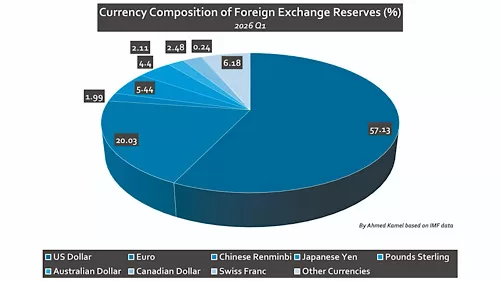
The rhetoric has been consistent and, at moments, loud. The data have been stubborn. The dollar’s share of global foreign-exchange reserves rose to 57.13 per cent in the first quarter of 2026, the IMF’s Currency Composition of Official Foreign Exchange Reserves data show, up from 56.42 per cent the prior quarter, against total reserves of roughly $13.1 trillion.
That is close to $7.5 trillion in dollar assets, more than five times the equivalent euro holding and nearly thirty times the renminbi’s.
A modest basket
The rest of the basket undercuts the diversification narrative more than it supports it. The euro held 20.03 per cent of reserves that quarter, the yen 5.44 per cent, and the renminbi, the currency most often cast as the dollar’s plausible long-run challenger, just 1.99 per cent.
Everything else, Australian and Canadian dollars, sterling, the Swiss franc and a residual other-currencies category under the IMF’s revised methodology, made up the remaining 6.18 per cent combined. Two decades of financial-market opening in Beijing and a web of bilateral swap lines have moved the renminbi’s reserve share by barely a point.
Falling shares, rising confusion
The stronger case against reading too much into any single quarter is the second quarter (Q2) of 2025, when the dollar’s share appeared to drop from 57.79 per cent to 56.32 per cent, precisely the kind of move cited as evidence of an accelerating exit.
The IMF’s own accounting found exchange-rate movements, not central-bank selling, explained 92 per cent of that decline; holding rates constant, the share would have fallen only to 57.67 per cent. Reserves are valued in dollar terms, so when the euro or yen appreciates, the dollar value of a bank’s euro or yen holdings rises even if it trades nothing.
Q1 2026’s uptick ran the mechanism in reverse: the IMF attributed roughly half the gain to dollar appreciation rather than net purchases.
Strip out the valuation noise and the reserve base looks like it is drifting, not stampeding, away from the dollar, and slowly enough that the direction from one quarter to the next is often ambiguous.
The liquidity problem
A currency that sits in 57 per cent of official reserves but underpins nine in every ten foreign-exchange transactions is not one losing its grip on the plumbing of global finance. If anything, the reserve share is the more contested of the two metrics.
The gap between rhetoric and reserves traces back to what central banks actually need reserves for. They are not badges of political alignment; they are working capital, held to intervene in currency markets, meet external obligations and absorb shocks without moving prices against whoever is buying or selling.
That requires a market deep enough to absorb outsized transactions without much slippage, and the US Treasury market remains, by a wide margin, the deepest of its kind in any currency. Redirecting even a modest share of $7.5 trillion in reserves would require an alternative able to absorb that scale without moving the very prices being hedged, a capacity the eurozone’s fragmented bond market, China’s capital-controlled market, and gold’s physical-settlement limits do not yet offer at the size required.
Diversifying, not defecting
None of this makes the diversification trend fictional. An OMFIF (Official Monetary and Financial Institutions Forum) survey of roughly 90 central banks and sovereign institutions in June 2026 found a majority planning to reduce dollar allocations over the coming decade, citing political risk as the main driver, and gold has spent the past two years overtaking Treasuries as a share of official reserves. A shift driven mostly by gold’s own price rather than central-bank buying, but a real reallocation nonetheless.
The honest description of where things stand is neither “de-dollarisation is a myth” nor “the dollar is being dethroned,” but something narrower: central banks are trimming dollar concentration at the margin, largely into gold, while still holding the bulk of their reserves, and conducting the overwhelming majority of their trading, in the one asset the system has yet to find a substitute for at scale.
Diversification and dominance, on the current numbers, are not opposites. They are what a slow, partial rebalancing looks like when it has nowhere large enough to go.

