


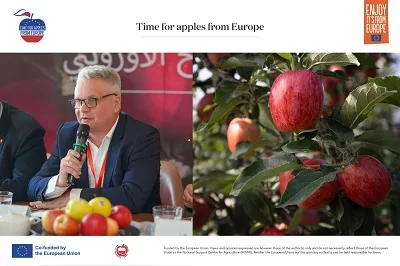
Mirosław Maliszewski, President of the Association of Polish Fruit Growers (ZSRP), an organization representing Polish fruit producers, gave an interview to Egyptian Gazette as part of the “Time for apples from Europe” campaign, which aims to promote European apples on international markets, including Egypt.
In his conversation with the newspaper, President of ZSRP discusses in detail the impact of the campaign on the fruit trade between Europe and Egypt, the benefits that Egyptian importers gain from this cooperation, and the challenges faced by European exporters.
- This is the third and final year of the “Time for Apples from Europe” campaign. How do you assess the overall impact of the campaign on the European apple market in Egypt? Have there been any significant changes since the beginning of the campaign?
The “Time for Apples from Europe” campaign has had a huge impact on the perception of European apples in Egypt. Over the past years, we have seen a growing interest in these fruits, both among consumers and importers. Initially, European apples were less known on the Egyptian market, but thanks to intense promotional activities, including presence at fairs, trade missions and promotions on social media, we managed to permanently introduce them to Egyptian consumers. The way in which European apples are promoted has also changed – not only at fairs, but also through online platforms. The increase in consumer awareness of the quality of these fruits and their unique taste is clearly visible, and trust in European apples is growing. It is not only a question of quality, but also the ecological benefits of production in the European Union, which are gaining importance among Egyptian consumers.
2. As this is the final year of the campaign, what key achievements would you highlight, and what challenges do we still face in the future?
I am proud of our achievements, especially in terms of establishing new business contacts and strengthening the position of European apples on the Egyptian market. The campaign has built a solid foundation for further cooperation between European exporters and Egyptian importers. Over the past three years, we have organised a series of events that have allowed for direct exchange of experiences and negotiations on terms of cooperation, as well as educating Egyptian consumers on the value of European apples. However, despite these successes, there is still a need for further work to improve export conditions and overcome certain logistical barriers that may still hinder the flow of goods. It is necessary to maintain continuity of supply, which requires flexibility in adapting to changing conditions. In addition, there is still a need to raise awareness of the value of ecological production in Europe, which is a great asset in markets such as Egypt. Although the campaign will end this year, continued cooperation and further activities promoting European apples will remain key to the long-term development of this market.
3. How has the Egyptian market for European apples changed in recent years and how do you expect it to develop after the campaign ends?
In recent years, the Egyptian market has become more open to European apples. Previously, the export of European apples to Egypt was limited and faced some difficulties related to the lack of awareness of the quality of European fruit and its availability. However, over the years, it has been possible to build a strong network of business contacts and gain the trust of local importers, who are now more willing to invest in European apples, treating them as a premium product. The increase in the number of importers who see the value of European apples, as well as the increase in consumer awareness of the quality of these fruits, confirm that this market has great potential. After the end of the campaign, we hope that this trend will continue and European exporters will be able to continue their activities in this market thanks to the contacts and trust of consumers that have already been established. The Egyptian market will become more stable, and European apples will become one of the main choices for consumers looking for high-quality fruit.
4. European apples have become more popular in Egypt thanks to the campaign. What steps will be necessary to ensure that their presence in the market remains strong after the campaign ends?
After the end of the “Time for Apples from Europe” campaign, it will be crucial to continue activities that will allow maintaining and developing interest in European apples on the Egyptian market. The focus should be on further building brand awareness, organizing meetings and trade missions, and maintaining regular communication with local importers and distributors. It is also worth continuing to educate consumers through local media, sales networks and the Internet, where information about the quality and exceptional taste of European apples can reach a wide audience. In addition, maintaining the high quality of products and adapting the offer to changing market needs and consumer preferences will be the basis for the long-term presence of European apples in Egypt. Continuing dialogue with Egyptian industry institutions will also ensure stability in trade and help solve potential problems related to import.
5. What are the main features that distinguish European apples, and especially Polish apples, on the Egyptian market, and how can they be promoted after the campaign ends?
European apples, including Polish ones, are characterized by exceptional quality and taste, which makes them attractive to Egyptian consumers. Production in the European Union is carried out in accordance with rigorous EU standards, which guarantee high quality fruit, as well as ensure sustainable development and environmental protection. European apples are particularly valued for their aroma, taste and aesthetic appearance, which makes them an exceptional product on the Egyptian market. Thanks to modern technologies and cultivation methods, Polish fruit growing offers fruit of exceptional durability, which tolerates long-distance transport well. After the campaign ends, it will be crucial to continue to engage the media, organize tastings and presentations, and develop the distribution network so that European apples are present in the widest possible circle of consumers.

