





Industrialisation is both a means and an objective for sustainable development in a country that is redrawing its socioeconomic priorities and making headway in its economic reform programme.
As tariffs reshape global supply chains, Cairo is betting industrialisation can close a widening trade gap, but the rules of the new trade war are shifting faster than factories can be built.
On July 24, Washington moved Egyptian exports into a rougher lane. The Office of the US Trade Representative (USTR) placed Egypt among 60 economies it deemed to lack adequate forced-labour import controls, setting its Section 301 duty at 12.5 per cent, the higher of two tiers, reserved for countries that had neither banned forced-labour goods nor committed to doing so.
The new rate replaced a temporary 10 per cent global surcharge that had briefly given Egyptian exporters something unusual: a landed-cost edge over rivals.
Trade deficits
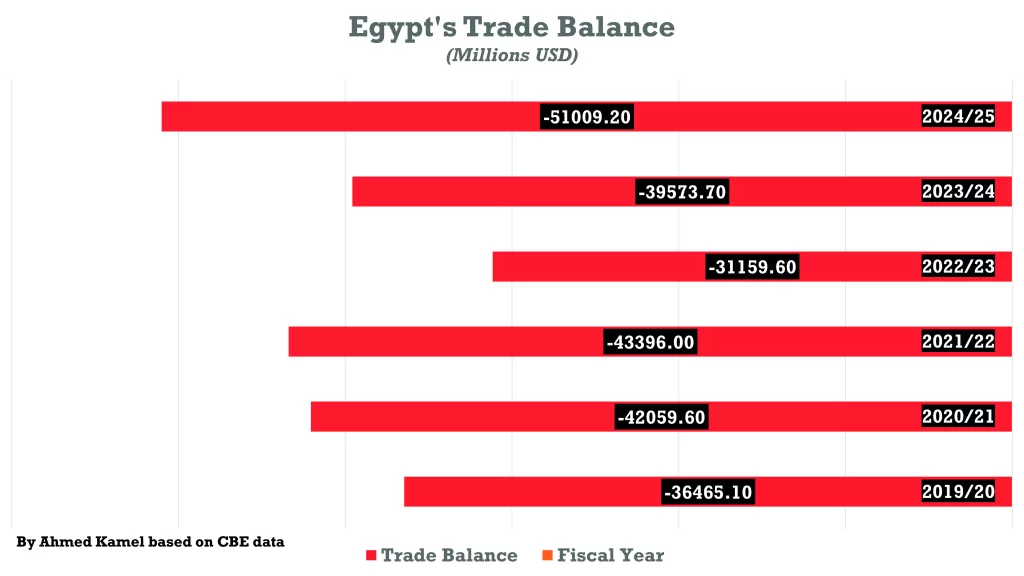
The stakes reach beyond one tariff notice. Egypt’s merchandise trade deficit widened from roughly $36.5 billion in fiscal 2019/20 to more than $51 billion in 2024/25, central bank figures show, a gap that officials increasingly view as a production problem rather than a currency one.
The government’s answer, a National Industrial Strategy reviewed by President Abdel Fattah El Sisi in July, targets $100 billion in non-oil exports by 2030 across seven priority industries: garments, textiles, food processing, pharmaceuticals, cars, and electrical and electronics goods.
Textiles offer the most credible near-term case. The sector topped $9.68 billion in output last year, and garment exports alone are tracking towards a record $4.4 billion in 2026, a 22 per cent jump, en route to a stated $12 billion target by 2031.
Qualifying Industrial Zone (QIZ) status has long given Egyptian apparel duty-free entry to the US, a privilege that made its old 10 per cent baseline look cheap next to Vietnam, whose tariff swung wildly this year, from a punishing 46 per cent down to 10 per cent after a February Supreme Court ruling struck down the broader tariff regime, with more turbulence still possible.
Whether QIZ shipments stay shielded from Egypt’s new 12.5 per cent duty remains unclear; the USTR notice leaves goods under special tariff programs exposed unless otherwise exempted.
Even on the best terms, Egypt still imports over $2.5 billion of textile raw material annually from China, a vertical-integration gap that mature rivals closed years ago.
Presidential initiative
Electronics tell a similar assembly-first story. Under the Egypt Makes Electronics initiative, mobile-handset capacity has climbed towards 20 million units a year, with Xiaomi, Oppo and Honour all opening or expanding plants.
Yet, local value content sits near 40 per cent, respectable for a young cluster but far from a mature one. Automotive is the bolder wager: Cairo wants annual output near 400,000 vehicles by 2030, up from about 95,000 today, anchored by the revived state carmaker El Nasr’s tie-ups with China’s FAW and Dongfeng and by Nissan, whose Egyptian plant became its only passenger-vehicle base on the continent after exiting South Africa.
Set against Morocco, which built more than half a million vehicles in 2024 and shipped €15.1 billion of them into the EU, Egypt’s automotive push looks like an earlier chapter of a story Rabat has already written. Morocco, notably, faces the same 12.5 per cent US forced-labour tariff Egypt just absorbed.
Pharmaceuticals may be the quieter success. Egypt now manufactures roughly 90 per cent of the medicines it consumes, has reached the World Health Organisation’s Maturity Level 3 rating, held by only 16 countries worldwide, and exporters such as EIPICO now reach more than 65 markets, positioning the sector as an African supply hub largely insulated from US tariff politics.
Food processing follows the same logic: agri-food exports nearly doubled from $3.5 billion in 2020 to $6.8 billion in 2025, with officials chasing $14 billion this year, most of it absorbed by Europe and the Gulf rather than an increasingly unpredictable US market.
Filling the gap
Two numbers temper the optimism. UN Trade and Development’s 2026 World Investment Report named Egypt among the economies best placed to catch reconfigured supply chains, crediting it with $15.5 billion in FDI last year, Africa’s largest inflow for a fourth straight year.
Yet, the same report found greenfield manufacturing investment outside AI, semiconductors and energy technology fell 17 per cent globally between 2015-2019 and 2021-2025, squeezing precisely the textile-and-garment on-ramp that industrialised Asia a generation ago.
At home, the S&P Global PMI spent most of the first half of 2026 below the 50-point growth line, weighed down by Middle East-conflict-driven energy costs and a softer pound.
None of that erases Egypt’s assets. The Suez Canal Economic Zone alone has drawn $16 billion in investment and now counts 205 operating factories, and Egypt’s overlapping access to the EU, the US, COMESA and the African Continental Free Trade Area is genuinely unusual.
But trade war 2.0 rewards speed and certainty, and July’s tariff surprise is proof that Cairo controls neither. The more honest verdict: in pharmaceuticals and food, Egypt is arguably already a winner; in textiles, plausibly soon; in electronics and cars, only if the tariff schedule holds still long enough for the factories to finish.

