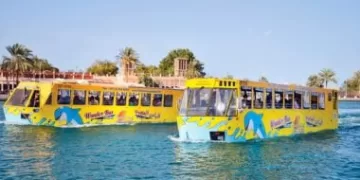







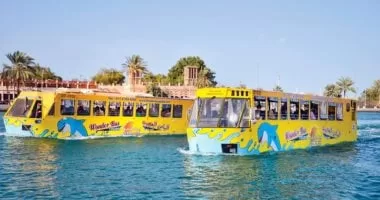
The banks of the Nile in Cairo are set to witness an extraordinary spectacle -a bus that transitions from navigating crowded city streets to cruising along the Nile River.
The amphibious bus, scheduled to start trial operations before the end of 2025, marks a significant leap in the country’s efforts to modernise its transport infrastructure and promote tourism.
According to reports from the Ministry of Transport, the amphibious vehicle, developed in co-operation with the Ministry of Tourism, the River Transport Authority and a private partner, will initially operate in key tourist cities including Cairo, Luxor, and Aswan.
The service will be dedicated exclusively to tourism rather than daily public transportation, offering visitors the chance to tour iconic sites by road and river in one seamless journey.
“This is more than just a new means of transportation—it’s a new way to experience Egypt,” Mofid Salah, head of the River Transport Authority, told the local media.
“The amphibious bus will allow tourists to move from the streets of Cairo directly into the waters of the Nile, combining cultural exploration with leisure in a safe, eco-friendly environment,” he said.
“The Nile has always been Egypt’s lifeline. Today, it’s becoming the highway of our tourism future,” he added.
To accommodate the new service, the Ministry of Transport has begun constructing special transition lanes that allow the bus to move smoothly between land and water. The bus is equipped with the latest safety technologies and is currently undergoing rigorous testing to ensure smooth performance before official launch.
“Eco-tourism is the future. This project will help position the country as a global leader in integrating green transport with cultural tourism,” Tourism expert Amr Sedky said.
“The introduction of this hybrid vehicle is no mere technological novelty—it represents a calculated strategy to diversify Egypt’s tourism experience. By seamlessly connecting land-based historical sites with Nile cruises, the amphibious bus addresses a fundamental need in tourist mobility while creating an unforgettable experience in itself,” he added.
”The bus eliminates the need for tourists to change vehicles between land and water excursions, streamlining itineraries and preserving valuable vacation time that would otherwise be spent in transitions,” Sedky stressed.
Beyond tourism and economic benefits, the amphibious bus aligns with broader environmental goals. River transportation presents a sustainable alternative to congested road networks, potentially reducing carbon emissions and fuel consumption .
“The amphibious bus is the centerpiece of a much broader, ambitious push to develop Egypt’s river transportation infrastructure,” said.
According to official govenrment data, recent years have seen massive investments exceeding LE4 billion in river transport, yielding tangible results. The number of operational river units increased from 289 in 2014 to 400 in 2023, carrying 18 million passengers and 7 million tonnes of goods annually.
By 2030, the Ministry of Transport aims to expand this fleet to 520 units, transporting 21 million passengers and 10 million tonnes of cargo each year.
“Such expansion not only strengthens the tourism sector but also stimulates the economy. River transport is among the most cost-effective and environmentally friendly forms of mobility, significantly reducing traffic congestion, fuel consumption, and carbon emissions,” said Abdallah Abu Khadra , Professor of Roads and Transport at Beni Suef University.

