



It could be another stress test. But for the entire economy.
Egypt and China agreed earlier this month to deepen co-operation across a number of major sectors, i.e., manufacturing, renewable energy, AI, digital transformation and the Suez Canal Economic Zone (SCZone).
Such partnership raises the question of whether Cairo can take its foreign direct investment (FDI) to the next level.
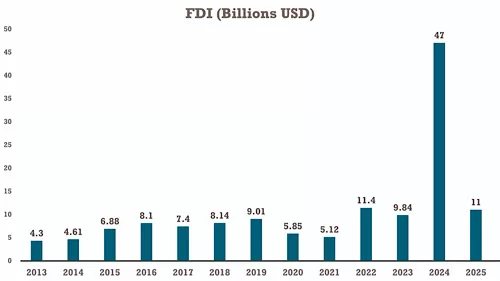
Egypt closed 2025 as Africa’s largest destination for FDI inflows, snatching around $15 billion, according to UNCTAD’s World Investment Report.
But the headline number obscures the more important question: what kind of capital is actually arriving, and is it the kind that builds an export economy, or the kind that simply monetises land?
What the IMF keeps saying
Egypt’s macroeconomic perspective has stabilised. GDP grew by 4.4 per cent in fiscal year 2024/25. The IMF projects 4.6 per cent for 2026.
The current account deficit narrowed 13.6 per cent to $9.5 billion in the first half of fiscal year 2025/26.
But look at what drove that improvement. Remittances leaped 30 per cent to $22.1 billion, and tourism revenue jumped 17 per cent. Exports played almost no role; the non-oil trade deficit actually widened. In other words, Egypt is financing its currency needs through migrant labor and tourists, not through what it manufactures and sells abroad.
The IMF’s own reviews are blunt about why. Its February 2026 assessment, completing the fifth and sixth reviews of Egypt’s Extended Fund Facility, found structural reform “uneven” and the divestment agenda “slower than envisaged,”warning that the state’s economic footprint remains the primary obstacle to durable, private-sector-led growth.
In other words: Egypt’s binding constraint isn’t a shortage of capital. It’s an economy still structured to privilege state and military players over private, competitive, export-oriented firms.
Xi’s visit as a test case
Xi Jinping’s state visit to Cairo earlier this month offers a useful stress test of whether the composition is genuinely shifting.
The two sides launched a third phase of their joint industrial zone inside the SCZone, explicitly targeting renewable energy, automotive manufacturing, textiles, and chemical fibers, with stated ambitions extending to electric vehicles, solar panels, wind turbines, desalination, and even semiconductors and data centres.
This is the kind of capital Egypt’s planners actually want: production capacity aimed at import substitution and, eventually, export through SCZone’s access to Europe, the Gulf, and Africa.
Yet, the scale gap is stark. Cumulative Chinese investment in the zone sits near $4 billion by Egyptian officials’ own count, a fraction of the single $35 billion Ras el-Hekma deal. The wider SCZone drew $7.26 billion in contracted investment across 117 projects in FY2025/26, expected to generate about 73,500 jobs.
And the trade relationship China is offering remains lopsided: Egyptian exports to China ran at just $840.8 million in the first half of 2026 against $10.4 billion in imports, a roughly twelve-to-one gap that manufacturing localisation is supposed to narrow, not yet has.
The Ras el-Hekma problem
Abu Dhabi’s ADQ fund committed $35 billion in February 2024 to develop a Mediterranean coastal city, a deal so large it single-handedly rescued Egypt’s balance of payments and unlocked an expanded IMF program.
The encouraging counterpoint is that FDI kept climbing even after stripping Ras el-Hekma out of the numbers. UNCTAD put the underlying increase at around 25 per cent in 2025, helped by Qatar’s $3.5 billion Alam El-Roum coastal project and continued Gulf appetite for Egyptian real estate.
Central bank data for the first half of fiscal year 2025/26 showed net FDI rising to $9.3 billion from $6 billion a year earlier, with $9.4 billion flowing to non-oil sectors. That is genuine broadening.
But it is still concentrated in real estate, tourism infrastructure, and services — not the tradable, export-oriented manufacturing Egypt actually needs to earn hard currency on a recurring basis rather than through periodic asset sales.
Qualitative capital
Egypt is diversifying its investment composition at the margin, not transforming it. Chinese manufacturing pledges and a broadening of non-Ras el-Hekma FDI both point in the right direction, but they remain small relative to the financial and real-estate inflows still dominating the headline figure.
Whether this becomes an actual change in growth model depends far less on the next investment summit than on whether Cairo follows through on the reform the IMF keeps flagging: shrinking the state and military footprint and levelling the field so private, tradable-sector capital can compete and scale. Until that happens, Egypt is attracting capital. It has not yet attracted the kind that changes what the economy makes and sells.

