



With only a click, one can reach relatives living abroad in seconds. Social media applications and emails facilitate communication between people, wherever they are.
Our grandparents had not enjoyed such a blessing. An envelope with a handwritten letter or a recorded message on cassette tape was their way to communicate.
Turn the clock back hundreds of years and start the journey of post in Egypt by visiting the Egyptian Postal Museum in Attaba, central Cairo.
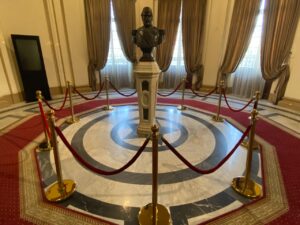
On entering you see a big star on the floor surrounded by five circles. From this point, the spaces between the governorates can be measured. The space between Cairo and Alexandria for example is measured by this starting point to that of Alexandria Post office, and so with other governorates.
One of the oldest postal systems in the world dates back to the Pharaohs, who communicated with foreign leaders by writing on papyri. This process was done by trained and reliable workers who were entrusted with delivering oral and written messages to various places.
During the Ptolemaic and Roman eras, messages were sent in sealed scrolls transported by horses, carts and sailboats along the Nile. Stations on the banks of the Nile were established and used as the resting place of the postmen and their horses.
The first Mail Office was established in the Islamic era during the rule of Umayyad caliph Muawiyah bin Abi Sufyan in the 7th century. This office was further developed during the reigns of Caliph Abd al-Malik bin Marwan, and Caliph Umar bin Abdul Aziz, as stations were built along the routes connecting the Islamic world.
Fatimid Jawhar Al-Saqali assumed the position of Head of the Postal Affairs and established stations on the Nile banks to serve the postmen. In the Mamluk era, the country was divided into 13 provinces to regulate deliveries of official messages.
On display is a mummified homing pigeon, an example of what Mamluks used to carry secret messages to various destinations. The Ottomans kept the Mamluks postal system, but divided the provinces into 24 stations. The mail continued to be sent by messengers on horseback or on foot.
In the 19th century, Mohamed Ali Pasha saw a growing need for better and faster means of communications to all parts of the country and abroad.
Hence, the routes of the postman carrying the official mail were paved and secured to enable them to deliver messages fast. The postal service was extended to the Levant in 1832. This enabled the state to become in control of the postal systems in the Levant and the Hijaz. During this period, the Egyptian Transport Company was also established, providing postal services to the public and foreigners residing in Egypt.
This coincided with the establishment of post offices abroad to provide postal services using their fleets and seals.
In 1840, the Posta Europea Company was established by Carlo Meratti. When the railways began operating in Egypt, the company monopolised mail deliveries by rail. In 1862, Said Pasha granted Posta Europea the right to use the railways for free for ten years in exchange for the free delivery of State correspondence.
Three years later, Khedive Ismail bought Posta Europea and transferred ownership to the Egyptian state. It was known as the Egyptian Khedive Mail, and Muzzi Bek was appointed as its first director, whose desk is in the museum.
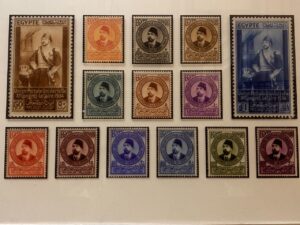
In 1866, the tariff for sending letters was set, the first Egyptian postage stamps were issued, and post boxes were placed in major streets across Cairo for public use. New offices and branches of the Egyptian Post were established within the country and abroad.
Later, boxes were patented and manufactured in the royal workshops in Egypt for the first time in 1938. Earlier, boxes were imported from Austria and England. Examples of all kinds of post boxes are on display in addition to clothes of postmen and their bags.
The history of railroad mail and airmail are also highlighted in the museum. In 1931, the Postal Authority contacted international postal agencies and museums requesting information and samples of postmen’s uniforms and letter boxes in order to learn about the latest developments in the field and include them in the Egyptian Postal museum. Many countries responded.
When leaving the museum, don’t miss to see that large clock which adorns the facade with its four bells centering its cupola. When it was installed in 1932, the bells used to ring at noon, replacing the cannon sounds which were not heard in many parts of the capital.


Discussion about this post