



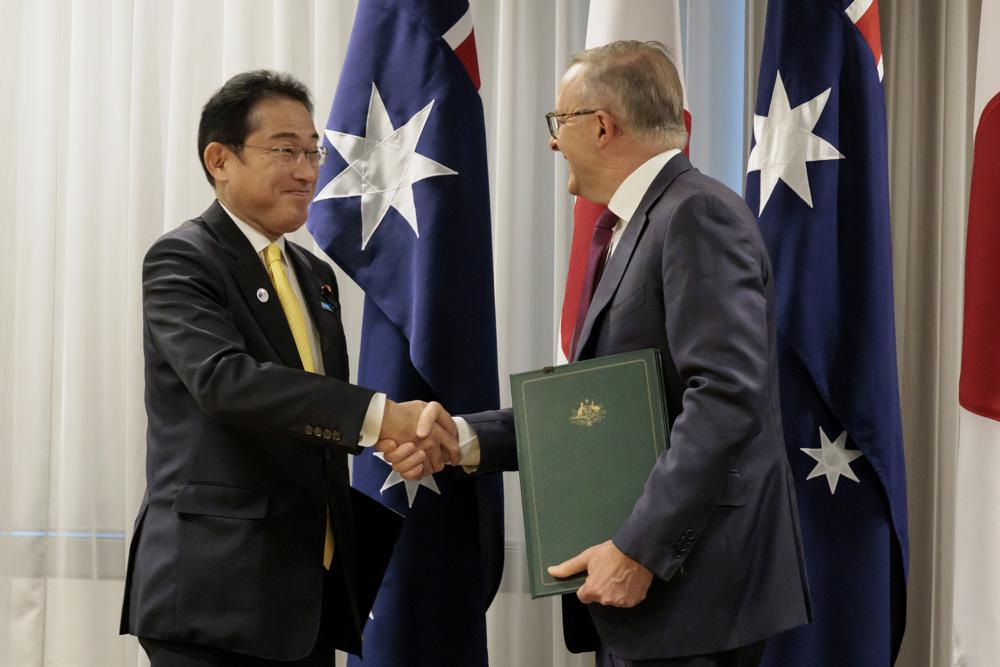
CANBERRA – Japan and Australia on Saturday signed a new bilateral security agreement covering military, intelligence and cybersecurity co-operation to counter the deteriorating security outlook driven by China’s increasing assertiveness.
The upgrade of the Joint Declaration on Security Co-operation, a pact first signed in 2007 when China’s rise was less concerning, was the major outcome of Japanese Prime Minister Fumio Kishida’s meeting with his Australian counterpart Anthony Albanese in the west coast city of Perth.
It builds on a reciprocal access agreement that Kishida inked in January with then-Australian Prime Minister Scott Morrison that removes obstacles to holding joint military exercises in either country.
That is the first such agreement Japan has struck with any country other than the United States. Japan announced Saturday that its Self-Defense Forces will train and take part in exercises with the Australian military. The exercises will be held in northern Australia for the first time under the agreement.
In the context of that agreement, Albanese told reporters: “This landmark declaration sends a strong signal to the region of our strategic alignment.”
The declaration covers military interoperability, intelligence, cybersecurity, operations in space, law enforcement, logistics and protecting telecommunications.
The declaration also refers to co-operation in “resisting economic coercion and disinformation” – threats that China is widely accused of.
Kishida said the new framework of co-operation had been developed under an “increasingly harsh strategic environment.”
“This renewed declaration will chart the direction of our security and defense co-operation in the next 10 years,” Kishida said through an interpreter.
The prime ministers agreed the new declaration reinforced Japan’s and Australia’s bilateral security treaties with the United States that underpin peace and stability in the Indo-Pacific.
Kishida’s visit for an annual bilateral summit is his fourth meeting with Albanese since the Australian leader’s government was elected in May.
They first met in Tokyo, two days after the election, for a summit of the Quadrilateral Security Dialogue, better known as the Quad, which brought Albanese and Kishida together with US President Joe Biden and Indian Prime Minister Narendra Modi.
The decision to hold Saturday’s meeting in Perth – Western Australia state’s capital, which provides much of Japan’s liquefied natural gas and the wheat from which udon noodles are made – was symbolic of the close economic ties between the two countries.
Japan and Australia agreed to co-operate on energy security, which is threatened globally by Russia’s invasion of Ukraine. Australia provides most of Japan’s energy in the forms of LNG and coal.
Kishida said he and Albanese were both deeply committed to nuclear disarmament. Kishida said a Russian nuclear strike on Ukraine would be an “act of hostility against humanity.”
“Russia’s act of threatening the use of nuclear weapons is a serious threat to the peace and security of the international community and absolutely unacceptable,” he added.
Japan and Australia have agreed to improve energy security by boosting Japan’s access to LNG, hydrogen and critical minerals as both countries transition to net-zero greenhouse gas emissions by 2050.


Discussion about this post