



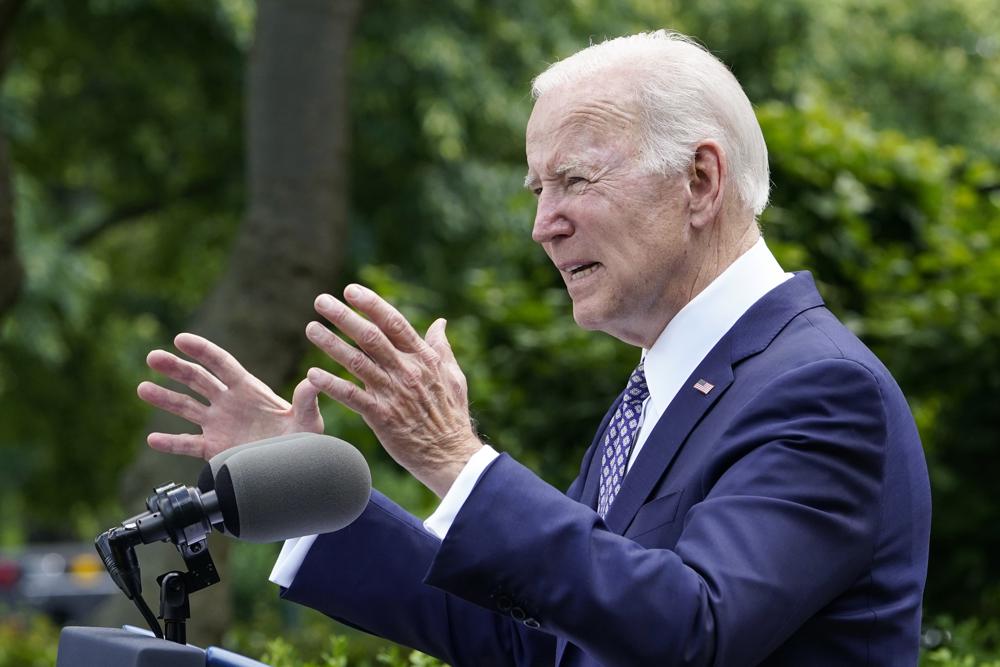
WASHINGTON — President Joe Biden departs on a six-day trip to South Korea and Japan aiming to build rapport with the two nations’ leaders while also sending an unmistakable message to China: Russia’s faltering attack of Ukraine should give Beijing pause about its own saber-rattling in the Pacific, AP reported.
Biden departs Thursday and is set to meet newly elected South Korean President Yoon Suk Yeol and Japanese Prime Minister Fumio Kishida. Their talks will touch on trade, increasing resilience in the global supply chain, growing concerns about North Korea’s nuclear program and the explosive spread of Covid-19 in that country.
While in Japan, Biden will also meet with fellow leaders of the Indo-Pacific strategic alliance known as the Quad, a group that includes Australia, India and Japan.
The US under Biden has forged a united front with democratic allies that has combined their economic heft to make Russia pay a price for its attack of Ukraine. That alliance includes South Korea and Japan. But even as Biden is to be feted by Yoon at a state dinner and hold intimate conversations with Kishida, the US president knows those relationships need to be deepened if they’re to serve as a counterweight to China’s ambitions.
“We think this trip is going to put on full display President Biden’s Indo-Pacific strategy and then it will show in living colour, the United States can at once lead the free world in responding to Russia’s war in Ukraine, and that at the same time chart a course for effective, principled American leadership and engagement in a region that will define much of the future of the 21st century,” White House national security adviser Jake Sullivan said.
The war in eastern Europe has created a sense of urgency about China among major US allies in the Pacific. Many have come to see the moment as their own existential crisis — one in which it’s critical to show China it should not try to seize contested territory through military action.
Biden’s overseas travel comes as he faces strong domestic headwinds: an infant formula shortage, budget-busting inflation, a rising number of Covid-19 infections, and increasing impatience among a Democratic base bracing for a US Supreme Court ruling that is likely to result in a roll back of abortion rights.
The conundrums Biden faces in Asia are no less daunting.
China’s military assertiveness has grown over the course of Biden’s presidency, with its provocative actions frequently putting the region on edge.
Last month, China held military drills around Taiwan after a group of US lawmakers arrived for talks on the self-governed island. Late last year China stepped up sorties into Taiwan’s air space. Taiwan considers itself a sovereign state, but Beijing views Taiwan as a breakaway province and has not ruled out the use of force to achieve unification.
Japan has reported frequent intrusions by China’s military vessels into Japanese territorial waters around the Senkaku Islands in the East China Sea. The uninhabited islets are controlled by Japan but claimed by China, which calls them Diaoyu.
In recent months, North Korea has test-launched a spate of missiles in what experts see as an attempt to modernise its weapons and pressure its rivals to accept the country as a nuclear state and relax their sanctions.
Sullivan said US intelligence officials have determined there’s a “genuine possibility” that North Korea will conduct another ballistic missile test or nuclear test around the time of Biden’s visit to Asia.
To be certain, China will also be carefully watching for “cracks in the relationship” during Biden’s trip, said Scott Kennedy, a China economic analyst at the Center for Strategic and International Studies in Washington.
Sullivan confirmed that Biden will use the trip to launch the long-anticipated Indo-Pacific Economic Framework, a proposed pact to set rules for trade and digital standards, ensuring reliable supply chains, worker protections, decarbonisation and tax and anticorruption issues. Known as IPEF, it’s a planned substitute for the Trans-Pacific Partnership that President Donald Trump left in 2017 and that the Biden administration has not rejoined.
Biden and his fellow leaders also have their own national interests and differences over what it means to strengthen supply chains that have been rattled by the coronavirus pandemic.
The Democratic president says the US must increase computer chip production on American soil. The shortage has fueled inflation by delaying production of autos, life-saving medical devices, smartphones, video game consoles, laptops and other modern conveniences. Yet allies in Asia are talking about the need to expand their capacity for making semiconductors — a valuable export — in their own countries.


Discussion about this post