



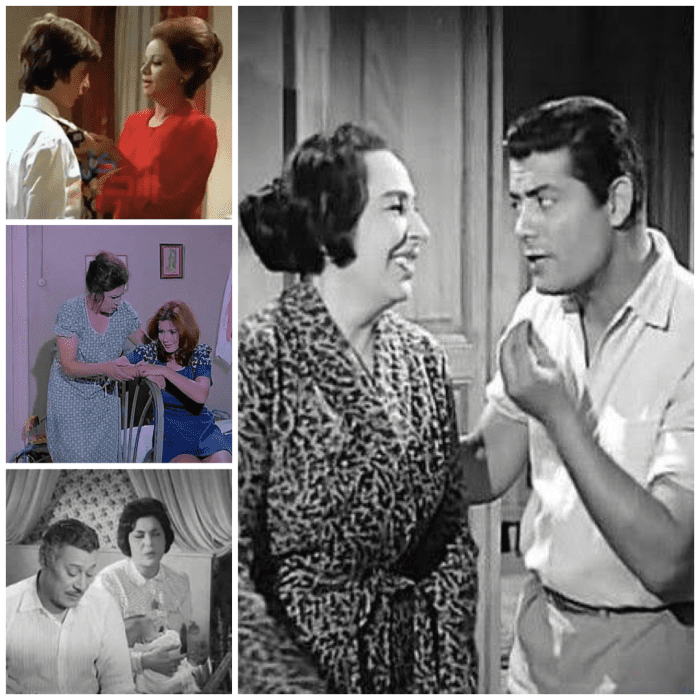
On March 21, Egypt celebrates Mother’s Day. Egyptian cinema has done more than its bit to celebrate motherhood in all its moods and guises.
Maternal roles have been taken on by the likes of Fardos Mohamed (1906-1961) as the kind, caring mother in Sayedat el-Kasr (The Lady of the Palace) and Antar bin Shaddad. Aziza Helmy (1929-1994) in el-Yatimateen (The Two Orphan Girls) and Zaman Hatem Zahran (The Time of Hatem Zahran) was another silver screen mum. Despite their playing supporting roles, these two women earned huge fame.
Aaz el-Habayeb (Most Beloved,1961), directed by Youssef Maalouf and written by Henry Barakat, starred Amina Rizk (1910-2003), who appeared in over 200 films portraying good mothers and strong ones in such screen gems as El-Mawlid (The Birthday), El-Aar (the Shame), Doaa el-Karawan (The Nightingale’s Prayer) and Ommahat fil-Manfa (Mothers in Exile). But, in Aaz el-Habayeb, Rizk plays Amina, who sacrifices herself for her children and lives with her domineering daughter-in-law who treats her badly as her son has a weak character and cannot stop his wife from making his mother’s misery. Amina escapes to find work as a hospital cleaner. By the way, Rizk never married real life and never had children of her own.
In 1963, actress and oriental dancer Tahia Karioka (1915-1999) played a remarkable mother in Umm el-Arousa (Mother of the Bride), directed by Atef Salem. Karioka plays a strong, elegant mother who advises her daughter: “A woman is known by her stocking.”
Umm el-Arousa deals with the socio-economic problems encountered by Egyptian family of seven.
In 1974, director Atef Salem wanted to repeat the success of ‘Mother of the Bride’ with El-Hafid (The Grandson), a new version of family that suits the 1970s. Karima Mokhtar (1934-2017), who specialised in mother roles in films like Ya Rabb Walad (Lord, Boy) and Ragol Faqad Akloh (A Man Who Lost His Mind) plays Zainab, a mother of seven. She advises her married daughters how to take care of their husbands and families.
After decades of being the starlet and the nation’s sweetheart, Faten Hamama (one time wife of Omar Sherif) is Mona, the widowed mother of six in Imbiratoriyat Meem (The Empire of ‘M’,1972), directed by Hussein Kamal. The story is based on a novel by Ihsan Abdel Quddous and scripted by Naguib Mahfouz. Mona is educated and struggles to raise her children, of whom most are teens. She falls in love with Ahmed (Ahmed Mazhar) and tries to find a balance between motherhood and a new relationship.
Nowadays, mothers in cinema are still marginalised roles and there is rarely a film that focuses on them as protagonists. In other words, she is just ‘her indoors’.


Discussion about this post