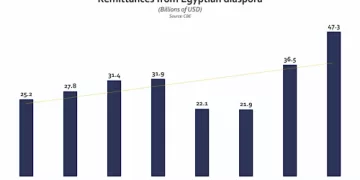




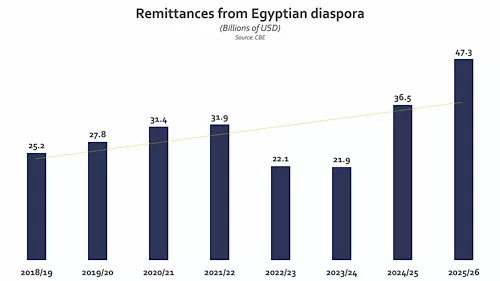
A record $47.3 billion in a single fiscal year has turned Egypt’s diaspora into the economy’s most dependable source of dollars. The harder question is what that money is actually doing once it lands.
Egyptian expatriates sent home $47.3 billion in the fiscal year that closed in June, the Central Bank of Egypt reported in August, a 29.6 per cent jump from $36.5 billion the year before and the largest sum the country has ever drawn from its own diaspora in a single year. The scale is no longer the interesting part.
What matters is that remittances have quietly become the load-bearing wall of Egypt’s external accounts, arriving bigger, steadier and with far less drama than the export receipts, tourism nights or foreign investment that once shared top billing on the balance of payments.
That reliability cuts two ways. It has given Cairo a genuine buffer against a run of regional shocks, a Middle East war, a hawkish Federal Reserve, a hostile new US tariff regime, that might otherwise have forced another currency crisis.
Whether that outsourcing is evolving into something durable, or simply repeating an old dependency in a bigger denomination, is the question the record number raises.
A number with an asterisk
Not all of the surge is organic. The central bank’s own explanation leans heavily on one policy change: the March 2024 decision to float the pound and unify the exchange rate, closing the gap between the official rate and the black-market rate that had starved the formal banking system for the better part of two years.
Egyptians abroad had routed transfers through informal networks paying better than any bank; once banks could match that rate, the same money began showing up in official statistics for the first time. The central bank concedes as much, describing a meaningful share of the increase as reclassification of flows that already existed rather than new money entering the country.
Layer onto that a genuine cyclical tailwind, a recovering Gulf labour market still flush with the proceeds of oil trading near $97 to $100 a barrel even after this year’s price whiplash, and the honest read is that both effects are real, in proportions nobody outside the CBE can cleanly separate.
Why remittances are not FDI
The distinction runs deep. In balance-of-payments accounting, remittances sit in the current account under what the CBE labels net unrequited current transfers: one-way flows, like pensions or humanitarian grants, that create no corresponding claim or repayment obligation. Foreign direct investment sits in the capital and financial account precisely because it is meant to create something durable – a factory, a stake in a company, a claim on future earnings its owner will actively manage.
The diaspora as depositor, not just spender
Cairo is not blind to this. Since late 2025, the CBE and the foreign ministry have pushed initiatives nudging part of the flow toward saving rather than pure consumption: “Open Your Account in Egypt,” letting expatriates open domestic accounts through embassies; an expanding instant-transfer network built on InstaPay; and “Tomorrow’s Pension,” a diaspora retirement product requiring a minimum $500 a year from Egyptians aged 18 to 59.
The pitch has one obvious point of leverage: with the CBE’s overnight deposit rate at 19 per cent against core inflation of 14.7 per cent, dollar certificates and pound deposits alike offer real returns few savers elsewhere can match. Nonresident real-estate investment, the closest thing to a direct remittance-to-asset channel, held roughly flat at $1.6 billion between July 2025 and March 2026, a rounding error against $34.9 billion in transfers, which suggests the productive-investment case remains aspirational rather than demonstrated.
Egypt’s company in this
Measured against the rest of the world, Egypt’s reliance has grown unusually pronounced for an economy of its size. World Bank data put personal remittances at roughly 11.4 per cent of Egyptian GDP in 2025, up from 7.6 per cent the year before. A leap owing something to the reclassification effect above, but one that still places Egypt in company more typical of Tajikistan or Nepal than of India, Mexico or the Philippines, the world’s three largest remittance recipients by dollar volume.
None of those larger economies has turned remittances into a primary growth engine either; decades of Indian and Philippine experience with the same current-account category suggest diaspora money smooths consumption and cushions crises far more reliably than it builds factories.

