



Qatar’s prime minister visited Tehran on Thursday in a bid to relaunch diplomacy after the US and Iran traded recriminations over Washington’s promise to increase economic pressure, a move one Iranian official described as “all-out economic war.”
A Gulf neighboعr of Iran and a US ally, Qatar has served as a back-channel negotiator for the warring parties and played a direct role in securing a June ceasefire that briefly led to a cessation of hostilities.
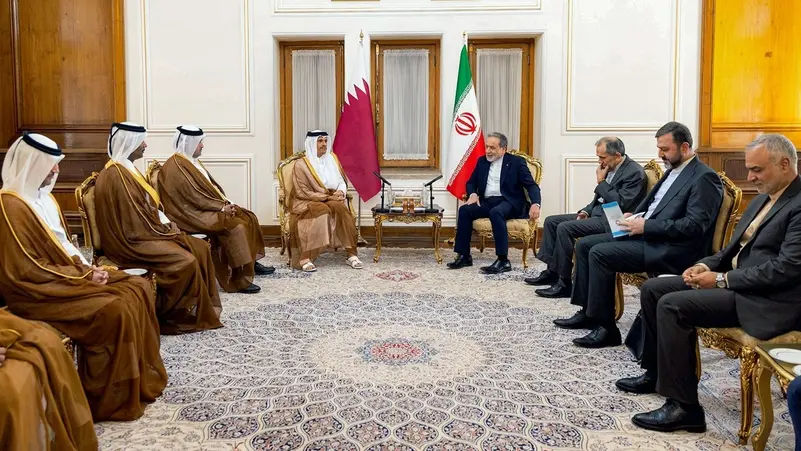
Qatar’s Prime Minister Sheikh Mohammed bin Abdulrahman Al Thani, who is also his country’s foreign minister, met Iranian Foreign Minister Abbas Araghchi, according to Iran’s foreign ministry channel on Telegram.
The visit comes as the war nears its sixth month with fighting largely paused but no diplomatic breakthrough in sight.
Both sides are at odds over control of the Strait of Hormuz, a chokepoint for global oil supplies that Tehran has used as leverage.
A memorandum of understanding reached between the US and Iran in June to end the conflict broke down in part because of differences over the narrow waterway between Iran and Oman where one-fifth of the world’s oil supplies passed before the war began on February 28.
Qatar and Iran discussed a proposed phased framework that includes establishing a temporary joint Iranian-Omani shipping corridor through the strait and carrying out a joint project to clear mines from the waterway, Qatar’s foreign ministry said. The two officials also reviewed the latest developments in the region and efforts to de-escalate tensions and create conditions for dialogue, the ministry said.
Although the strikes have stopped, Washington is now piling on economic pressure by announcing plans to cut Iran off from its trading partners with increased sanctions.
Iranian Parliament Speaker Mohammad Baqer Ghalibaf on Thursday called for national unity in the face of what he described as “all-out economic war”, warning that internal division was “exactly what the enemy wants.”
Ebrahim Azizi, the head of the Iranian parliament’s national security committee, said the sanctions were an “inhumane and hostile act” which nonetheless had lost their effectiveness.
Tehran has lived under various forms of US sanctions since the Islamic Revolution in 1979.
Hormuz oil flows have fallen to a three-month low, with just 5 million barrels per day transiting on Monday, according to the latest ship-tracking data. Before the war, the strait carried roughly 20 million barrels per day of crude oil.
Prices rose again on Thursday, with Brent crude futures up 0.6 percent at $88.35 a barrel, as investors weighed the prospects for reopening of the strait.

