




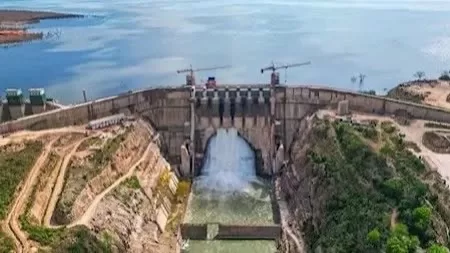
A major hydropower dam and power station built by Egyptian companies in Tanzania is set to strengthen the country’s electricity supply and support industrial and agricultural development, officials and company data say.
The Julius Nyerere Hydropower Project, located on the Rufiji River inside the Selous Game Reserve in southern Tanzania, is the country’s largest hydropower project and one of the biggest infrastructure schemes undertaken by Egyptian companies in Africa.
The contract was signed in December 2018, with a planned implementation period of 42 months, including six months for mobilisation. The project has an installed capacity of 2,115 megawatts, generated by nine vertical Francis turbines, each with a capacity of 235 megawatts.
Electricity will be connected to Tanzania’s national grid through a 400-kilovolt substation and transmission lines.
The project includes a 131-metre-high concrete main dam, measuring 1,025 metres along its crest, as well as four auxiliary dams. Its reservoir is designed to hold around 34 billion cubic metres of water.
In addition to power generation, the project aims to regulate flows on the Rufiji River, reduce flood risks, support agriculture and fishing, and provide year-round water storage. It is also intended to contribute to the protection of wildlife in the surrounding natural area.
Construction works include about four million cubic metres of excavation, 7.5 million cubic metres of aggregate fill, three million cubic metres of high-performance concrete and around 64,000 tonnes of reinforcing steel.
The infrastructure also comprises a 660-metre river diversion tunnel, spillways with seven radial gates, a permanent bridge over the Rufiji River, access roads and a 400-kilovolt electrical connection.
Egyptian construction giant Arab Contractors and electrical engineering company Elsewedy Electric are carrying out the project. Egypt’s Foreign Minister Badr Abdelatty visited the site in March 2025, according to Egypt’s State Information Service, which said the scheme was designed to meet Tanzania’s growing electricity needs.
The project has provided employment for around 1,961 workers, most of them Tanzanian, and used approximately 525 pieces of equipment, according to the latest detailed statement published by Arab Contractors.
The scheme has also received several industry awards, including a 2025 “Highly Commended” honour in the Partnership of the Year category at the Big 5 Egypt Impact Awards, and the 2025 ENR Global Best Project award in the water projects category. Arab Contractors was also named Tanzania’s best construction company for the second consecutive year in the 2023 East Africa Construction Awards.
The project is widely viewed as a prominent example of development cooperation between Egypt and Tanzania, and of Egyptian participation in major energy and infrastructure projects across Africa.

