



Communities lived, worked and buried their dead at Kom el-Khilgan, a low mound in the eastern Nile Delta, ong before the pyramids were built and centuries before Egypt was united under a single pharaoh.
New excavations at the Dakahlia governorate site reveal thousands of years of northern Egyptian history through mudbrick homes, grain silos, hearths and modest graves rather than regal monuments.
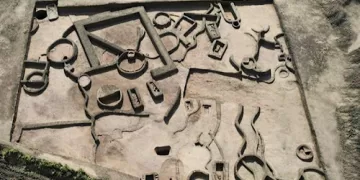
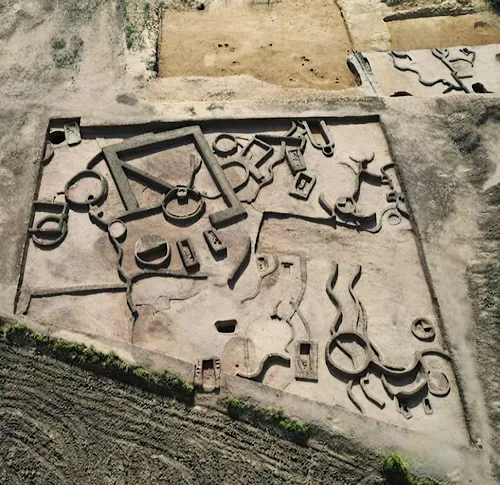
The Supreme Council of Antiquities has uncovered a cemetery spanning from the predynastic period to the Greco-Roman era, alongside a residential quarter from the Second Intermediate Period. Its importance lies in this unusually long record, which documents changing settlement patterns, burial customs and daily life over several millennia.
The earliest burials belong to the Buto I and Buto II phases of Lower Egyptian culture, dating to the first half of the fourth millennium BC. Oval burials contained bodies in varying postures, with handmade pottery and marine shells. Their number indicate that a sizeable community existed before pharaonic rule.
Subsequent strata reveal mudbrick buildings, ovens, hearths and grain silos, indicating sustained domestic and agricultural activity. Fish, bird and animal bones are helping researchers reconstruct the residents’ diet, shaped by the Delta’s rivers and wetlands.
Kom el-Khilgan was also occupied during the Second Intermediate Period, near Avaris, the Hyksos capital. Graves contained jewellery, amulets, scarabs, bronze tools, weapons and Tell el-Yahudiyeh pottery.
Egyptologist Hussein Bassir said the site’s significance for cultural tourism helps recast the Nile Delta as a connected historical and civilisational landscape, rather than merely an agricultural region associated with fertile land and food production.
“The real value lies in reframing how the Delta is discussed, less a question of why it has been overlooked, and more one of how to build a coherent historical narrative for northern Egypt,” Bassir told The Egyptian Gazette. He described the region as central, rather than marginal, to the development of the Egyptian civilisation.
Realising that potential, he said, would require linking scientific research to site development, creating heritage trails, upgrading local museums and using virtual reality and 3D imaging to help visitors interpret archaeological locations.
Scientifically, Bassir said, the site’s value lies in the depth of its occupational record, extending from the predynastic era to the Greco-Roman period.
That continuity gives researchers a rare opportunity to study long-term changes in settlement, the economy and funerary practices in northern Egypt.
Egypt’s cultural tourism has traditionally focused on Cairo, Giza, Luxor, Aswan and Abu Simbel, leaving much of the Delta underrepresented in international tourism programmes despite its archaeological importance.
By connecting Delta sites into shared itineraries rather than portraying them as isolated locations, discoveries like Kom el-Khilgan could help in closing that gap, according to Bassir.
He cautioned, however, that transforming the discovery into a sustainable tourism attraction would require the scientific study and documentation of the site to be completed first.
“Tourism should not precede science,” he said. “It should be its natural result.”
Tourism expert Dalia Helal said discoveries like Kom el-Khilgan emerge at a critical time for Egypt’s tourism industry, which aims to diversify its destinations and products rather than rely on a single model or a limited number of regions.
“Kom el-Khilgan could add a new dimension to Egypt’s cultural offering and open fresh routes for international visitors beyond the country’s traditional destinations,” Helal told The Gazette.
She added the discovery could support government efforts to spread tourism activity geographically and extend the average length of visitor stays.
Helal linked the strategy to Egypt’s Vision 2030 and its target of attracting 30 million tourists annually. Reaching that goal, she said, would require new tourism products and a wider range of destinations, in addition to increasing hotel capacity and flights.
“If Egypt is aiming for 30 million tourists,” she said, “the question is no longer just how to attract them to Egypt, but where to take them once they’re here. And that’s the significance of discoveries like Kom el-Khilgan.”

