



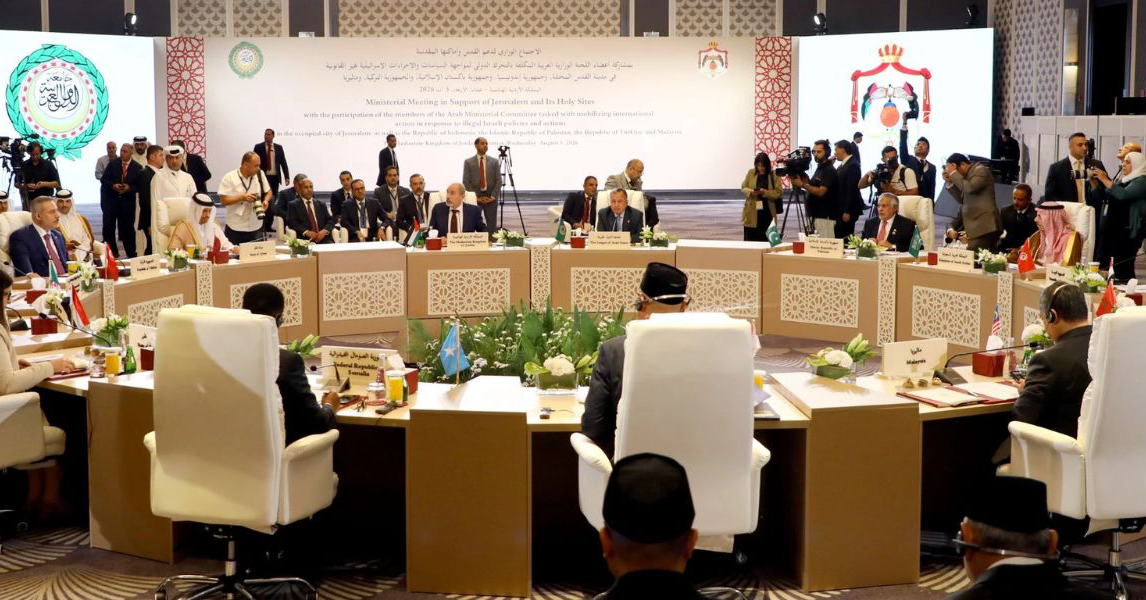
The participants of the Arab Ministerial Committee on Jerusalem strongly condemned Israeli policies and measures aimed at altering the Arab, Islamic and Christian identity, legal status and demographic composition of occupied Jerusalem, describing them as illegal, null and void under international law.
The committee comprised Jordan, Tunisia, Algeria, Iraq, Qatar, Saudi Arabia, Somalia, Palestine, Egypt and Morocco, together with the Secretary-General of the League of Arab States and representatives of Indonesia, Pakistan, Türkiye and Malaysia.
Meeting in Amman on August 5, 2026 at Jordan’s invitation, the participants reaffirmed that East Jerusalem is an integral part of the occupied Palestinian territory and the capital of the State of Palestine, the committee said in a statement.
They stressed that the establishment of an independent Palestinian state on the June 4, 1967 borders, with East Jerusalem as its capital, remains the only path to a just and lasting peace in accordance with the two-State solution, relevant UN resolutions, the Arab Peace Initiative and the New York Declaration.
The ministers condemned Israeli violations at Al-Aqsa Mosque/Al-Haram Al-Sharif, including attempts to alter its historic and legal status quo, settler incursions, restrictions on worshippers, interference with the Jerusalem Awqaf Department and excavations beneath and around the Mosque.
They reaffirmed that the entire 144-dunum compound is exclusively a Muslim place of worship and that the Jerusalem Awqaf and Al-Aqsa Mosque Affairs Department, affiliated with Jordan’s Ministry of Awqaf, is the sole legal authority responsible for administering the site.
The ministers also condemned violations against Christian holy sites and reaffirmed support for the historic Hashemite Custodianship over Jerusalem’s Islamic and Christian holy sites.
The participants pledged support for the resilience of Jerusalemites through development assistance and the protection of Palestinian institutions.
They also recognised the role of the Al-Quds Committee and the Bayt Mal Al-Quds Al-Sharif Agency in supporting the city and its residents.
The ministers warned that continued attacks on Islamic holy sites could provoke a wider religious conflict affecting nearly two billion Muslims and threatening regional and international peace and security.
They called on the international community and the UN Security Council to halt Israeli measures in occupied Jerusalem, reject unilateral decisions affecting the city’s legal status, including the establishment or relocation of diplomatic missions, and reverse such actions.
The participants also agreed to launch coordinated international action, establish a permanent institutional and media mechanism to document Israeli violations and raise global awareness.

