




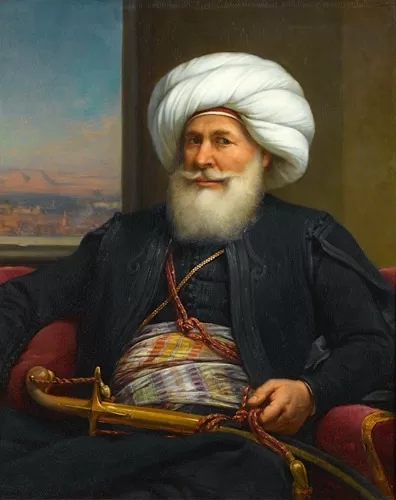
Today is the anniversary of Mohamed Ali Pasha’s death. He died in 1849 at the age of 80.
An Albanian-born Ottoman officer, he rose to become the effective ruler of Egypt from 1805 to 1848 and is widely seen as the founder of modern Egypt and of the dynasty that governed the country until the middle of the 20th century.
Through a series of far-reaching reforms, he laid the groundwork for a modern state.
He reorganised the army and navy on European lines, building a force strong enough to extend Egyptian influence into Sudan, Arabia and parts of the Levant.
In agriculture he promoted cash crops, above all cotton, improved irrigation, and introduced state monopolies that strengthened the economy.
He also pushed early industrialisation, establishing factories for textiles, weapons and other goods, and sent students to Europe for technical training.
One of his more unexpected contributions was the mango. In the early 1800s, he imported shrubs from India and Sri Lanka and planted them in the gardens of the Shubra palace. The fruit later became a national favourite.
His educational projects included new schools, a medical college and institutions devoted to translation and printing.
These helped spread knowledge and created a new administrative class.
Together the reforms centralised authority, weakened the old Mamluk elites, and turned Egypt into a semi-independent power within the Ottoman Empire, even if European intervention later limited how far his ambitions could go.
Mohamed Ali died at Ras el-Tin Palace in Alexandria. He was buried in the mosque he had commissioned inside the Cairo Citadel.
That mosque remains one of the city’s most recognisable landmarks and a lasting emblem of his legacy.
On this anniversary, Egyptians and historians continue to weigh his complex record.
He was a determined moderniser whose reforms brought real progress and prosperity.
Much of what he built still shapes Egypt’s institutions, infrastructure and sense of national identity.

