




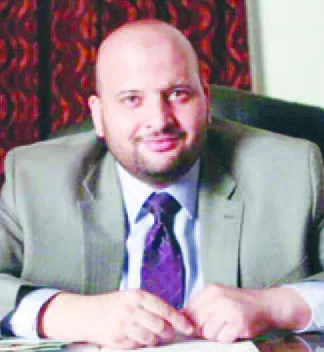
By Ibrahim Negm
Any nation that walks through history with its back turned to the future will find itself, willingly or not, at the tail end of nations – no matter how long it endures or how far its territory extends.
Our community today, for all the greatness of its civilisational inheritance and the depth of its intellectual reservoir, suffers from a quiet epistemic crisis in its relationship with tomorrow.
The symptoms fall into three patterns that feed one another, and together they strip the individual of the capacity to be an active author of his own civilisational destiny – leaving him instead to be inscribed into history by a hand that neither knows him nor shows him mercy.
The first pattern is the flight into the past. A segment among us has taken history as a refuge from the pressures of the present and the challenges of what is to come. They summon the glories of their forebears not to draw inspiration or insight, but to hide behind them and avoid the demands of the moment.
For the earliest generations, history was a teacher whose lessons were actively interrogated – a source of instruction and moral example. For this group today, it has become a prison that confines consciousness, a sedative that lulls resolve to sleep, and a curtain that conceals the weakness of the present behind the grandeur of the past.
The distance is vast between one who reads history in order to build a future upon it, and one who reads history in order to dwell inside it as an escape from that future. The first invests yesterday as capital for tomorrow; the second turns it into a grave in which to bury his civilisational shortcomings, offering the achievements of the ancients as an apology for the failures of the moderns.
The second pattern is total absorption in the present. Another group has become so consumed by the current moment – its cascading crises and accumulating hardships – that they never lift their gaze from daily events to consider what lies beyond the horizon. They have no room for questions about tomorrow while they chase today’s sustenance and the pressure of the hour.
When an oppressive present takes complete hold of a nation’s consciousness, the faculty of long-range planning atrophies and strategic vision withers. The nation is reduced to a posture of reaction rather than initiative – waiting to be acted upon by others rather than acting upon them and upon history itself.
This represents a dangerous inversion of the function of the Muslim intellect, which the Qur’an repeatedly commands to reflect upon divine patterns and signs. Reflection here is not merely visual observation; it is a forward-looking discernment that draws conclusions about outcomes from present conditions, and reads within the folds of reality the seeds of what is to come.
The third pattern is the most dangerous: intellectual dependency on others. This group has grown comfortable importing Western visions of the future and its trajectories, receiving them as inevitabilities that must be accepted without question. Without realising it, they have come to believe that the making of future visions is the exclusive province of others, and that their own share of tomorrow is merely to receive what has been drawn up for them – never to participate in the drawing.
In doing so, they abandon what most distinguishes a community entrusted with a civilisational message: the calling to bear witness before humanity and to help shape civilisation – rather than serve as false witnesses to a destiny fashioned by other hands.
Importing ready-made future visions – without filtering, critique, or rooting in one’s own principles – is a form of soft colonisation that occupies minds before it occupies lands.
A scholarly diagnosis
In this connection, I was struck by the observation of the Malaysian researcher Wan Fariza Alyati in her pioneering work on futures studies in contemporary Islamic and Western thought. She argued that the absence of systematic future-oriented thinking among Muslims represents one of the most serious causes of the civilisational decline we suffer, and that reviving this mode of thinking should be a top priority in any project of renewal and reform.
She has struck the heart of the matter. A community that produces no vision of its own future is driven, unwillingly, into someone else’s future – placed at a coordinate it did not choose on a map it did not draw.
Towards a composite awareness
Escaping this three-fold crisis requires a composite awareness:
• Of the past, as a repository of experience rather than a shackle on movement.
• Of the present, as a station along a path rather than a final destination.
• Of the future, as an open space for our own agency rather than merely a stage for the actions of others.
It also requires reviving the science of foresight within our academic, religious, and intellectual institutions – and cultivating a generation of scholars and researchers who combine deep rootedness in the tradition with sharp insight into what lies ahead. They must be able to read the patterns of the cosmos and society in ways that speak of tomorrow, not merely describe yesterday. They must craft for the community a future vision drawn from its own foundations, attentive to the shifts of its era, and engaged with the experiences of others – without dissolving into them or being dazzled by them.
Our community will have no share of tomorrow except to the degree that it makes tomorrow present in its consciousness today. For whoever fails to carve out a place for himself in the future will find a grave dug for him there instead.
Ibrahim Negm is a senior advisor to the Grand Mufti of Egypt

