



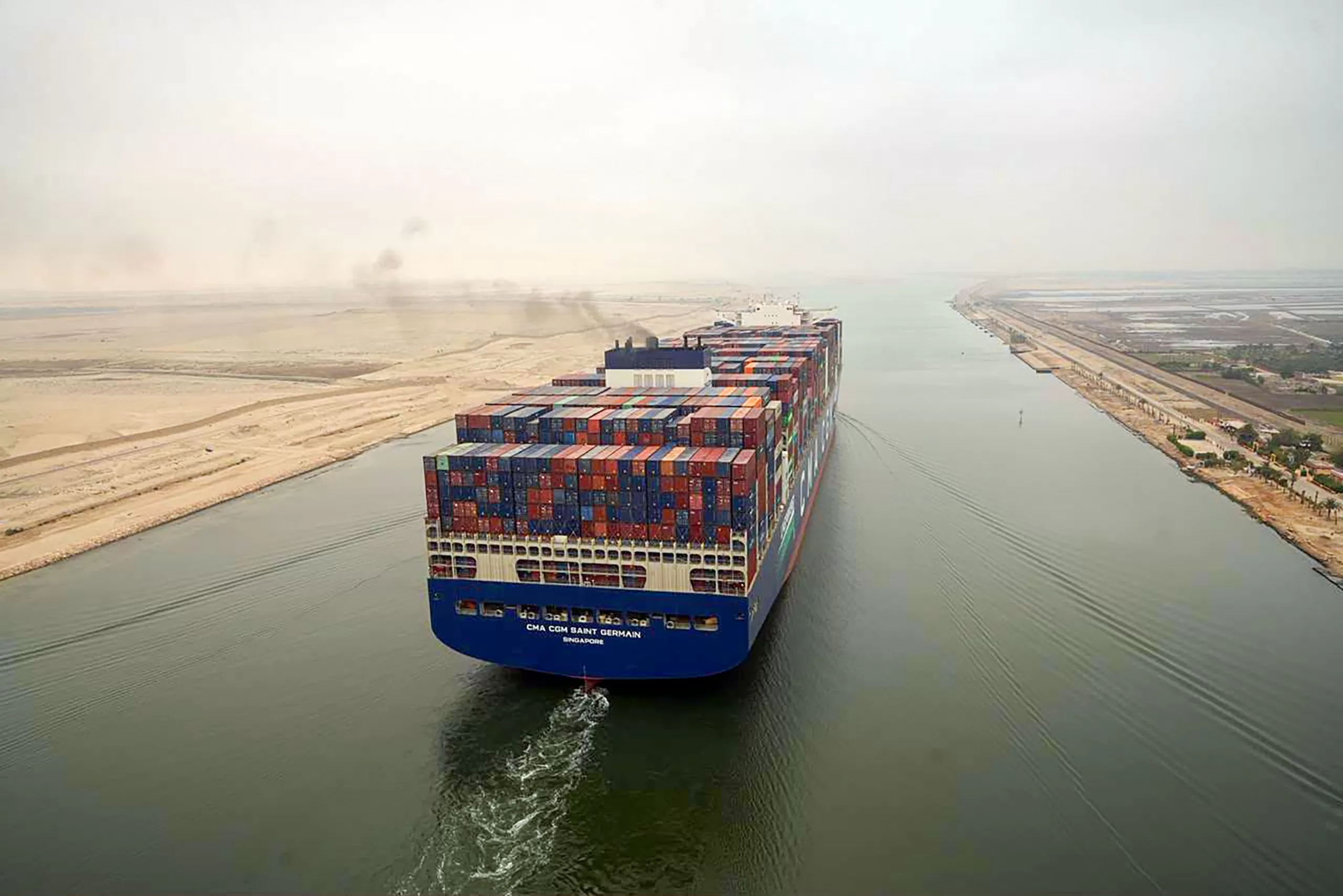
A giant container ship belonging to the French shipping line CMA CGM has completed its first transit through the Suez Canal. The crossing marks another positive sign of the gradual return of major global shipping lines to the critical waterway.
Osama Rabie, Chairman of the Suez Canal Authority (SCA), confirmed that the CMA CGM Saint Germain crossed the canal on Friday as part of the northbound convoy during its maiden passage. The vessel is currently sailing from Morocco to Malaysia.
The CMA CGM Saint Germain ranks among the world’s largest container vessels, with a length of 399.9 metres, a width of 61.3 metres, and a draft of 16 metres. The vessel’s gross tonnage stands at 238,000 tonnes. Its capacity is up to 23,876 twenty-foot equivalent units (TEUs).
Powered by liquefied natural gas (LNG), the vessel is equipped with an 18,600-cubic-metre fuel tank, enabling long-distance, lower-emission voyages between Europe and Asia. It operates on the Ocean Alliance’s NEU 5 FAL3 service, which links the Far East with Northwest Europe.
To ensure the massive ship’s safe transit, the SCA assigned a team of senior pilots and provided dedicated navigational support with escort tugboats.
As part of the authority’s standard protocol for vessels making their first journey through the canal, Rabie delegated senior pilots Captain Ahmed Nassir and Captain Samir Jaafar to board the ship. The pilots welcomed the crew and presented the ship’s captain with a commemorative gift.
Chairman Rabie stated that the continued passage of giant container ships through the canal reflects growing confidence among major shipping companies and signals the gradual return of regular maritime traffic. He stressed that the Suez Canal remains fully prepared to accommodate the world’s largest and most technologically advanced vessels while continuing to support global trade and supply chains.
Rabie also highlighted that the authority is actively expanding its maritime services to boost competitiveness. These expanded offerings include marine rescue, ship maintenance and repair, marine ambulance services, refuelling, and crew changes—all aimed at strengthening the Suez Canal’s position as the world’s premier maritime trade route.

