



Same red blooms, shared green dreams
By Zhao Wencai
After more than two years in Cairo working as a journalist, I often wonder what memories of this city will stay with me forever.
Certainly the breathtaking sunsets over the Nile, when fading lights paint the river in shades of gold and crimson. But just as unforgettable is the sea of scarlet flame trees that burst into bloom across the city every spring.
The flame tree thrives in warm, sunny, and relatively humid conditions. In May and June, Cairo erupts in red. Flame trees line streets, shade neighbourhood cafes, and brighten residential squares, their fiery blossoms all the more striking in a region largely defined by desert landscapes.
These trees have left a lasting impression on me not only because of their striking beauty, but also because they remind me of another city that once felt like home – Xiamen, on China’s southeastern coast.
Separated by over 8,000km, Cairo and Xiamen may, to many, seem to have little in common. Yet for me, having lived in both cities for years, their shared qualities surface in the most unexpected moments.
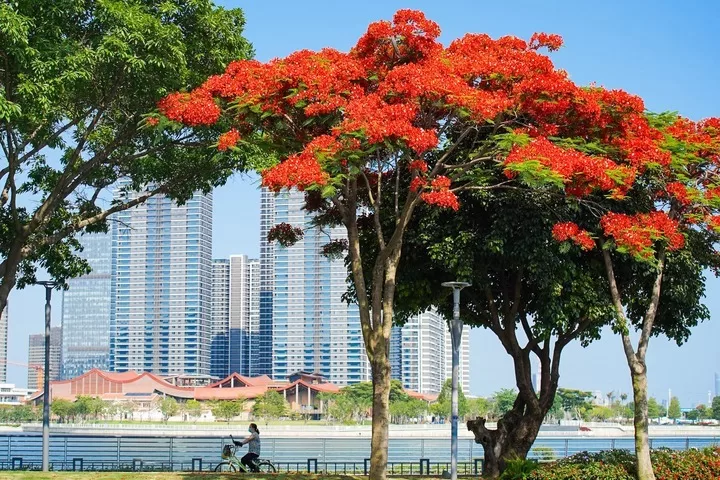
Every spring and early summer, both cities are transformed by the same brilliant crimson blossoms. Like in Cairo, every spring flame trees bring sudden colour to streets and waterfronts across Xiamen. Walking beneath those trees was once one of my favourite things to do. Today, whenever I stroll through Cairo during blossom season, those memories return almost effortlessly.
Xiamen stands as a symbol of China’s efforts and success in balancing rapid economic development with environmental protection. It is now one of China’s most prosperous coastal cities, with a per capita GDP of more than $23,000.
Located at a latitude similar to Cairo’s, it is known as one of China’s “garden cities,” where flowers bloom for much of the year. Each year, it attracts millions of visitors with its stunning scenery.
It is hard to imagine that just a few decades ago, Xiamen was a city struggling with poverty, pollution and serious environmental challenges.
The roots of its transformation can be traced back to the 1980s, when environmental protection was first integrated into its long-term development strategy.
At the time, Xi Jinping, now China’s president, was serving as vice mayor of the city. He played a key role in shaping Xiamen’s development blueprint, which places a sound ecological environment as an important development goal for the city.
He pushed for intensified efforts to curb pollution, improve urban planning, and restore the natural environment, which laid the foundation for the “garden city” Xiamen known as today.
It was also during this period that the flame tree was designated as Xiamen’s “city tree.”
In the years that followed, Xi continued to prioritise environmental protection over short-term economic gains while working in China’s Fujian Province, Zhejiang Province, and Shanghai.
For Xi, economic development and environmental protection are not mutually exclusive, but can be mutually beneficial, as embodied in his over 20-year-old well-known saying, “lucid waters and lush mountains are invaluable assets.”
Time has repeatedly borne out the foresight of this approach. Many of the places where these ideas were first put into practice have enjoyed not only healthier ecosystems, but also stronger economic and social development. Xiamen is among the clearest examples.
Today, “ecological civilisation” has become one of the pillars of China’s national development strategy. China’s latest development plan for 2026-2030 explicitly calls for integrating green development into every aspect of economic and social progress, accelerating industrial transformation, promoting greener lifestyles, and advancing the broader goal of building a “Beautiful China.”
In Cairo, I see a similar aspiration taking shape, with greater attention being paid to environmental protection. In early June, Prime Minister Moustafa Madbouli announced the “Greening Cairo” initiative, which aims to transform vacant urban land into green spaces and increase per capita access to greenery. The vision echoes China’s approach to green development.
Not long ago, officials, experts and scholars from Egypt visited China to study its experience in ecological governance and biodiversity conservation.
This kind of shared understanding and exchange of ideas is no less important than trade and economic co-operation. Rather, it lays the groundwork for a more enduring and wide-ranging partnership between the two countries.
Over the past decades, China’s experience has shown that when environmental protection is treated as a core element of governance, it can yield lasting dividends for development.
In many ways, it is like the flame trees, which, native to Madagascar, have taken root in China and now bring beauty to everyday life. In the same way, China’s development philosophy and practical experience can also find resonance in Egypt, contributing to improvements in local livelihoods.
Zhao Wencai is an editor of the Middle East Regional Bureau of China’s Xinhua News Agency and a researcher at the Xinhua Institute.

