




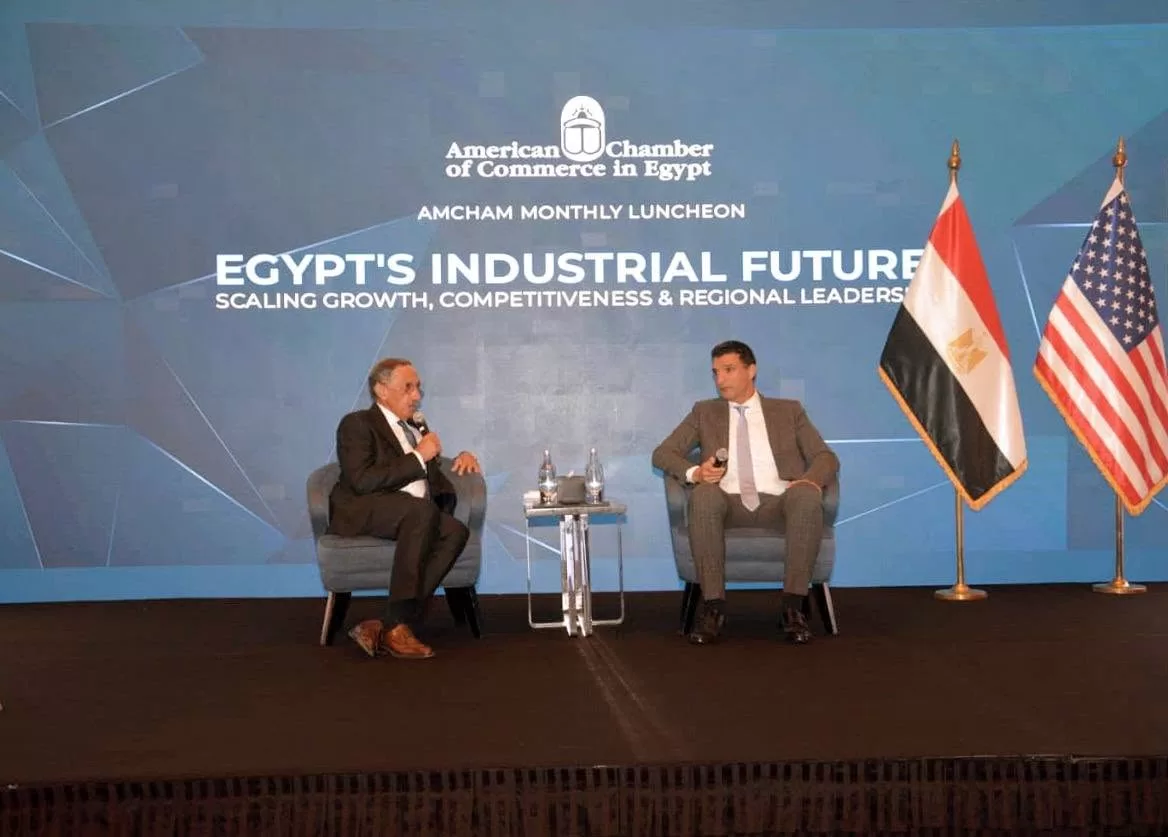
Minister of Industry Khaled Hashim has outlined an ambitious industrial transformation strategy aimed at positioning Egypt as a leading regional manufacturing hub, with industrial exports targeted to reach $100 billion by 2030.
Addressing the monthly business meeting of the American Chamber of Commerce in Egypt, Minister Hashim reaffirmed the ministry’s commitment to sustained, direct engagement with the private sector.
“This meeting reflects our ministry’s determination to maintain open, continuous dialogue with the business community with the chief aim of understanding the real challenges facing Egyptian industry, and to translate that understanding into practical, implementable solutions,” Hashim said.
The minister stressed that the private sector is Egypt’s primary partner and the essential driver of economic development. He underscored the government’s firm commitment to boosting the private sector’s role, expanding its contribution to sustainable growth, and increasing production and employment rates across the country.
“Our industrial strategy was built on what we heard from investors and manufacturers themselves,” Hashim stated. “They are best placed to identify the real obstacles — and the realistic solutions. Everything we are doing is designed to remove barriers, improve the investment climate, and make Egyptian industry more competitive.”
Minister Hashim announced that the Ministry of Industry has recently updated Egypt’s Industrial Advancement Strategy, structured around six core pillars: strategic programmes, human capital, product development, operations and procedures, mechanisms, and performance measurement.
The strategy is governed by four guiding principles: a scientific, evidence-based methodology; private sector partnership; institutional integration; and strategic balance.
The minister emphasised that reaching the $100 billion export target requires a fundamental shift in approach — moving from a domestically oriented model toward full integration with the global economy and international supply chains. This means actively attracting foreign direct investment linked to technology transfer and industrial expertise, and cementing Egypt’s position as a regional manufacturing centre capable of accessing global markets.
Hashim highlighted the critical importance of expanding the small and medium enterprise base as a foundation for sustainable industrial growth. Key initiatives include providing financial facilitation, linking SMEs to industrial supply chains, empowering young investors, and boosting local production to substitute imports.

