




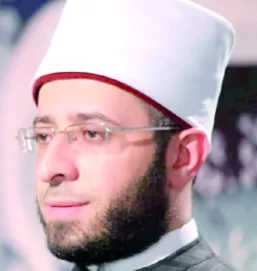
Islam Made Simple
Dr Osama Al-Azhari
Minister of Awqaf (Charitable Endowments)
Ladies and gentlemen, the great people of Egypt, daughters and sons of the Arab and Muslim nations – welcome to a new journey with the Ever-Glorious Qur’an in which we dive into the depths of the twenty-third part, draw pearls from its treasures, seek guidance from its lights, and derive from its eloquence the noble values and great principles Allah has placed within it.
This blessed part abounds in magnificent verses from which we extract wisdom, meanings, and refined manners, and from which we gather pearls and coral. Come with us on this blessed day to live in the radiance of the twenty-third part of Allah’s Book.
I have selected for you a set of its clear verses, so that we may pause together before the wisdoms and meanings they carry, and the divine gifts that awaken the heart and open inner sight to witnessing the reality of divinity and the majesty and grandeur of Lordship.
Whenever a servant deepens in contemplation and reflection on the blessings Allah Almighty has poured forth, there is born within the heart true knowledge and spiritual witnessing, sound conduct and behaviour, and a renewed discourse and journey toward Allah – Glorified and Exalted is He. For this reason, Allah Almighty repeatedly reminds us in the Ever-Glorious Qur’an of His favours in the heavens and on the earth.
The First Reflection
Allah Almighty says: “And a sign for them is the dead earth. We give it life and bring out of it grain, so they eat from it. And We made therein gardens of palms and vineyards, and therein We caused (some) springs to erupt forth.” [Qur’an 36: 33–34]. Here, Allah Almighty graciously bestows upon His servants this tremendous blessing. He also says elsewhere: “And in case you number the favour (s) of Allah, you (cannot) enumerate them.” [Qur’an 14: 34].
These blessings are renewed before us every day; yet familiarity and habit may veil a person from witnessing divine power and lordly wisdom. Among the gravest enemies of the human being is becoming accustomed to blessings until they fade from awareness, so their true value is not realised except when they are lost.
The Prophet Muhammad PBUH said: “There are two blessings in which many people incur loss: health and free time.” (Reported by al-Bukhari). A person may live within the blessing of health granted by Allah while remaining heedless of it and only perceive its value when it is taken away.
Habit and idle stability may distract a person from reflection. Therefore, out of His mercy towards His servants, Allah awakens their hearts and alerts them, saying: “Man was created of haste.” [Qur’an 21: 37]. The earth that you see as lifeless – when rain descends upon it – stirs and swells, brings forth vegetation, and the manifestations of life appear upon it.
Then Allah Almighty says: “That they may eat of their produce and what their hands have made. Will they not, then, thank (Us)?” [Qur’an 36: 35]. In this verse there is a subtle grammatical nuance: the particle “maa” may be understood as a relative pronoun meaning “that which,” yielding the sense “and (of) that which their hands have produced,” i.e., what they planted and irrigated; and it may also be read in a negating sense, yielding “and not (of) that which their hands made,” i.e., that Allah alone created the fruits, not the human being. This is one aspect of the linguistic inimitability of the Ever-Glorious Qur’an: a single expression may carry multiple meanings within one context, opening doors to reflection and contemplation.
The Second Reflection
We continue our contemplation of this blessed part as we move from the conclusion of Surah Yasin to Surah al-Saffat, and then to Surah Sad, remaining within the scope of the twenty-third part. Among the remarkable features of Surah al-Saffas is that it is the surah of the doers of excellence (al-muhsinun).
Allah Almighty says concerning Prophet Nuh (Noah) PBUH: “And We made his offspring the ones who are the (enduring) survivors. And We have left for him (honour) among the later (generations). Peace be upon Nuh (Noah) among the worlds! Surely thus do We recompense the fair-doers.” [Qur’an 37: 77–80].
What is meant by: “And We have left for him (honour) among the later (generations)”? It means that Allah preserved for him a noble status among subsequent generations; he continues to be mentioned with goodness until the Day of Judgment. This is a profound lesson for us: a person should strive to leave behind a wholesome legacy and a beautiful memory, rather than being remembered for injustice and wrongdoing.
Allah repeats the same meaning with Prophet Ibrahim (Abraham) PBUH: “And We have left for him among the later generations. Peace be upon Ibrahim (Abraham).’ Thus We recompense the fair-doers.” [Qur’an 37: 108–110”].
Likewise, with Musa (Moses) and Harun (Aaron) PBUT: “And We have left for them both among the later (generations). Peace be upon Musa and Harun. Surely thus We recompense the fair-doers.” [Qur’an 37: 119–121].
And about Ilyas (Elijah) PBUH, Allah Almighty says: “And We have left for him (honour) in the later generations. Peace be upon Ilyasin!”(Elias). Surely thus We recompense the fair-doers.” [Qur’an 37: 129–131].
It is truly the surah of the doers of excellence, wherein the prophets are described as people of ihsan. Ihsan is to worship Allah as though you see Him, and to perfect one’s work – performing it with sincerity and love.
The Third Reflection
In the same part, we read Allah’s saying about Dawud (David) PBUH: “And remember Our bondman Dawud (David) (a man) possessing prowess (Literally: hands). Surely he was a constant resorter (to Allah).” [Qur’an 38: 17]. The term awwab (constant resorter) means one who frequently turns back to Allah – constantly engaged in remembrance and glorification – such that even the mountains and the birds joined him in praise.
As for Prophet Sulayman (Solomon) PBUH, Allah Almighty says concerning him: “This is Our gift; so be bounteous or hold back without reckoning.” [Qur’an 38: 39]. Then the Almighty also says: “And surely he has indeed in Our Providence a near proximity and a fair resorting.” [Qur’an 38: 40].
The Fourth Reflection
At the conclusion of this part, Allah Almighty says: “Who listen to the Saying (and) so closely follow the fairest of it.” [Qur’an 39: 18].
This is the essence of reflection: to listen attentively, to select the best of what we hear, and to make every statement a criterion for truth and goodness. We ask Allah Almighty to illuminate our hearts with the light of His Book, to guide us to His straight path, and to grant us sound understanding and righteous action through the blessing of the Ever-Glorious Qur’an.
Until we meet again, stay noble; stay safe.

