



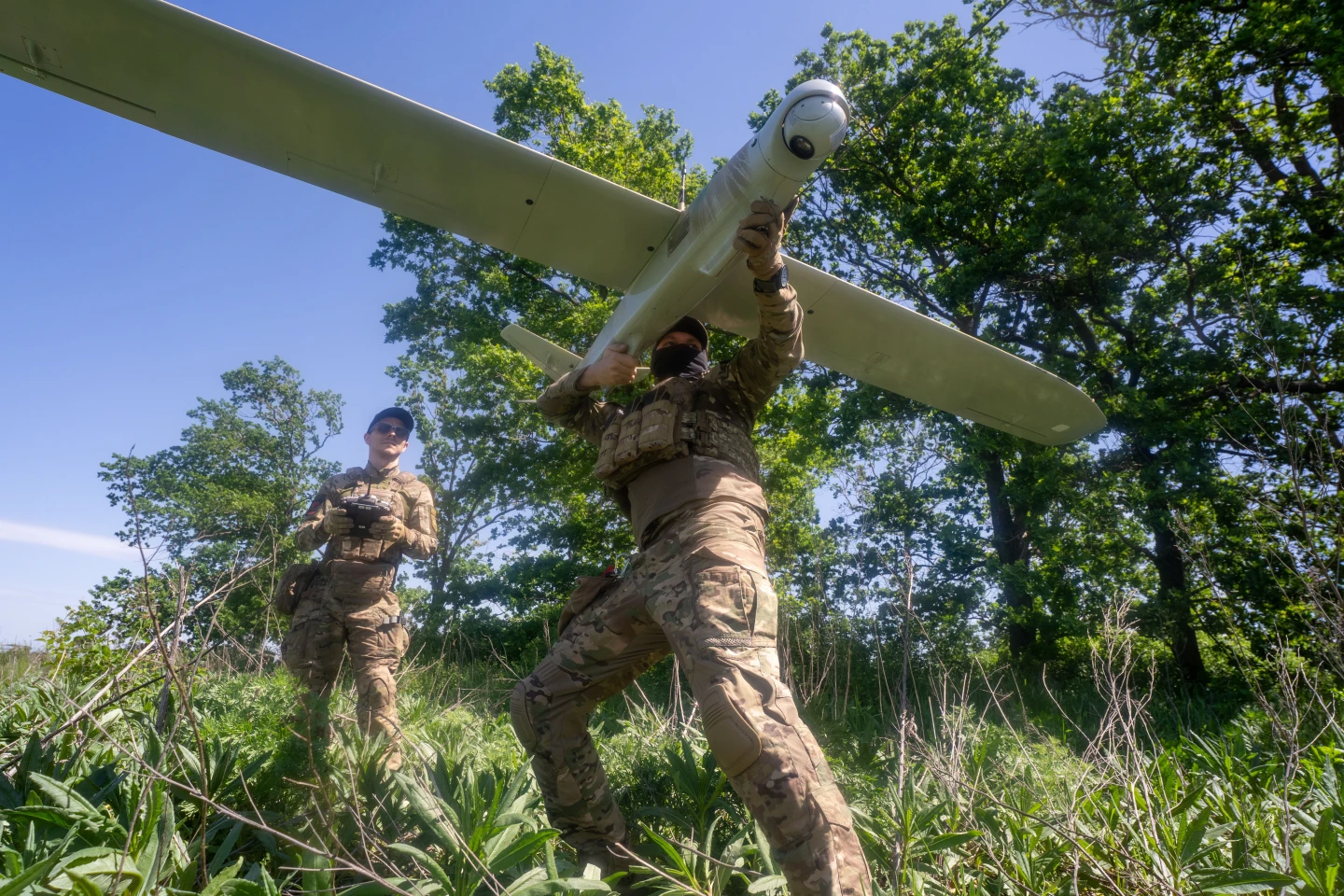
Over the past months, Ukrainian drones have crashed into the chimney of a power plant in Estonia, hit empty fuel tanks in Latvia and been shot down by Romanian fighter jets stationed in Lithuania.
For the first time in a NATO and European Union capital, Lithuanians were pictured sheltering in underground car parks in Vilnius on Wednesday, as authorities warned of unidentified drone activity in neighboring Belarus.
No one has died or been injured recently, but the increasing airspace incursions have prompted some Baltic ministers to chastise Ukraine for the violations, which also led to the collapse of the Latvian government in May.
As US President Donald Trump’s war in Iran has driven up the price of oil, a key revenue stream for the Kremlin, Ukraine has ramped up attacks on Baltic Sea ports used for Russian energy exports in an attempt to hit Moscow’s war chest.
As Ukraine’s drones have snaked up north, they have skirted the borders of NATO members Latvia, Lithuania, Estonia and Finland. Some of them were not detected before they crash landed in some of the Baltic states.
Ukrainian officials apologised and said the drones were aimed at military targets inside Russia but were sent off course by Russian electronic interference.
The string of airspace violations has prompted questions about the state of air defenses on NATO’s eastern flank.
Ukraine has ramped up its attacks against Russia, focusing on arms factories, ports on the Baltic Sea and energy facilities as the war in Iran has boosted the oil price.
It has particularly targeted the ports of Ust-Luga and Primorsk, close to the borders of Estonia and Finland.
Russian uses the ports to load up ships taking its oil exports through the Baltic Sea.
During one attack in May, which set part of the port of Primorsk on fire, more than 60 Ukrainian drones were shot down, Leningrad region governor Alexander Drozdenko said.
After stray Ukrainian drones entered Latvian airspace on May 7, the country’s Defense Minister Andris Spruds and Prime Minister Evika Silina resigned.
On May 19, a Romanian fighter jet based in Lithuania shot down a Ukrainian drone over southern Estonia.
Estonian Defense Minister Hanno Pevkur said it was likely aimed at targets in Russia and that he told Ukraine to send its drones “as far from NATO territory as possible.”
Since Russia’s 2022 attack on Ukraine, Nordic and Baltic nations have increasingly warned about electronic interference from Russia disrupting communications with planes, ships and drones.
In the Baltic region, Russia often uses jamming and spoofing to send drones off course.
Satellite communications systems — known collectively as the Global Navigation Satellite System, or GNSS — receive precise time signals from satellites around 20,000 kilometres (12,400 miles) away in space.
A smartphone, car, marine or aircraft navigation system compares how long it takes to receive signals from several different satellites to calculate an exact location.
Jamming occurs when a receiver is overwhelmed by a strong radio signal transmitted in the same frequency range as GNSS and other satellite navigation signals, leaving the receiver unable to fix its location or time.
Spoofing involves transmitting fake signals that imitate a real GNSS satellite signal, commonly known as GPS, to mislead a phone, ship, or aircraft into thinking it is in a different place.
Lithuanian Foreign Minister Kęstutis Budrys said Tuesday that Russia is “deliberately” redirecting Ukrainian drones into Baltic airspace with electronic interference.

