



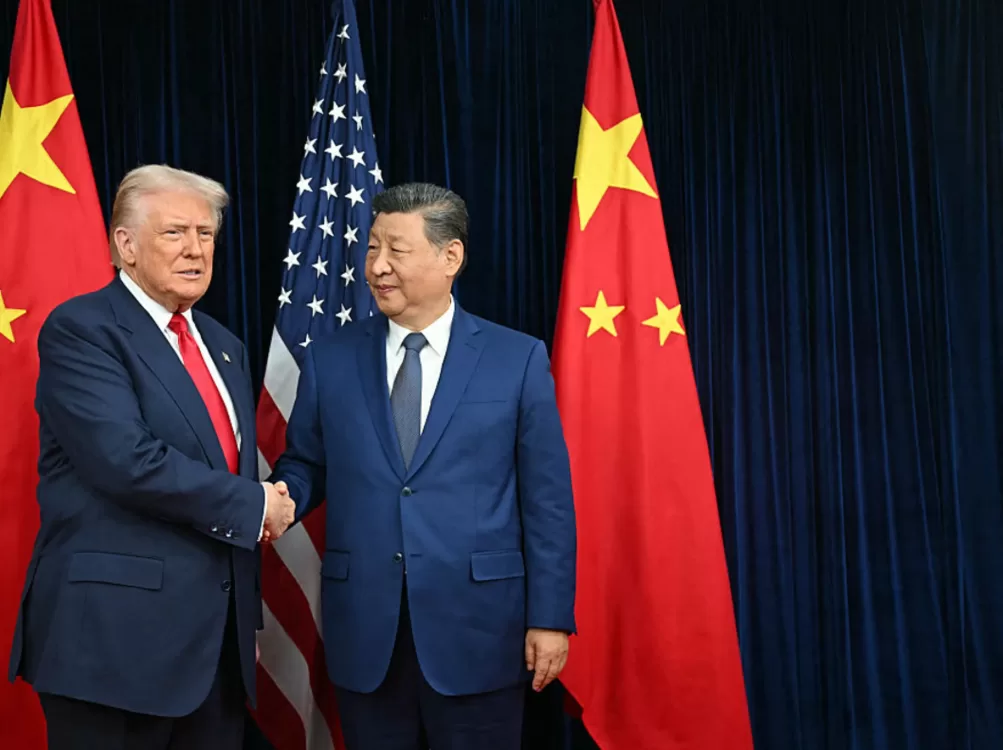
BEIJING (AP) — President Donald Trump is set to leave on Tuesday for Beijing to meet with President Xi Jinping after weeks of trying, and failing, to persuade the Chinese government to use its considerable leverage to prod Iran to agree to U.S. terms to end the 2-month-old war — or, at the very least, reopen the Strait of Hormuz.
Trump has veered between venting that China, the world’s biggest buyer of Iranian oil, hasn’t done more to get the Islamic Republic in line and acknowledging that Xi’s government helped de-escalate the conflict last month by nudging Tehran back to ceasefire talks when negotiations wobbled.
But ahead of the U.S. leader’s high-stakes visit, the White House has set low expectations that Trump will be able to persuade Xi to change China’s posture.
Instead, Trump’s Republican administration seems determined not to let differences on Iran overshadow efforts to make headway on other difficult matters in the complicated relationship — ranging from trade to further Chinese cooperation to block exports of fentanyl precursors.
“We don’t want this to be something that derails the broader relationship or the agreements that might come out of our meeting in Beijing,” U.S. Trade Representative Jamieson Greer said on Bloomberg TV last week.
Beijing publicly insists that it wants to see the war end and has been working diplomatically behind the scenes to help its ally Pakistan push to broker a peace agreement. It has also sent a “subtle message of discontent to Iran” for closing the Strait of Hormuz and to the U.S. for its blockade of Iranian shipping, said Ahmed Aboudouh, a specialist on China’s influence in the Middle East with the London-based Chatham House think tank.
“They are very cautious, risk averse, and they don’t want to be involved in anything that would drag them into something that they don’t consider their problem,” he said.
Meanwhile, Kuwait on Tuesday accused Iran of dispatching an armed paramilitary Revolutionary Guard team to launch a failed attack earlier this month on an island in the Middle East nation that is home to a China-funded port project. Iran didn’t immediately acknowledge the allegation by Kuwait, which came under repeated attack by Iran in the war and even during the shaky ceasefire still holding in the region.
In recent days, Secretary of State Marco Rubio and Treasury Secretary Scott Bessent have stepped up their calls for China to use its influence to help reopen the strait, through which about 20% of the world’s crude flowed before the war began.
The State Department announced on Friday it was sanctioning four entities, including three China-based firms, for providing sensitive satellite imagery that enables Iranian military strikes against U.S. forces in the Middle East. Earlier, the Treasury Department moved to target Chinese oil refineriesaccused of buying oil from Tehran, as well as shippers of the oil. The sanctions cut off the companies from the U.S. financial system and penalize anyone who does business with them.
Beijing has called the sanctions “illegal unilateral pressure” and enacted a blocking statute — passed in 2021 and never used until now — that prohibits any Chinese entity from recognizing or complying with the sanctions.

