




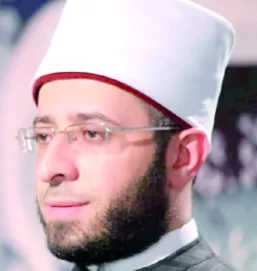
By Dr Osama Al-Azhari
Minister of Awqaf (Charitable Endowments)
Dear readers, honourable Egyptian people, daughters and sons of Arab and Muslim nations, welcome to a new blessed journey with the Ever Glorious Qur’an, in which we sail through its verses, drink from its lights, and draw from it treasures and secrets, and from the guidance, wisdom, admonition, and healing that Allah Almighty has placed therein.
Today, we stand at the threshold of the eighteenth part of the Ever Glorious Qur’an, seeking shade in its blessings and picking pearls and gems from its gardens, as we extract the values and principles it contains and are illuminated by its insights and lessons.
Let us begin with the first point of reflection at the verse talking about water and the wise management of Allah the All-Wise. Allah Almighty says: “And We have sent down from the heaven water in a determined estimate, then We made it to dwell in the earth; and surely We are indeed (the) Determiners over putting it away.” [Qur’an 23: 18].
Reflect on this tremendous blessing: water sent down from the sky in due measure, made to dwell in the earth in tranquillity, through which life comes into being and by which the world is built up.
It is a divine management, wondrous in its details: from the composition of the atmosphere, to the courses of the winds, the condensation of clouds, the falling of rain, the flow of rivers, and the growth of crops and fruits.
It is that amazing recurring cycle, with all that it contains of majesty and beauty, life and revival.
Then, immediately in the next verse, Allah Almighty says: “So We have brought into being for you therewith gardens of palms and vineyards; in them you have many fruits for you, and of them you eat.” [Qur’an 23: 19].
What a generous outpouring from the Almighty: gardens, date palms, grapevines, and abundant fruits lawful provision and scenes of beauty that refresh the heart and awaken faith.
These are many blessings, all of which go back to the great blessing of water, and all of that, in turn, goes back to the mercy of Allah Almighty.
The second point of reflection in this part is found in the verse talking about the tree of Sinai and the blessed land.
Allah Almighty says: “And a tree that comes out (Literally: goes out) from At-Tû r of Sayna’ (Mount Sinai) that grows (i.e., oil) and seasoning for (the) eaters.” [Qur’an 23: 20].
Pause here a little to ponder, reflect, and contemplate: why does Allah specifically mention “Mount Sinai”? It is an indication of the honour of that land that blessed part of the earth, Sinai which Allah has blessed and in which He placed a blessed tree that produces oil and rich fat, as nourishment, healing, and a delightful taste for those who eat.
Egypt, this good and blessed land, is not merely mentioned five times in the Qur’an; rather, it is alluded to in many places, and great events unfolded on its soil as mentioned in magnificent surahs such as al-A’raf, Taha, al-Qasas, al-Shu’ara’, and al-Naml.
The people of Sinai have every right to take pride in this divine favour: the land is blessed, agriculture therein is blessed, and the divine mention of it is an enduring honour.
The third reflection in this part relates to humble supplication in times of crisis. Allah Almighty says: “And indeed We already took them (to task) with torment, yet in no way did they yield themselves to their Lord, and in no way did they supplicate (Him).” [Qur’an 23: 76].
Here the Qur’an presents to us a scene of nations, who were tried and tasted hardship, yet they did not soften themselves before Allah.
They neither supplicated, nor submitted to Allah Almighty. In our own time, crises sweep across the world: from wounded Palestine, to the consequences of pandemics, to wars and conflicts. So what is the way out?
The way out lies in two inseparable elements:
Guiding and directing: awareness and understanding, knowledge and planning, and the wise, insightful management of crises.
Sincere turning to Allah: a humble heart, a supplicating tongue, true repentance, and unceasing invocation.
The fourth reflection in this part lies in the inviolability of dwellings and the etiquette of seeking permission.
Allah Almighty says: “You who have believed, do not enter houses other than your houses until you (first) announce your presence (i.e., make yourself known and ask permission) and salute the family thereof.” [Qur’an 24: 27].
Dwellings have sanctity, and the Qur’anic expression is unique: “until you ascertain welcome (announce your presence (i.e., make yourself known and ask permission) – tasta’nisu),” not merely “seek permission (tasta’dhinu).”
That is, the one entering should bring a sense of warmth and ease to the people of the house, not anxiety or burden.
The Prophetic guidance teaches that the door should not be knocked more than three times. One should not say “It is me” when asked “Who is it?”, but should clearly identify oneself.
And if it is said to a person, “Go back,” then let that person return without anger or resentment, in humble submission to the command of Allah.
The fifth reflection in this part is at the magnificent Qur’anic declaration that Allah Almighty is the Light of the heavens and the earth. Allah Almighty says: “Allah is The Light of the heavens and the earth.” [Qur’an 24: 35].
This verse is the jewel, the axis, and the central pillar of Surah al-Nur. Light in Islam is not merely physical illumination, but it is knowledge, guidance, faith, purity, and civilisation.
Allah is light, the Prophet (PBUH) is light, and the Qur’an is light, so why do we not become light as well?
As Ahmad Shawqi, the Prince of Poets, said:
“With faith in their right hands they hold two lights: remembrance and Sunnah;
So why are they then in the depths of darkness”?
Let us be a light that illuminates the path in our dwellings, our schools, our mosques, and our communities.
In conclusion, we ask Allah Almighty to make the Qur’an a light for us, and the guidance of His Prophet (PBUH) our path; to illuminate our hearts, rectify our conditions, and make us beacons of guidance in a time when layers of darkness have multiplied.
Until we meet again, stay noble; stay safe.

