




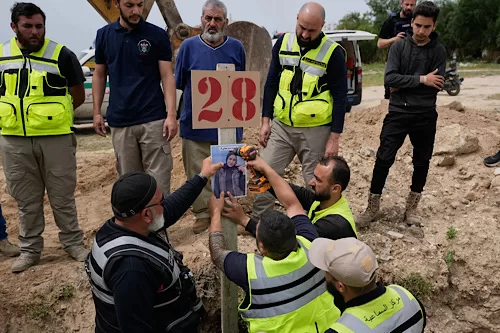
The president of Lebanon refused Thursday to speak with the Israeli prime minister ahead of a planned discussion that would have been the first direct conversation between the leaders of the two countries in more than 30 years, a government official told The Associated Press.
U.S. President Donald Trump had announced that the leaders would speak about halting the fighting between Israel and the Iran-backed militant group Hezbollah in Lebanon.
But Lebanese President Joseph Aoun declined to speak to Israeli Prime Minister Benjamin Netanyahu, a government official familiar with the developments told The Associated Press.
The government official, who spoke on condition of anonymity in line with regulations, said the remarks were made during a call with U.S. Secretary of State Marco Rubio and that Washington “understands Lebanon’s position.”
Aoun’s office acknowledged a call with Rubio in a public statement, but did not mention the possibility of talks with Netanyahu. Netanyahu’s office did not do so either.
Meanwhile, Pakistan’s powerful army chief met with Iran’s parliament speaker as part of international efforts to press for an extension to a ceasefire that has paused almost seven weeks of war between Israel, the U.S. and the Islamic Republic.
Lebanon and Israel held their first direct diplomatic talks in decades Tuesday in Washington following more than a month of war between Israel and Iran-backed Hezbollah.
Lebanon has insisted on a ceasefire to stop the fighting between Israel and Hezbollah before engaging in direct talks, while vowing to commit to disarming the group.
Washington has not publicly stated its support of a ceasefire as a precondition, and the Israeli government has framed the talks as peace negotiations with a focus on disarming Hezbollah.
Israel and Hezbollah exchanged fire across the border, with Hezbollah targeting towns in northern Israel with rockets and drones. Israeli fire against southern Lebanon intensified, especially around the cities of Tyre, Nabatieh and the strategic town of Bint Jbeil near the border with Israel.
Israel and Lebanon have technically been at war since Israel was established in 1948, and Lebanon remains deeply divided over diplomatic engagement with Israel.
Israeli troops have pushed deeper into southern Lebanon to create what officials have called a “security zone,” which Netanyahu has said will extend at least 8 to 10 kilometers (5 to 6 miles) into Lebanon.
Pakistani Army Gen. Asim Munir met Thursday in Iran with Iranian Parliament Speaker Mohammad Bagher Qalibaf, Iran’s state television said. Qalibaf has emerged as his country’s chief negotiator.
It was unclear whether the frantic diplomacy could lead to a lasting deal as the two-week ceasefire passes the halfway mark. The Iran war has killed thousands of people and upended global markets by disrupting the flow of oil.

