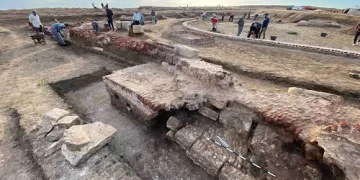




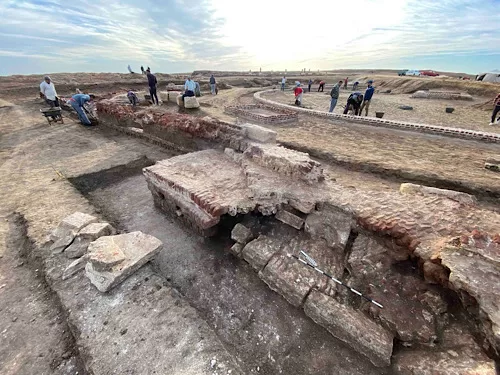
Egyptian archaeologists have uncovered the remains of a unique religious complex dedicated to the ancient city god Pelusius at Tell el-Farama in North Sinai, the Ministry of Tourism and Antiquities said on Thursday.
The discovery came after six years of excavations at Pelusium, a strategic port city on Egypt’s northeastern frontier that served as a gateway between the Nile Delta and the eastern Mediterranean world.
Tourism and Antiquities Minister Sherif Fathy hailed the find as fresh evidence of North Sinai’s strategic and archaeological importance، saying the ministry would continue excavations and scientific studies at the site to deepen historical knowledge.
The secretary-general of the Supreme Council of Antiquities, Hisham el-Leithy, called the discovery significant for shedding light on Pelusium’s pivotal role in transmitting religious and cultural ideas across the ancient world.
He said the newly identified temple complex reflects an architectural blend of ancient Egyptian traditions with Hellenistic and Roman styles, highlighting long-running cultural interaction between Egypt and its Mediterranean neighbours.
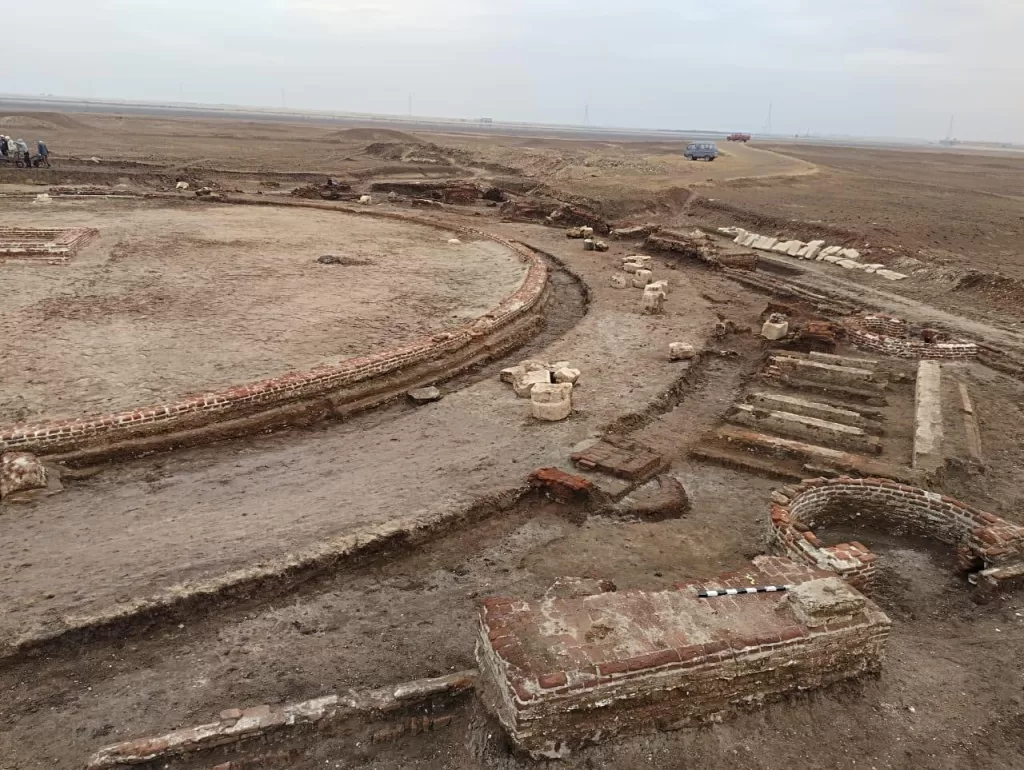
The remains include a vast circular basin about 35 metres in diameter connected to the Pelusiac branch of the Nile and designed to be filled with silt-laden water.
The features appear to carry symbolic meaning linked to the local deity, whose name, the statement said, derives from the Greek word pelos” meaning mud.
Archaeologists also documented a surrounding network of drainage channels, and a square base at the centre of the basin believed to have supported a large statue of the god.
Stratigraphic evidence suggests the complex remained in use from the 2nd century BC until the 6th century AD, with limited architectural modifications over time, the ministry said.
The structure was first partially found in 2019, when only around a quarter of a circular brick-built installation had been uncovered and was initially thought to be a civic senate building.
Further seasons of excavation revealed the full scale and complexity of the monument, including multiple entrances on the east, south and west sides, while the northern section suffered major destruction.
The team carried out field studies and compared the design with Hellenistic and Roman-era architectural parallels outside Egypt, the statement said.
Following scientific discussions with several scholars, including Sorbonne University classical archaeologist Jean-Yves Carrez-Maratray, researchers concluded the structure was not a civic council hall but a sacred water installation connected to religious rites, it added.

