



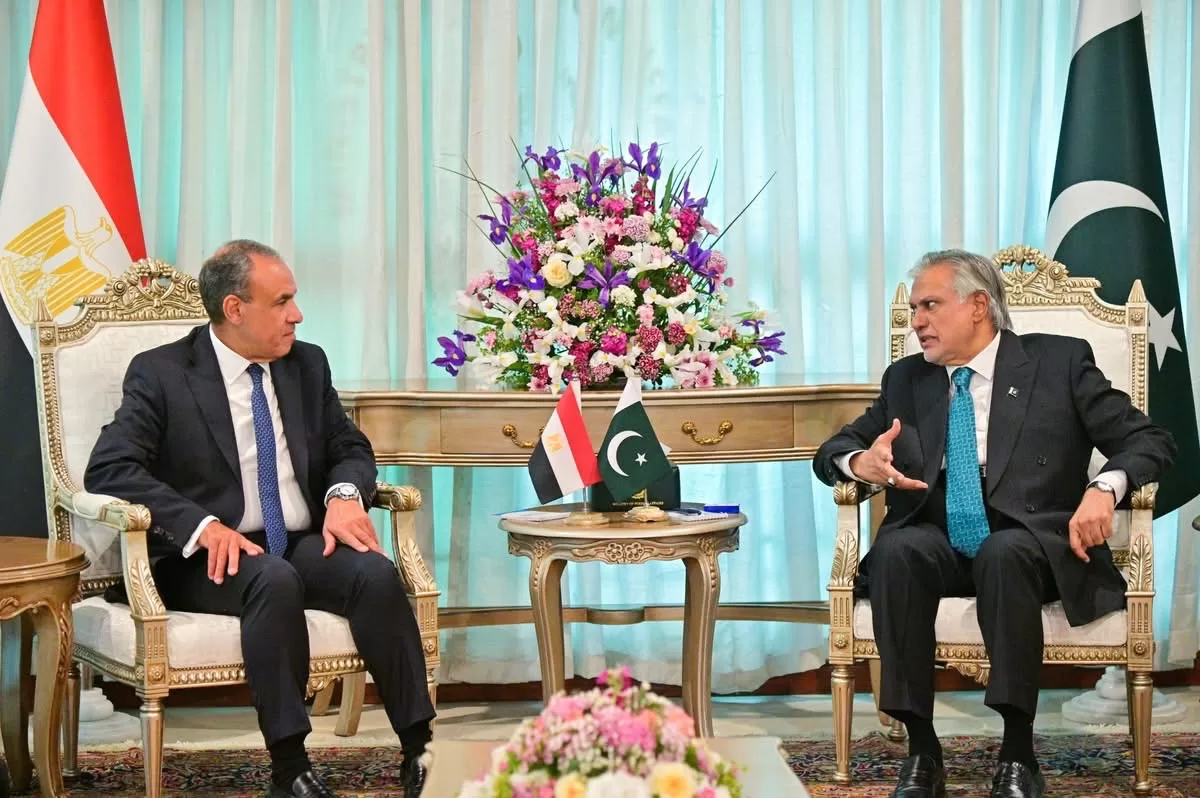
Egypt’s Foreign Minister Badr Abdel-Aati held talks in Islam Abad on Sunday with Pakistan’s Deputy Prime Minister and Foreign Minister Muhammad Ishaq Dar on strengtheningbilateral relations, and regional developments.
Abdel-Aati met Dar during his visit to Pakistan where he is participating in a quadrilateral ministerial meeting that will address on regional developments and ongoing efforts to pronotede-escalation, and reduce tensions, according to ministry spokesman Tamim Khallaf.
During the meeting, Abdel-Aati underscored the need to enhance bilate4ral economic and investment co-operation and increase trade volumes in line with the two countries’ potential, citing global economic shifts, supply chain disruptions and volatility in energy and commodity markets that require developing countries to adopt more integrated approaches to strengthen economic resilience.
He also highlighted the importance of deepening economic partnership through stronger links between logistics and industrial hubs in both countries to improve market integration and access to African and Asian markets.
He pointed to the strategic geographic locations of Egypt and Pakistan as key global trade hubs and stressed the importance of boosting trade connectivity between the Suez Canal Economic Zone and Pakistan’s Gwadar port, while exploring opportunities to localise value-added industries in the Suez Canal Economic Zone to support regional supply chains.
The Egyptian top diplomat reviewed Egypt’s recent economic reforms and called for activating the joint business council to encourage greater private sector participation in bilateral economic co-operation.
The two ministers discussed regional developments in the Middle East, particularly efforts to reduce tensions and promote de-escalation.
They reviewed ongoing quadrilateral efforts aimed at encouraging a negotiated track between the United States and Iran to prevent broader regional instability and mitigate potential impacts on the global economy.
Abdel-Aati stressed the importance of coordinated regional and international efforts to contain the situation, saying diplomatic solutions and de-escalation remain the only viable path to resolving the current crisis and preventing a wider conflict.
The two sides agreed to carry on with close consultation and coordination to support regional security and stability and prevent further escalation.

