



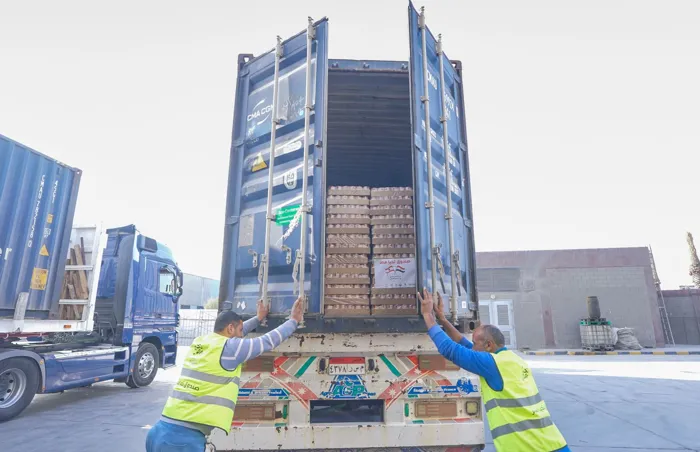
As Egypt dispatches a new humanitarian shipment to Lebanon, the move reflects more than a simple gesture of support. It underscores a consistent policy of standing by neighboring nations in times of crisis. Nearly 1,000 tonnes of relief supplies were delivered to Beirut as part of the most recent humanitarian effort, spearheaded by Foreign Minister Badr Abdel-Aatti, with the goal of alleviating the strain on a nation currently hosting nearly one million internally displaced persons.
“The Egyptian state is always among the first countries to offer all forms of support, especially in circumstances like those Lebanon is currently enduring,” Hamed Fares, Professor of International Relations, told The Egyptian Gazette.
This is not the first time Egypt has intervened. Cairo has significantly scaled up its humanitarian efforts in the Gaza Strip in recent years. Through the Egyptian Red Crescent, the country continues to dispatch regular aid convoys carrying thousands of tonnes of food, medical supplies, and essential goods. Egypt has also facilitated the entry of international aid through the Rafah crossing, which remains a vital lifeline for Palestinians during recurring crises.
“Egypt’s support has not always been only political, but also diplomatic and humanitarian,” Fares added, highlighting the multidimensional nature of Cairo’s regional role.
Egypt has further expanded its outreach across Africa. Coordinated by the Egyptian and Sudanese Red Crescent societies, Cairo launched a land aid convoy in December 2025, delivering approximately 70 tonnes of food, medical supplies, and shelter equipment to Sudan. This is in addition to more than 1,000 tonnes of humanitarian aid transported since the Sudanese crisis began in 2023, as well as Egypt’s hosting of hundreds of thousands of Sudanese fleeing the conflict.
Other critical examples of ongoing assistance include South Sudan and Somalia. Cairo supplied food and medical aid to both nations during the 2022 Horn of Africa drought, frequently working in tandem with regional and international partners.
These efforts reflect a broader strategy that blends humanitarian action with regional engagement. Even beyond immediate crises, Egypt has maintained a steady pipeline of support. In the aftermath of the 2020 Beirut port explosion, Egypt quickly dispatched field hospitals, medical teams, and tonnes of emergency supplies to Lebanon, setting a precedent for the current mission.
It is not only the scale of these operations that is noteworthy, but their continuity. Egypt’s aid efforts—ranging from rapid-response shipments to ongoing logistical support—are frequently coordinated across state institutions and civil society, led by organizations such as the Tahya Misr Fund and various humanitarian partners.
Fares emphasized that, for many in the region, Egypt’s role transcends diplomacy; it is defined by its presence during the most difficult moments.
“Egypt is a country of great weight and is called the ‘Home of the Arabs’ because it always opens its arms to all Arab peoples. Its hand is always extended to everyone,” Fares noted.

