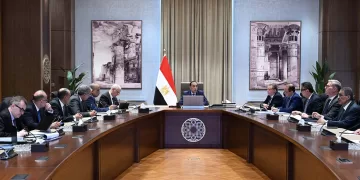





Prime Minister Moustafa Madbouli chaired a high-level meeting Sunday evening to review the repercussions of recent military developments in the region and their potential impact on global markets and supply chains.
The meeting followed military operations carried out by the United States and Israel against Iran, in addition to Tehran’s attacks targeting several Gulf states.
Discussions focused on assessing the implications of these developments for global supply chains, international markets, and energy prices, said the Cabinet Spokesman Ambassador Mohamed el-Homosani.
Central Bank Governor Hassan Abdullah, Minister of Electricity and Renewable Energy Mahmoud Esmat, Minister of Finance Ahmed Kouchouk, Minister of Tourism and Antiquities Sherif Fathy, Minister of Supply and Internal Trade Sherif Farouk, Minister of Foreign Affairs, International Co-operation and Egyptians Abroad Badr Abdel-Aati, Minister of Petroleum and Mineral Resources Karim Badawi, Minister of Investment and Foreign Trade Mohamed Farid, Minister of State for Information Diaa Rashwan, and Minister of Planning and Economic Development Ahmed Rostom were present at the meeting.
The participants form the government’s crisis group, chaired by the prime minister.
According to Spokesman Homosani, the meeting of the crisis group aimed to ensure continuous monitoring of rapidly evolving regional and international developments, and also assessed the potential effects of the ongoing military escalation on global trade and supply chains.
Participants reviewed the latest developments related to military operations involving Iran and the broader regional escalation, including its impact on global energy markets, particularly oil and gas prices.
Relevant ministries and agencies also presented updated scenarios and contingency plans to address potential repercussions and mitigate possible impacts on the domestic market.
The prime minister directed all concerned entities to maintain full coordination and continuously update response plans to address emerging developments.
These measures, he noted, aim to safeguard the stability of local markets and ensure the availability of strategic commodities and production inputs.
The meeting also reviewed international and regional diplomatic efforts aimed at containing the escalation and advancing a political settlement that could help restore regional stability and limit the crisis’s impact on the global economy.

