




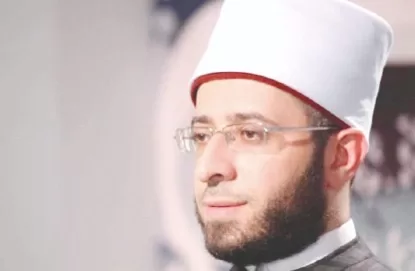
Dr Osama Al-Azhari
Minister of Awqaf (Religious Endowments)
To the esteemed readers in Egypt, Arab and Muslim nations, to every human, and to every atom in this universe: May you be divinely blessed with all goodness, your souls with serenity, and your minds with enlightened understanding.
Today, we stand at the twelfth part of the Ever-Glorious Qur’an, extracting from its verses what helps us to walk the paths of life, and gives us insight and light in a time when challenges abound.
This part is initiated with a majestic scene from the story of the Prophet Noah (PBUH), when the flood was sweeping across the earth, and the ark of salvation was navigating through waves like mountains. In this turmoil, the Ever-Glorious Qur’an encourages us to reflect on a poignant human moment: a dialogue between a prophet of great resolve and his son, who was lost in heedlessness, as Allah Almighty says: “And it (was) to run with them amid waves like mountains.” [Qur’an 11:42] In the midst of this horror, the Qur’an records Noah’s call (PBUH): “O my son, embark with us, and do not be with the disbelievers.” [Qur’an 11:42] But the son responds; clinging to the illusion of material salvation: “He said, “I will soon have my abode to a mountain that will safeguard me from the water.” [Qur’an 11:43] Then the decisive answer came from the Prophet of Allah, Noah (PBUH): “Said he, “Today there is no safeguard from the Command of Allah except for him on whom He has mercy.” And the waves interposed between them; so he was (among) the drowned.” [Qur’an11:43]
The mountains in this scene are not just mountains of stones, but there are “human mountains”: great men, wise and steadfast ones, to whom people turn in times of distress, so they illuminate the path and grant reassurance. And how many people in our lives are mountains! Mountains of wisdom, steadfastness, and tranquility. You throw your worries to them and they relieve you of them with a word, a prayer, or a wise opinion. So search in your life for such a mountain, a steadfast man, get to know him in times of hardship, for he is the refuge when the waves are turbulent.
Among the sources of light in this section is the call of Allah’s prophet Houd (PBUH) to his people, when he said: “And, O my people, ask forgiveness of your Lord; thereafter repent to Him, (and) He will send the heaven showering plentifully upon you and He will increase in power to your power; and do not turn away as criminals.” [Qur’an 11:52] Seeking forgiveness is the key to all good, a path to strength and sustenance, and relief from distress. This meaning is further emphasised by the saying of the Prophet Muhammad (PBUH): Whoever constantly seeks forgiveness from Allah, Allah will grant him relief from every worry, a way out of every hardship, and provide for him from sources he could never imagine.” [Narrated by Abu Dawud, 1518]
In another place, Noah (PBUH) said to his people, as mentioned in Surah Nouh (Noah): So I have said, ‘Ask forgiveness of your Lord; surely He has been (The) Superb Forgiver; He will send down on you (rain) from the heaven showering plentifully; And He will supply you with riches and sons, (Or: seeds) and will set up (Literally: make) for you gardens, and will set up for you rivers. [71: 10-12]
In a third scene, we hear the call of Allah’s prophet Salih (PBUH) to his people, when he says: “O my people! worship Allah. In no way do you have any god other than He. He is (the One Who) brought you into being from the earth and has made you settle therein.” [Qur’an11:61] The phrase ‘and has made you settle therein’ means that He commanded you to cultivate it. Scholars have pointed out that there are three purposes of creation:
1) Worship: As illustrated in the Almighty’s saying: “And in no way did I create the jinn and humankind except to worship Me.” [Qur’an 51:56]
2) Al-Umran (civilisation), meaning construction and development and good deeds, as Allah Almighty says: “He is (the One Who) brought you into being from the earth and has made you settle therein.” [Qur’an 11:61]
3) And Tazkiyah, which means the purification of the soul, as in His -Almighty–saying: He has already prospered who has cleansed himself. [Qur’an 87: 14]
Among the verses that enlighten minds is the saying of Allah Almighty: “So, if only there been of the generations even before you, (remaining nations) endowed with (i.e., of understanding) forbidding corruption in the land.” [Qur’an 11:116]
Those ‘remaining nations’ endowed with understanding’ are the people of wisdom and knowledge, who stand as an impenetrable barrier against corruption. So preserve the status of the scholars, and be guided by their light, for they are the treasures of the nation and its moral compass.
This blessed part concludes with the story of Joseph (PBUH), whom the Qur’an describes as: “We, Ever We, narrate to you the fairest of narratives…” [Qur’an 12:3] because of the profound human meanings it carries. So consider the symbol of the “shirt” in the story: The shirt of estrangement “And they came with false (Literally: lying, a lie) blood on his shirt.” [Qur’an 12:18]; the shirt of trial “and she ripped his shirt from the rear.” [Qur’an 12:25]; and the shirt of healing “Go with this shirt of mine; then cast it on my father’s face and he will recover his sight” [Qur’an 12:93]. The message of the story is that one thing can be a calamity or a cure according to Allah’s will and decree, both of which have their manifestation in man’s life choice.
In conclusion
We bid farewell to the twelfth part of the Book of Allah, which has brought us light and insights, through the stories of the prophets, the expanses of seeking forgiveness, and the lessons of life.
Until we meet again with a new part, we seek illumination from the words of Allah Almighty and drink from a spring that never runs dry. Stay noble; stay safe.

