



From Beijing to Cairo
Zhao Wencai
Just a week ago, families across China gathered to celebrate the Spring Festival, also known as the Chinese New Year, the most important holiday on the Chinese calendar, and the moment when homesickness strikes hardest for those of us living abroad.
It is a season when China’s highways clog, train stations heave, and, for a brief interlude, the world’s second-largest economy slows to the rhythm of reunion dinners and fireworks.
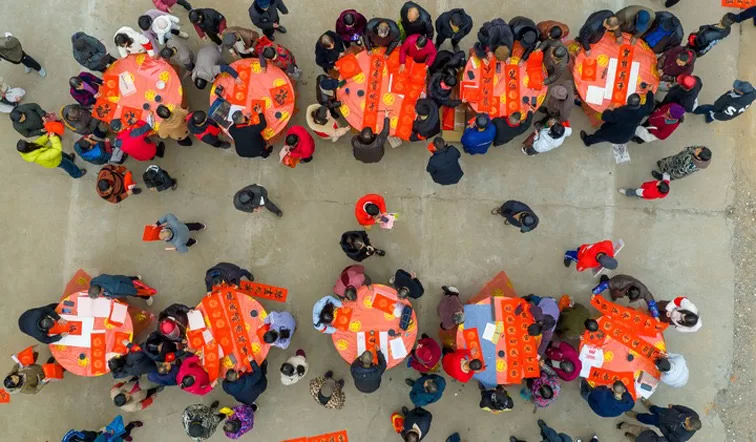
One of the most enduring customs of the Spring Festival is pasting red couplets on the front door – vertical strips of calligraphy bearing best wishes of ordinary Chinese families for the year ahead. Read closely, and these couplets are more than mere decoration; they are a window into the moral grammar of Chinese society.
Among the characters most commonly inscribed on these couplets, alongside wishes for wealth and health, is one in particular: He. In Chinese, it is a capacious character, encompassing harmony, peace, unity and concord.
“When the Family Lives in He, All Affairs Prosper,” “He Breeds Wealth” … These lines have graced Chinese doorways for generations.
For centuries, He has embodied a quiet strain of Chinese idealism – an aspiration not only for peace within the family, but for amity among nations. The logic is straightforward: When relationships are kept in good repair, whether at the dinner table or across borders, prosperity has a chance to take root; without concord, development is little more than a house built on sand.
In the early years of the People’s Republic of China, Chinese leaders articulated what became known as the Five Principles of Peaceful Coexistence, which placed He – peace and harmony – at the very core of China’s foreign policy. Sovereignty, non-aggression and mutual respect were not presented as tactical conveniences, but as guiding norms for how states should treat one another.
To this day, the philosophy still drives China’s role in international affairs. By mediating landmark reconciliation between Saudi Arabia and Iran in 2023, convening 14 Palestinian factions in Beijing in 2024 to help forge an agreement on ending internal rifts and strengthening unity, and consistently championing justice and fairness on the world stage, China has sought to translate He into concrete action and results.
As a Chinese journalist based in Cairo and traveling across the Middle East over the past two years, I have learned a lot from the region’s rich culture. What has impressed me most is the Middle Eastern equivalents of He. Whether in Islamic scripture or in everyday conversation, peace, harmony and mutual respect are not abstract ideals but cherished values, frequently invoked and deeply admired.
It is precisely this shared understanding that has undergirded friendly ties between China and countries across the Middle East. Two civilisations that developed independently, across vastly different geographies and histories, arrived at strikingly similar convictions about what makes societies flourish.
Yet the current international climate offers those convictions little comfort. Hegemonic and interventionist impulses are on the rise, with some powers pursuing military action with alarming abandon and openly signaling territorial ambitions.
The Middle East has been among the principal casualties of this troubling trend. From the “12-day war” involving Israel, the United States and Iran last year, to the ongoing Israeli-Palestinian conflict, and to the recent flare-up of tensions between Washington and Tehran, the shadow of hegemony and unilateral force looms large behind each of these flashpoints.
If this trajectory continues unchecked, the consequences for developing nations, including those across the Middle East, could be profound. A system driven by might over right rarely pauses to heed the concerns of the vulnerable. The interests of less-developed states risk being traded away in the pursuit of great-power advantage, precisely the outcome that He, in all its iterations, is meant to prevent.
As a country that once fell victim to hegemony and intervention, China understands this danger from the inside. It has sought to act as a force for peace and development – not through coercion or the blunt instrument of force, but through dialogue grounded in equality and co-operation for mutual benefit.
Through the Belt and Road Initiative, China has strengthened economic ties and promoted mutually beneficial development across the Global South. Through mediation, investment and technology transfer, it has extended its He philosophy into an expanding range of partnerships. And through various multilateral mechanisms, it has consistently advocated that all nations, large and small, treat one another with respect.
For the Middle East, this approach speaks directly to the region’s core interests. A diplomatic philosophy rooted in harmonious coexistence and shared development offers something the region has long been denied: a framework that does not require choosing sides, surrendering sovereignty, or accepting peace on someone else’s terms.
Unsurprisingly, the philosophy of He is gaining increasing recognition and appreciation among leaders, thinkers, and the general public across the Middle East. On the first day of the Chinese New Year, I woke up to a flood of messages from Arab friends. Among them was a photo of an Egyptian diplomat who had worked in China for decades and had recently taken up Chinese calligraphy. In slightly unsteady but earnest brushstrokes, he wrote: “I know you miss home,” he said in his message. “Happy Spring Festival.”
Looking at those Chinese characters, rendered by an Egyptian hand, on an Egyptian wall, and carrying a Chinese wish that somehow feels universal, I was unexpectedly moved. “Thank you,” I replied. “Now I feel much less homesick, because your writing has given me a sense of home.”
In that small gesture, I sense something larger: He, the quiet aspiration written on Chinese doorways for centuries, needs no translation. When a diplomat in Cairo picks up a brush and writes of harmony, the message travels without effort across every border that separates us.
Zhao Wencai is an editor of the Middle East Regional Bureau of China’s Xinhua News Agency and a researcher at the Xinhua Institute.

