



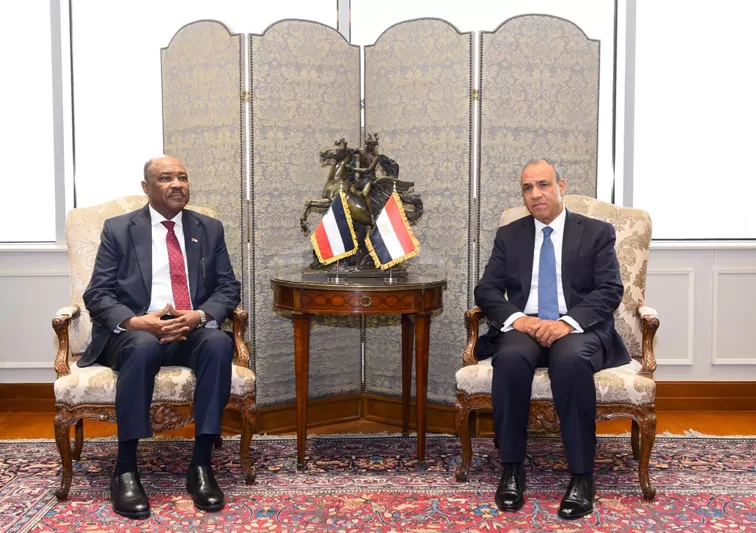
Means of supporting the ongoing efforts to conclude a comprehensive settlement to the Sudanese crisis, featured high on the agenda of talks between Minister of Foreign Affairs, Emigration and Egyptian Expatriates Badr Abdel-Aati and the visiting Sudanese Minister for Foreign Affairs and International Co-operation, Mohieldin Salem Ahmed Ibrahim.
The talks were part of the close strategic relations between the two countries, and the mutual desire to strengthen bilateral co-operation in various fields, Foreign Ministry Spokesman Tamim Khallaf said.
Minister Abdel-Aati reiterated during the meeting Egypt’s unwavering support of Sudan’s unity, territorial integrity and the preservation of its national institutions, as well as rejecting any attempts to divide the country or undermine its sovereignty and stability.
He also reaffirmed Egypt’s condemnation of the horrific atrocities and violations taking place in El Fasher and Kordofan, and affirmed Cairo’s solidarity with the brotherly Sudanese people in light of the grave challenges they are facing.
In addition, the Egyptian top diplomat stressed the importance of launching an effective humanitarian track to ensure the unfettered delivery of humanitarian aid.
Abdel-Aati also underlined the need for concerted regional and international efforts to support a comprehensive ceasefire and create the conditions for launching an inclusive political process that meets the aspirations of the Sudanese people for security, stability and development.
He stressed the necessity of enhancing coordination and integration between existing regional and international tracks to resolve the Sudanese crisis in a manner that achieves maximum effectiveness and consistency in the efforts exerted.
In addition, the meeting addressed close coordination between Egypt and Sudan on issues of mutual interest, particularly the Nile water issue, where the two ministers affirmed their countries’ commitment to their historical water rights and their rejection of any unilateral measures that would harm the interests of the downstream countries.
For his part, the Sudanese Foreign Minister highly appreciated Egypt’s supportive role towards Sudan and its people, praising the Cairo’s political and humanitarian efforts, as well as relentless relief and medical efforts to provide assistance to the Sudanese people.
Meanwhile, the chief diplomats attended on Tuesday a ceremony organised by the Egyptian Agency of Partnership for Development, which honuored members of the Egyptian medical team who participated in the Egyptian medical convoy that visited Sudan, on December 20-27, 2025, in appreciation of their humanitarian and professional efforts in supporting Sudan’s health sector.
In a related development, Minister Abdel-Aati discussed regional developments including Gaza, Sudan and Iran’s nuclear file in two separate meetings with his Saudi and UAE counterparts.
Minister Abdel-Aati’s meetings in Riyadh with Saudi Foreign Minister Prince Faisal bin Farhan and UAE’s Deputy Prime Minister and Foreign Minister Sheikh Abdullah Bin Zayed Al Nahyan were part of continuous consultations and coordination between Egypt and the two countries, and also highlighted the deep-rooted bilateral ties.
The talks stressed the necessity of containing tensions and averting more escalation in the region through intensifying efforts to achieve de-escalation and prioritising political and diplomatic tracks to address crises, in a way that spares the region from entering a new cycle of instability, according to press releases by the Foreign Ministry in Cairo.
They also reaffirmed that the nature of the challenges facing the region requires the pooling of Arab efforts and the continuation of consultation and coordination among Arab states as a fundamental pillar for safeguarding Arab national security in the face of regional crises.
Addressing developments in Gaza, the meetings stressed the necessity of implementing the commitments of the second phase of US President Donald Trump’s plan, supporting the National Committee for the Administration of Gaza, and the swift deployment of an international stabilisation force to monitor the implementation of the ceasefire.
Minister Abdel-Aati also underscored the importance of ensuring unimpeded flow of humanitarian aid, in addition to paving the way for early recovery and reconstruction.
On Iran’s nuclear file, the Egyptian chief diplomat underlined the necessity of adhering to diplomatic tracks and creating favourable conditions for the resumption of dialogue between the United States and Iran, with a view to reaching a comprehensive and balanced agreement that takes into account the interests and concerns of all parties.
Such an agreement, he noted, would contribute to enhancing security and stability at both the regional and international levels, reduce the risks of escalation, and strengthen opportunities for sustainable de-escalation and confidence-building.

