




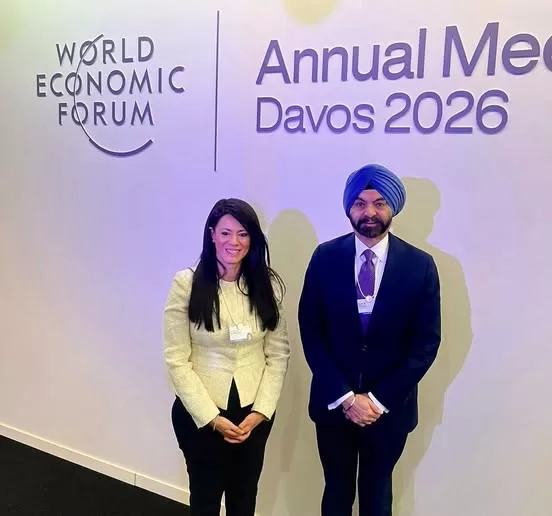
Egypt’s Minister of Planning, Economic Development, and International Cooperation, and Egypt’s Governor at the World Bank, Rania Al-Mashat, stressed that the messages delivered by President Abdel Fattah El Sisi during his participation in the Davos Forum clearly reflect the scale of challenges facing the global economic system.
The president’s messages also highlight the need to reshape paths of international cooperation in a way that ensures support for sustainable development and preserves the momentum of international partnerships in confronting interconnected crises, she said yesterday.
Minister Al-Mashat’s remarks were made during her meeting with President of the World Bank Group Ajay Banga on the sidelines of her participation in the World Economic Forum in Davos, where the two sides discussed ways to strengthen the strategic partnership in light of accelerating global challenges and the ongoing transformations in the landscape of international cooperation and development finance.
The minister stressed that multilateral development banks, foremost among them the World Bank Group, are required to play a more effective role in supporting developing countries by providing long-term development financing and expanding concessional and innovative financing tools.
This would enhance the resilience of economies and enable them to achieve growth amid the current geopolitical and economic conditions, while maintaining the trajectory of international partnerships for development.
Minister Al-Mashat said that human development, industrial localization, increased investments, and enhancing labor market efficiency represent key pillars within the implementation of the “National Narrative for Comprehensive Development,” which seeks to achieve more sustainable and inclusive growth led by the private sector.
The minister noted that the partnership with the World Bank Group has witnessed a qualitative shift in recent years, moving more strongly toward supporting policies and reforms that empower the private sector, improve the business climate, and enhance the competitiveness of the national economy.
Davos targets AI-driven economy
The World Economic Forum, which wrapped up yesterday, announced major global commitments to invest in skills development for workers. The Reskilling Revolution initiative is on track to reach more than 850 million people worldwide, nearing its target of equipping 1 billion people with better access to skills, education and economic opportunities.
As artificial intelligence, geoeconomic shifts and the energy transition rapidly reshape global labour markets, preparing workers for the economy of tomorrow is an urgent global priority. The new commitments span corporate pledges, university-employer partnerships and national skills accelerators focused on redesigning how people enter the workforce, transition between jobs and remain employable in an economy increasingly shaped by AI.
Among the Reskilling Revolution commitments, more than 25 technology companies have pledged to support 120 million workers with AI access, skills training and job pathways. In parallel, India launched a new national skills Accelerator, aiming to rapidly scale industry-aligned training and improve employability for millions of workers.
“The global economy is undergoing its most significant transformation in decades. But the future of work is not fixed. How it unfolds for workers depends on opportunities for learning, support for job transitions and backing for entrepreneurship,” said Saadia Zahidi, Managing Director, World Economic Forum. “Today’s announcements represent decisive action – mobilizing education providers, employers and governments to ensure the future of work delivers opportunity for all.”

