







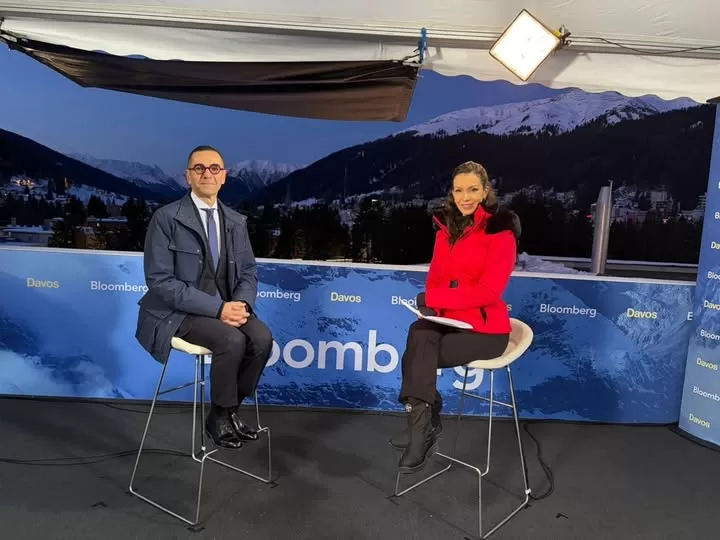
Egyptian Minister of Investment and Foreign Trade Hassan el-Khatib said the government is implementing a comprehensive economic reform programme aimed at maximising the efficiency of state-owned assets, accelerating the transition to a green economy, and strengthening the role of the private sector as a key driver of development.
El-Khatib made the remarks during a televised interview with Bloomberg on Tuesday, conducted on the sidelines of his participation in the 56th Annual Meeting of the World Economic Forum (Davos 56) in the Swiss city of Davos.
The minister noted that the state has adopted a modern, results-oriented approach to asset management, centred on redevelopment, re-planning, and optimising asset utilisation to generate real added value for the national economy.
He noted that this approach has already delivered tangible outcomes, citing the redevelopment of a project that evolved from an initial concept comprising around 300 hotel rooms into a fully integrated tourism destination with nearly 1,800 rooms.
El-Khatib highlighted Egypt’s vast potential in renewable energy, estimating more than 1,000 gigawatts of combined solar and wind capacity, compared to current consumption of no more than 40 gigawatts.
He pointed out that the Western Desert alone could generate approximately 700 gigawatts, in addition to around 200 gigawatts from floating solar power.
On energy subsidy reform, the minister said the government has made significant progress in restructuring energy pricing, particularly natural gas, through the adoption of pricing mechanisms that reflect average actual costs. He stressed that these reforms have helped address long-standing structural imbalances that previously resulted in an annual deficit of around $2 billion in the gas sector, thereby supporting fiscal sustainability, improving resource efficiency, and enhancing Egypt’s attractiveness to investors.
El-Khatib underscored that these policies form the cornerstone of building a competitive economy driven by investment, sustainability, and value creation, reaffirming the state’s commitment to strengthening Egypt’s position as a regional hub for energy and investment.

