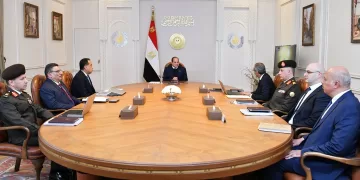






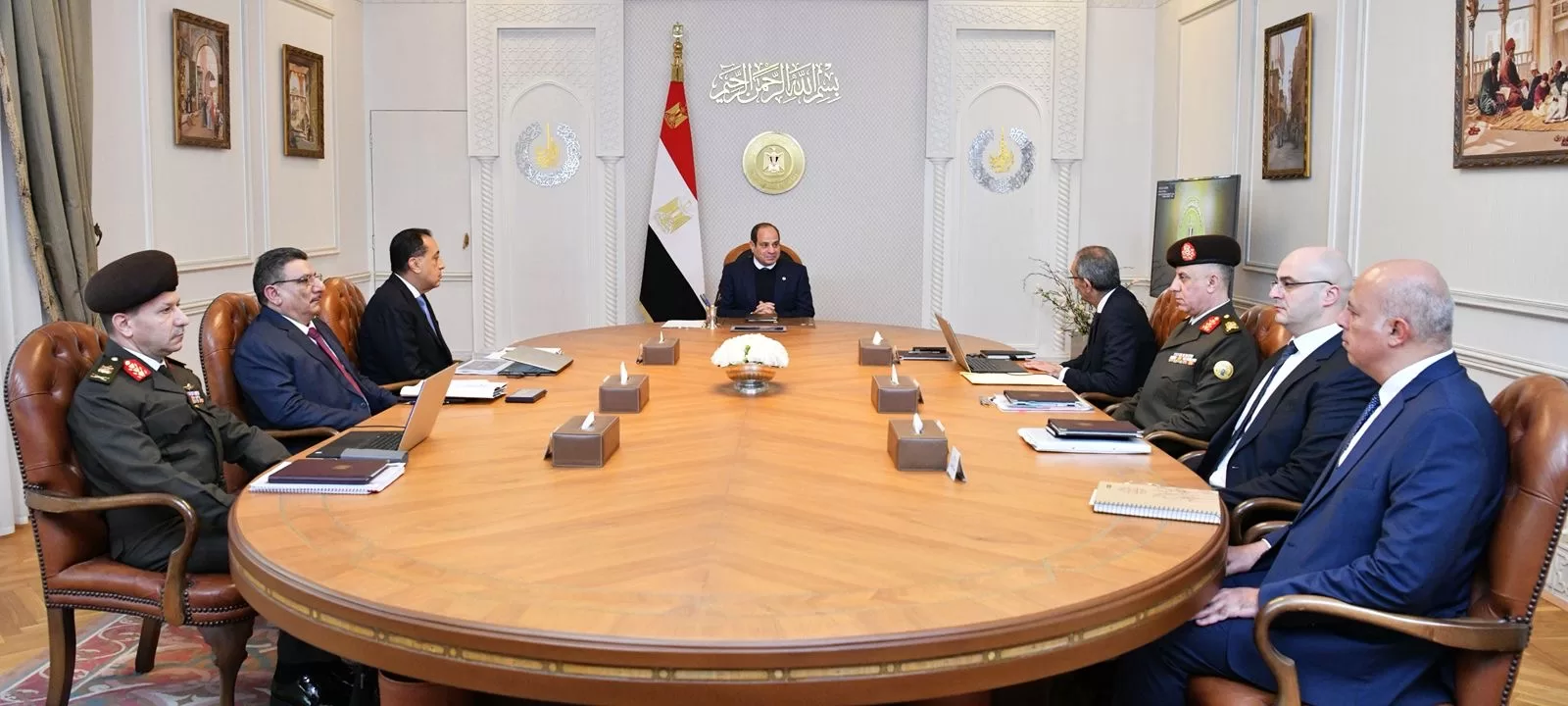
Egypt’s President Abdel Fattah El Sisi conferred with Prime Minister Mostafa Madbouli and senior aides on Monday to review Egypt’s strategy for developing the telecommunications sector and strengthening the knowledge-based economy.
Taking part in the meeting were Minister of Communications and Information Technology Amr Talaat, Presidential Adviser for Financial Affairs Lt. Gen. Ahmed Al-Shazly, Head of the Armed Forces Financial Affairs Authority Lt. Gen. Khaled Ahmed Abdullah, Director of the Armed Forces Signal Corps Maj. Gen. Hany Mahmoud Mansour, and National Telecommunications Regulatory Authority (NTRA) CEO Mohamed Shamroukh.
Presidential Spokesperson Ambassador Mohamed El-Shennawy said the meeting addressed the strategic pillars for advancing the telecommunications industry. Minister Talaat reviewed a package of recently launched services, most notably fifth-generation (5G) mobile services, which represent a qualitative leap in network quality and speeds nationwide, as well as the WiFi Calling service, which has improved call quality, particularly in areas with weak or no coverage.
The minister also highlighted the inauguration of the National Spectrum Monitoring Center, describing it as a major addition to Egypt’s national infrastructure for spectrum management. The center relies on advanced wireless monitoring systems, including fixed and mobile stations and portable equipment, to accurately measure spectrum usage.
The president was briefed on plans to continue upgrading mobile networks and expanding internet and mobile services across all cities, villages, and underserved areas to ensure high-quality services nationwide.
In his briefing to the President, CIT Minister Talaat noted that the telecommunications sector has become a productive, service-based industry contributing effectively to economic growth and sustainable development, achieving the highest growth rates in the country for the seventh consecutive year at 14%–16%, with its contribution to GDP rising to nearly6%.
Also reviewed during the meeting was the implementation status of nationwide digital infrastructure projects, including replacing copper networks with fiber-optic networks under a comprehensive national plan, and expanding mobile tower construction to improve service quality.
Minister Talaat underscored the pivotal role of the private sector in telecommunications and information technology as a key partner in implementing sectoral plans, reflecting the state’s commitment to unified efforts and deeper cooperation to support the national telecommunications industry.
At the conclusion of the meeting, President Sisi stressed the importance of opening new horizons for developing the telecom sector and addressing challenges related to local manufacturing. The President gave directives to officials to study the prospects of developing data centers and cloud computing services, expanding local manufacturing of telecommunications equipment, and establishing effective mechanisms to support and promote local products, the Presidency spokesman said.

