




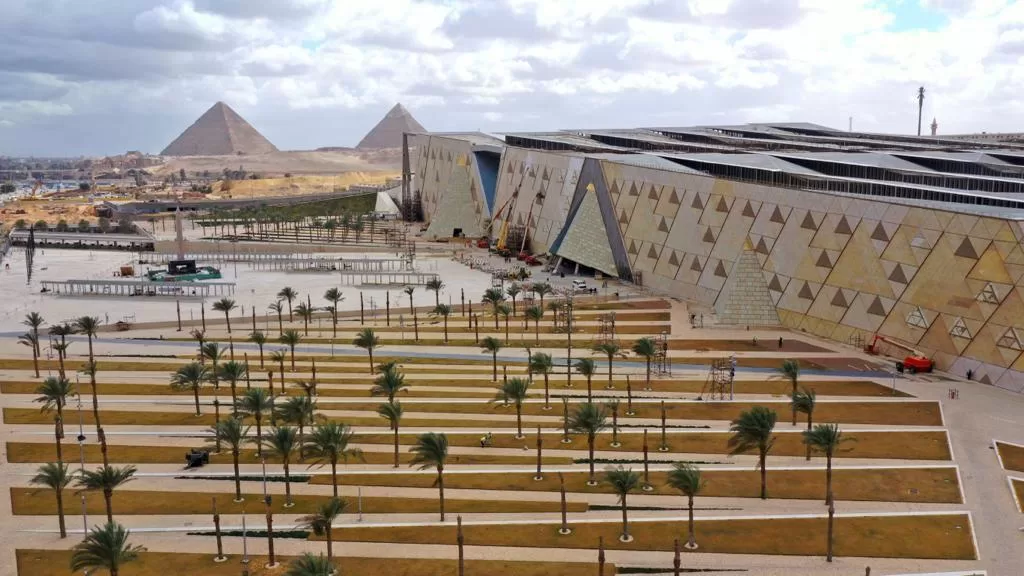
Rising on the Giza Plateau with the pyramids in view, the Grand Egyptian Museum (GEM) bridges Egypt’s ancient past and vibrant present.
For over 30 years, it inspired global hope to unite 100,000 artefacts under one roof.
The path was challenging: political shifts, global events, and logistics delayed it. Yet Egypt’s spirit prevailed in honouring its heritage.
Conceived in 1992, construction began in 2005, but stalled amid 2011 political unrest, funding woes, and Covid-19.
The $1.2 billion complex trialled in 2023-2024; openings delayed from May 2024 and July 2025.
On November 1, 2025, President Abdel Fattah El Sisi inaugurated it to dignitaries and public entry followed.
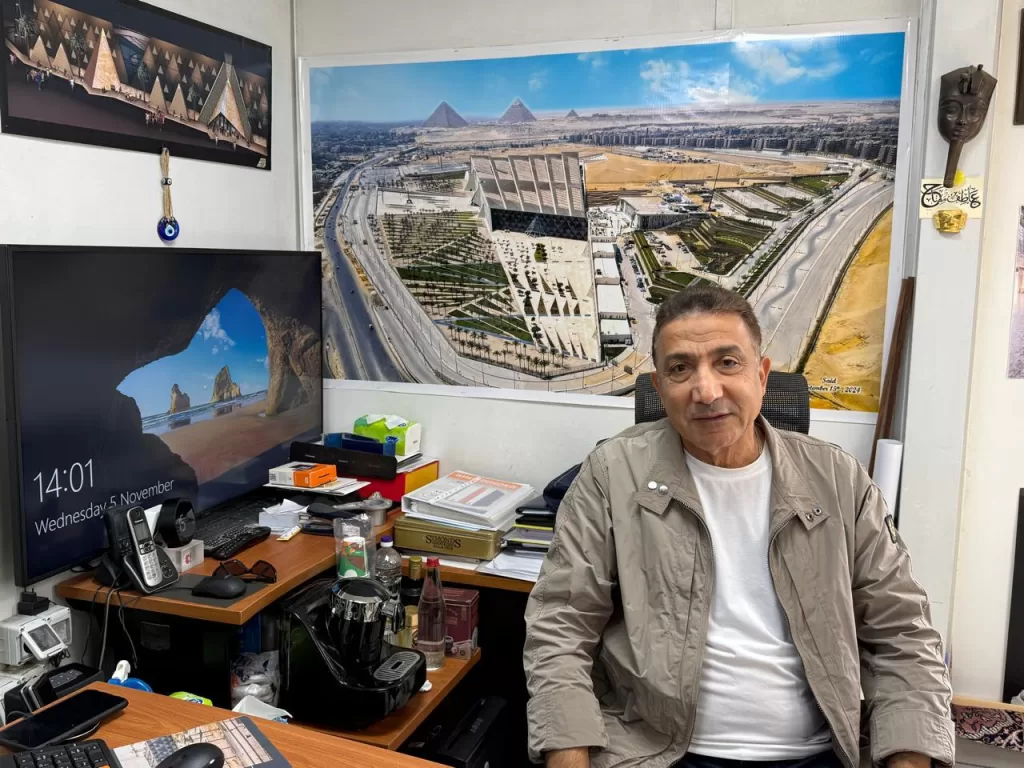
At the heart of this remarkable story is Maj. Gen. Atef Moftah, engineering supervisor of the GEM, whose integrity, and tireless dedication guided the museum through its most trying chapters.
In January 2016, President Sisi summoned him with a direct charge: finish the museum without compromising on efficiency, spatial vision, or cost.
What Gen. Moftah found was staggering. After 11 years, only 15 per cent of the project was complete: just foundations, fragments of walls, and the colossal statue of Ramses II, still in the iron cage he had inhabited since 2006, waiting for his rightful place inside.
The acclaimed 2002 design from Dublin’s Heneghan Peng Architects existed only as basic sketches; no detailed plans existed to steer the project forward.
On January 22, 2016, Gen. Moftah gathered the full cast of stakeholders, Besix-Orascom JV (main contractor), Hill Intl.- EHAF JV (project management consultant), JICA, museum exhibition designers, and OMC, the chief archaeologist, Egypt’s finest engineers, and arbitration and design team members, some dialling in from Ireland.
At that crucial meeting, Gen. Moftah demanded full commitment: stay or step aside.
“We had to act with precision and resolve,” Gen. Moftah told the Egyptian Mail.
“The project was at a standstill, and Egypt’s heritage could not wait another decade,” he added.
At the helm
Gen. Moftah’s first, and most daring decision, was to sideline the Irish design team because, according to him, 40 per cent of the project hung undefined, leaving critical details to guesses.
“Routine queries ping-ponged from contractors to consultants in Egypt, then across continents to Ireland, leading to endless delays and impractical suggestions,” he explained.
After 11 difficult years, only a fraction was done. Projections stretched completion to 50 years, 40 for construction, and another ten just for relocating the artefacts.
“The communication chain was broken,” Gen. Moftah explained. “Every delay compounded the crisis. We needed control on the ground, in Egyptian hands.”
But the second, more profound challenge was about the soul of the museum and Egyptian identity.
Hidden symbols
As he delved into the Bill of Quantities, Gen. Moftah discovered a major issue in the museum’s design: the Sierpinski Wall, a massive decorative structure inspired by fractal geometry, was not just an abstract pattern. Its repeated triangular shapes secretly formed symbols like the Star of David and the Freemason “G,” both loaded with foreign meaning. The wall’s alignment also placed Ramses II along an axis used in Masonic symbolism.
Gen. Moftah felt the wall imposed a subtle, non-Egyptian cosmology onto a space meant to celebrate Egypt’s heritage.
The impression was clear: a subtle, foreign cosmology embedded in the museum’s centrepiece, overshadowing Egypt’s own narrative.
“It was not overt, but once seen, it could not be unseen,” Moftah revealed. “This was Egypt’s museum, our story, our symbols. No foreign geometry would overshadow that.”
Gen. Moftah took his concerns to President Sisi, and was quietly empowered to fix it, discreetly.
“We handled it quietly, professionally,” he said. “The goal was correction, not confrontation.”
Copyright posed no obstacle; Heneghan Peng had been fully compensated, and Egypt now owned the design rights.
Gen. Moftah simply told the Irish firm by email that the wall’s construction was “postponed.”
He cited cost-savings to justify waiting: while foundations and portions of the structure existed, attention shifted to refining the main wall’s finish and bringing the design home.
Authentic Egyptian philosophy
Gen. Moftah envisioned a replacement wall rich with indigenous symbolism, anchored in Egyptian civilisation, faith, and creative renewal.
He drew inspiration from the number seven, hallowed in religion, the days of creation, the seven heavens, representing the march of civilisation from Egypt’s southern origins northward to enlighten the world.
Where pyramids once signalled death, Gen. Moftah reimagined them as icons of rebirth through light.
The new façade displayed seven dynamic, partially-revealed pyramids, set in perpetual motion, angled to the Great Pyramid’s very tilt (51 degrees, 59 minutes), suggesting a civilisation never complete, always reviving.
“Seven represents completeness, renewal,” Gen. Moftah said. “Light is life. The pyramids are not static. They move, they breathe, and invite the world forward.”
The grand northern wall became a transparent expanse, channelling light and making the new entrance an allegory for progress, from south to north, from darkness to enlightenment.
The triangular forms echoed the Giza trio: Khufu’s pyramid recessed deeply, Khafre protruding halfway, and Menkaure advancing in modern materials, a fusion of history and innovation.
New narratives
Serendipity struck: in the new design, the statue of Ramses II was shifted from its eastward stance.
Now, the king looked southeast. The base, surrounded by water, symbolised life’s origin and echoed how the Nile, the seas, and the sky shaped Egypt’s story.
Even more symbolism abounds: a towering obelisk from San el-Hagar was sited nearby, and a companion Ramses II statue now presides over the food court, facing north, declaring the expansion of civilisation.
Every element reflects a conscious confluence of faith, heritage, and proud Egyptian continuity.
“Every detail tells a story,” Gen. Moftah said. “Ramses looks to the future, rooted in faith and flow. Water is memory, our Nile, our lifeblood.”
Living testament
Under Gen. Moftah, the museum became more than just a sanctuary for relics.
Efficiency was achieved. The pharaoh at the core reclaimed his identity, the building rebuked foreign mystique, and every feature, from the very angle of its pyramids to the water at its heart, was imbued with tales of endurance and the ceaseless renewal of Egyptian heritage.
“This is not just a museum,” Gen. Moftah concluded. “It is Egypt talking to the world, on our terms, in our voice, forever.”

