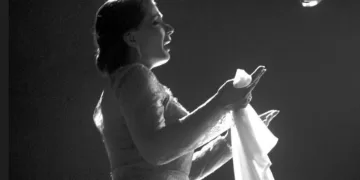












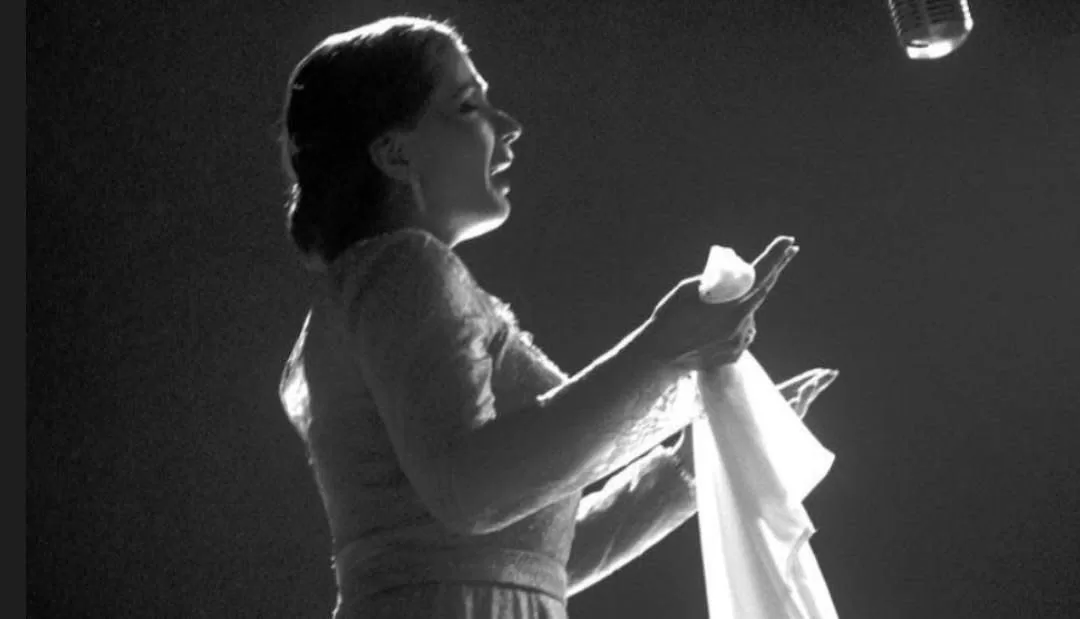
Right after the defeat of the Egyptian army against Israel in 1967, legendary singer Um Kalthoum accepted an invitation to sing in the famous Olympia Theatre in Paris.
She used the occasion to raise funds for Egyptian military efforts at that time.
Um Kalthoum sang for five hours to a huge audience that contained some senior Arab government officials in a concert that was also attended by then-French President Charles de Gaulle.
All of a sudden, however, what nobody anticipated had happened: a male member of the audience rushed to Um Kalthoum and tried to kiss her feet. This was when she fell on the stage.
This well-known incident was caused by neither fatigue nor sickness.
Script writer Ahmed Murad uses this incident as the beginning of the movie el-Set (The Lady), directed by Marawan Hamed and starring Mona Zaki in the leading role, along with a number of some of the finest Egyptian actors and actresses.
The movie tells the biography of the legendary singer. With the beginning of the concert and the fall, Murad delves into the life of Um Kalthoum, with flashbacks from her childhood and early years until stardom.
The life of Um Kalthoum was tackled in detail in different works, including a TV series in 1999, starring actress Sabrin, which made great success. It was also turned into a movie, titled Kawkab el-Sharq (Star of the Orient) (1999), starring veteran actress Fardous Abdel Hamid, but this didn’t make the same success.
Each work focused on the life and career of the Egyptian singing icon.
El-Set aims, however, to spotlight a new side of the same narration. It wants to focus on the inner feelings and the uncovered spots in her character. But whether this approach is successful or even matters to her huge audience is debatable.
In fact, el-Set presents a version of Um Kalthoum that few feel the need to see, assuming the script even accurately represents her.
The fall at the beginning of the movie feels like a forced entry point into the diva’s past, lacking a clear link to the flashbacks that follow.
At the time of the Olympia concert, Um Kalthoum was still riding the crest of a wave of stardom, globetrotting to boost Arab morale.
The fall was simply an accident caused by a fan who loved her extremely, yet the film treats it as a central point.
Even if we accept this weak opening, the film struggles with its characterizations.
Although the movie runs for over two hours and a half, it fails to present clear or complete relationships between the singer and those around her.
Um Kalthoum’s relation with her father is contradictory in the movie. There are hints that he exploited her talent as a child, forcing her to sing in neighbouring villages to support the family. Nonetheless, in some of the movie’s scenes, she appears to love and appreciate him.
Also, throughout the movie, we see the beloved icon as a selfish exploitative person.
For example, when the famous poet Ahmed Ramy falls in love with her, she seems to be aware of his love and even tells him “all that time I wondering when you will say it”.
Nonetheless, to his utter shock, she coldly rejects his entreaties, even without giving herself enough time to think, to protect her career.
Another scene shows her at the zenith of her stardom and leading the Musicians’ Syndicate. She tells one of the musicians that if he and his colleagues don’t vote for her, they will lose their work within her band in future concerts.
In fact, through these scenes and others, the writer wants to show her as a strong woman, but this backfires, instead making her appear as a manipulative person.
Whether this matches the reality of the iconic vocalist, two and a half hours of such scenes can only carry bad connotations.
On a technical level, the movie presents an impressive image.
Director Hamed delivers lavishly vibrant scenes. He masterfully captures the spirit of the age.
One of the master scenes was capturing the reactions of the audience in Um Kalthoum’s concerts, which show people not just listening to a singer but rather entering a divine state of ecstasy.
His camera movements are expressive and create a visually stunning Hollywood-style fantasy.
The acting is also impressive. Mona Zaki made a lot of effort to be as close as possible to the real character, but she is noticeably decapacitated by the script and the makeup.
If the movie aims to show the woman inside this icon, it should have shown her love affairs in more details not just glimpses.
The chosen scenes in the movies lack persuasion and, at times, are uninteresting.
El-Set succeeds as a piece of high-quality cinema, but it fails as a definitive biography of Um Kalthoum.

