








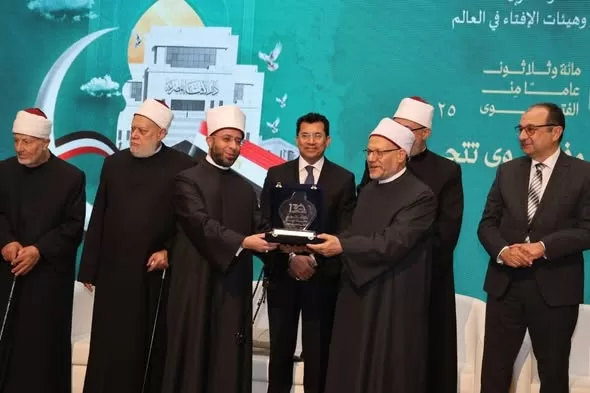
CAIRO – Egypt’s Mufti and Secretary General of the General Secretariat for Fatwa Authorities Worldwide Nazir Mohamed Ayad on Sunday affirmed that Dar al Iftaa has, throughout its long history, remained a fundamental institution for promoting moderate Islamic thought, correcting misconceptions, raising religious and societal awareness, and confronting extremist ideology.
Its approach is deeply rooted in the long-standing values and centrist methodology of Al Azhar, Ayad added.
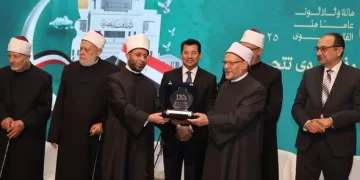
He made the remarks during the opening session of Dar al Iftaa’s celebration marking its 130th anniversary.
The ceremony is attended by several ministers, senior Al Azhar officials, representatives of the Ministry of Awqaf, and figures from the fields of thought, culture, media, and civil society.
The grand Mufti highlighted that Prophet Muhammad (peace be upon him) was the first to assume the role of issuing fatwas, delivering rulings guided by Divine revelation, and offering concise judgments encompassing clear and decisive guidance.
After him, the Companions and members of the Prophet’s household continued to uphold this responsibility. It was then passed to the early generations of scholars such as Sa‘id ibn al-Musayyib and Ata’ ibn Abi Rabah, who were authorized by senior Companions to undertake the task.
Ayad explained that eight major jurisprudential schools later became established across the Islamic world: the four Sunni schools (Hanafi, Maliki, Shafi‘i, and Hanbali); the Shia schools (Imami and Zaydi); alongside the Ibadi and Zahiri schools.
Each developed into structured legal traditions with codified principles, and their leading scholars carried the responsibility of issuing legal opinions throughout the ages. He noted that the modern era witnessed the transformation of fatwa-giving into an official institutional practice with defined administrative and scholarly systems—an area in which Egypt’s Dar al Iftaa emerged as a pioneering body.
He aid that the 130th anniversary of Dar al Iftaa is an opportunity to reflect on its rich legacy, which has become a treasured repository of jurisprudence and scholarly knowledge for researchers, distinguished by a methodology that carefully balances religious texts with contemporary realities, in line with the higher objectives and noble values of Islamic law.

