


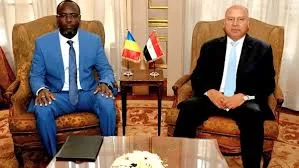
CAIRO – Deputy Prime Minister for Industrial Development and Minister of Industry and Transport Kamel el-Wazir affirmed that the Egypt-Chad road represents a strategic axis.
He added that the project will strengthen connectivity between North and Central Africa, open new avenues for intra-African trade, and facilitate the movement of people and goods on an unprecedented scale.
Speaking during his participation in the Egyptian-Chadian Committee meeting, Wazir highlighted the strong relations between Egypt and Chad.
He noted that President Abdel Fattah El Sisi has called for strengthened cooperation with African nations, including friendly Chad.
The minister added that Egyptian companies specialized in infrastructure, transport projects, and industrial zones, which have successfully executed large-scale projects both domestically and abroad, are fully prepared to implement various projects in Chad and contribute to its developmental progress.
He stated that Egyptian companies have extensive experience and proven expertise in Africa, equipping them to efficiently execute major infrastructure, transport, and industrial projects.
Wazir highlighted the successful track record of the Arab Contractors Company in executing major infrastructure projects in Chad, noting that it reflects the efficiency and capability of Egyptian firms to deliver projects to the highest quality standards.
He expressed anticipation for expanded cooperation between the two sides in dry ports, logistical, industrial, and agricultural zones.
The minister outlined key sectors with significant potential for Egypt-Chad cooperation.
These include the livestock sector (meat production and processing), which encompasses the establishment of joint automated slaughterhouses adhering to the highest quality standards, production of chilled and frozen meat, and processed meat products.
Coordination is underway with the Egyptian private sector to establish livestock farms and automated slaughterhouses in Chad.
Other promising areas include dairy and cheese production, the establishment of milk processing plants, development of collection and quality testing centers, transfer of Egyptian expertise in modern packaging and drying techniques for infant milk, and leather industries, leveraging Chad’s livestock resources to produce tanned leather and leather products.
Cooperation also extends to pharmaceuticals and veterinary industries, including the production of veterinary drugs and disinfectants, establishment of joint laboratories for meat and dairy control, and support for animal health systems.
Agricultural industries and food integration are targeted through feed mills, storage silos, and processing of agricultural products such as sesame, peanuts, and gum arabic.
Wazir noted that the scope of cooperation extends to a forward-looking vision, including the formation of a permanent joint technical committee to monitor the implementation stages of the Egypt-Chad land link project.
The committee will be responsible for establishing a joint execution timeline for the three sectors, addressing challenges promptly, and expanding the role of Egyptian companies, primarily the Arab Contractors Company, to implement additional infrastructure projects in Chad, including roads, logistical zones, and dry ports.
Egyptian training programs will also be launched to develop Chadian cadres in road engineering, transport, supervision, and project execution, supporting national capacity-building in Chad.
Idriss expressed his pleasure at visiting Egypt and witnessing the country’s remarkable development across multiple sectors.
He described Egypt’s experience as pioneering and emphasized Chad’s strong commitment to cooperation with Egypt in all transport sectors to benefit from Egypt’s extensive expertise.
He also highlighted the importance the Chadian government places on the Egypt-Chad land route, describing it as a bridge for trade and economic cooperation not only for the current generation but for generations to come, and a key starting point for enhanced bilateral cooperation.
The Chadian minister of livestock noted the country’s vast livestock resources, including cattle, camels, and sheep.
He stated that cooperation with Egypt to establish joint automated slaughterhouses adhering to the highest standards, produce chilled and frozen meat and processed meat products, and develop livestock farms would mark a major step forward in bilateral collaboration between the two countries.
On the sidelines of the Egyptian-Chadian Joint Committee meeting, Wazir held an expanded session with Chadian officials.
Participants included Minister of Infrastructure, Disenclavement and Road Maintenance Amir Idriss, Minister of Livestock Abdelrahim El Tayeb, and the Director-General of the Chadian National Investment and Export Agency (ANIE)
The meeting was also attended by Egypt’s Assistant Minister of Transport for Roads and Bridges Hossam Eldin Moustafa, and Chairman of the General Authority for Dry Ports and Borders, Sayyed Metwally.
The meeting reviewed updates on the Egypt-Chad land route project, which passes through Libya over a total length of 2,570 km.
Work is currently underway on the East Al-Oweinat/Al-Kufra road, spanning 370 km within Egyptian territory, with 15% of the project completed.
The Arab Contractors Company has signed a memorandum of understanding with Libya to conduct studies for the 390 km section from the Egypt-Libya border to the Libya-Chad border.
The company signed two memorandums of understanding with the Chadian government.
The first covers the 550 km section from the Libya-Chad border to Um Jaras, with topographical survey work currently underway.
The second covers the 380 km section from Um Jaras to Ibsha, where earthwork for a bridge has already commenced.
The 880 km section from Ibsha to Chad’s capital N’Djamena is currently in good condition.
Construction of the Al-Kufra land border crossing on the Egypt-Libya border is also underway, which will serve as a key trade exchange point between Egypt and Chad.
The project holds economic and logistical significance for Chad by providing the shortest route to the sea, opening up major markets, supporting development and security, and enhancing the regional role of both countries.
Egypt regards the route as a strategic axis to strengthen connectivity between North and Central Africa, open new opportunities for intra-African trade, and facilitate unprecedented movement of people and goods.

