




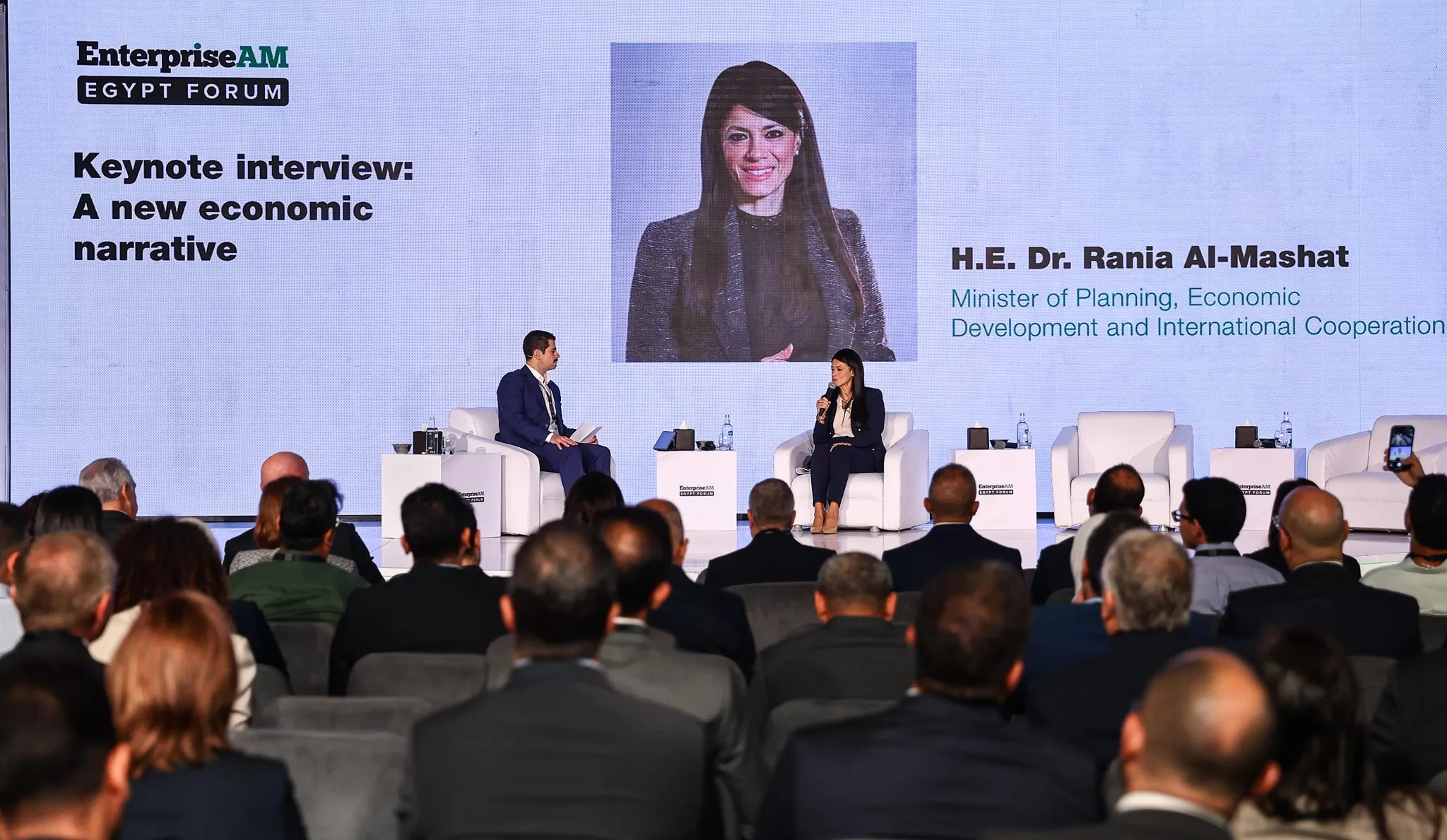
Minister of Planning, Economic Development, and International Co-operation, Rania Al-Mashat, participated in the Enterprise Egypt 2025 Forum on Wednesday, titled “Preparing the Future of Egyptian Business.” Her attendance underscored the government’s commitment to strengthening communication with the private sector and the wider business community to review the key pillars of the “National Narrative for Economic Development.”
During her speech, Al-Mashat emphasised that the National Narrative is a new economic reform programme that goes beyond the financial element, encompassing sectors of the real economy and a clear timetable for implementing structural reforms.
She explained that the government’s aim is to shift towards higher-productivity sectors with significant private sector participation. The goal is to drive greater exports and capitalise on global developments to open new markets, all while maintaining macroeconomic stability through prudent fiscal and monetary policies and the proper governance of public investment.
Economic recovery
Minister Al-Mashat highlighted the fiscal and monetary reforms implemented in March 2024, which followed a challenging period marked by regional and global geopolitical shocks. She noted the current recovery in GDP, stressing the importance of looking at the sources of this growth.
Al-Mashat pointed out that the growth rate reached 4.4% during the 2024/2025 fiscal year, hitting 5% in the last quarter. This growth is being driven primarily by the industrial sector (including pharmaceuticals, vehicle manufacturing, textiles, and some chemical industries), as well as the communications and information technology sector and tourism. However, she acknowledged that some more traditional sectors, such as the Suez Canal, had unfortunately seen negative growth rates.
Regarding tourism, Al-Mashat stated that the sector is benefiting from infrastructure developed over the past few years, highlighting the opening of the Grand Museum next November, which is expected to attract more visitors.
Private sector and structural pillars
The Minister stressed the crucial role of the private sector, noting that it accounted for 57% of total investments during the last fiscal year. This aligns with the government’s commitment to a firm public investment ceiling, its governance, and its targeted allocation to priority sectors. Additionally, numerous ongoing reforms are designed to facilitate business and create a more competitive environment, including addressing previous exemptions granted to state-owned enterprises.
She explained that the entire structural reform programme is founded on three main pillars:Maintaining macroeconomic stability, promoting greater competitiveness and increasing private sector participation, and green transformation.
The ‘narrative’ includes more than 100 structural reforms that have been or are being implemented to enhance the business environment and competitive neutrality, thereby encouraging the growth of private sector investment.
Finally, she confirmed that the National Narrative for Economic Development features a dedicated chapter on labour market efficiency and flexibility. This aims to align vocational education and training programmes with market needs, expand applied technology schools in partnership with the private sector, and integrate trade, industry, and employment strategies.

