



By Bassem Abdelsamih
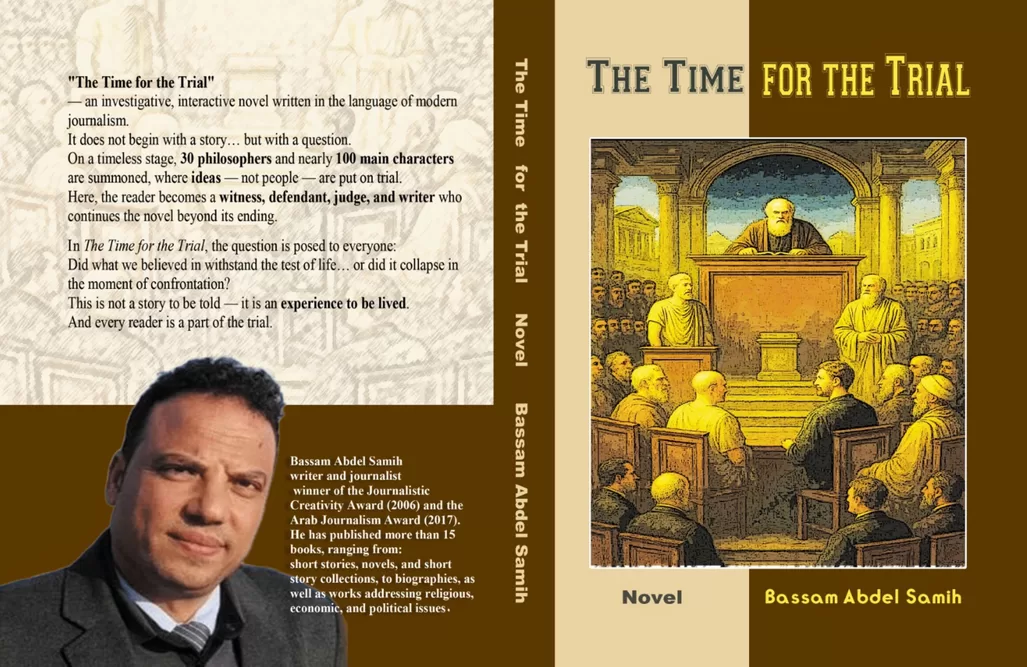
Bassem Abdelsamih’s The Time for the Trial is not a conventional novel. It defies narrative expectations, refusing to begin with a story and instead opening with a question—an inquiry into the endurance of human belief when tested against the rawness of reality. It is investigative, philosophical, and interactive, crafted in the language of modern journalism yet shaped like a timeless parable.
On its metaphysical stage, Abdelsamih summons thirty philosophers and nearly a hundred characters, but what is truly on trial are not individuals, but the very ideas that have defined civilizations: morality, faith, justice, freedom, and power. The courtroom here is not confined by walls; it is an expansive intellectual arena where the reader is no longer a passive observer. Instead, one is called to shift roles—witness, defendant, judge, even writer—continuing the novel in their own imagination long after its closing lines.

The brilliance of the book lies in its refusal to offer closure. Abdelsamih understands that the human condition is not about answers but about grappling with the right questions. “Did what we believed in withstand the test of life… or collapse in the moment of confrontation?” This central question echoes through every page, forcing the reader to confront their own assumptions and to measure them against lived reality.
Stylistically, the novel mirrors Abdelsamih’s career as a journalist and essayist. His prose is sharp, investigative, and layered with a sense of immediacy that makes philosophy feel urgent rather than abstract. He writes as if the reader is in a pressroom and a courtroom simultaneously—where truth is interrogated, not declared.
With more than fifteen published works spanning fiction, biography, and socio-political analysis, Abdelsamih has long mastered the art of weaving intellectual inquiry with accessible storytelling. But The Time for the Trial may be his most daring project yet, precisely because it abandons conventional narrative comfort. It is not “a story to be told” but “an experience to be lived.”
For readers who crave fiction that provokes, unsettles, and engages them as active participants, this book offers an uncommon journey. It does not simply challenge the ideas of great philosophers and leaders across history—it places the reader alongside them, demanding participation in the ultimate trial: the trial of human conviction itself.
The Time for the Trial is less a novel than an intellectual encounter, a mirror held up to both history and the reader. It is a bold and innovative work that transforms reading into an act of judgment, reflection, and creation.

