



Israeli Prime Minister Benjamin Netanyahu has once again chosen war over peace, isolation over engagement, and personal survival over the future of his country.
Hours before unleashing yet another brutal ground offensive on Gaza City, the Israeli prime minister stood before his nation and called for the creation of a “super Sparta”, a militarised fortress that would live in permanent conflict, cut off from the world, and economically self-reliant.
This is not a vision for security. It is rather a blueprint for disaster.
Netanyahu’s rhetoric confirms what many across the region have long believed: Israel under his leadership is prepared to sacrifice morality, stability, and even its own prosperity in pursuit of endless war and territorial ambition.
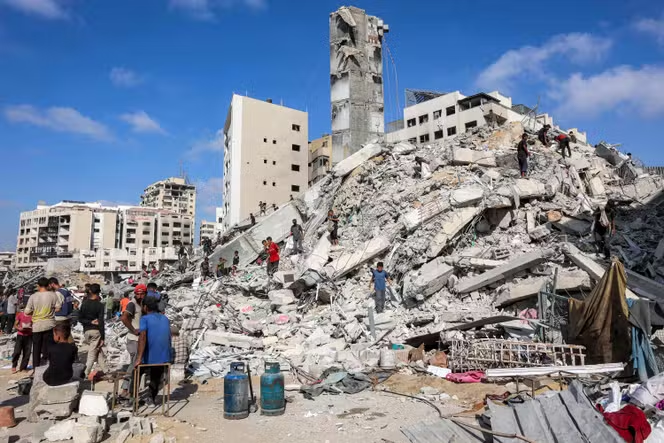
The consequences are already unfolding. On the same day Israeli tanks rolled into Gaza, a UN commission released a damning report accusing Israel of committing genocide, a charge with serious implications for its standing in international law.
In Europe, the EU is moving towards suspending parts of its trade agreement with Israel. More nations are recognising the State of Palestine, and public opinion across the West is turning decisively against Tel Aviv.
Even the cultural sphere is not spared, with multiple countries threatening to boycott the Eurovision Song Contest if Israel participates.
The backlash is not just external. Inside Israel, alarm bells are ringing. Tel Aviv’s stock market plunged, the shekel (Israel’s national currency) dropped, and leading economists warned that the Gaza campaign is inflicting billions of shekels in damage, threatening Israel’s place among developed economies.
Arnon Bar-David, head of the Histadrut trade union federation, declared: “I don’t want to be Sparta. We deserve peace. Israeli society is exhausted.”
Netanyahu’s response? Blame everyone else: China, Qatar, and Muslim communities in Europe for Israel’s isolation.
This tired narrative of victimhood is straight out of the playbook of the far right, with whom Netanyahu has forged alliances, even when those movements carry anti-Semitic baggage. Instead of self-reflection, he spins conspiracy theories to distract from his government’s failures.
Domestic critics, like Knesset member Yair Golan, are blunt: Netanyahu is dragging Israel into endless war to avoid elections and keep himself out of jail on corruption charges. At his own trial this week, the prime minister used the Gaza offensive as an excuse to limit his court appearances proving his critics right.
This is where Netanyahu’s “super-Sparta” dream leads: permanent militarisation, economic decline, and international pariah status.
Sparta, after all, did not survive. It fought bravely but perished, its society crushed by the very wars that were meant to preserve it.
Washington’s backing, cautious from Joe Biden, unconditional from Donald Trump and Secretary of State Marco Rubio, may keep Netanyahu in power for now, but it cannot shield Israel from the global tide of condemnation. Nor can it protect Israelis from the price of perpetual war: isolation, fear, and an economy in free fall.
Netanyahu’s far-right coalition welcomes this siege mentality. For them, a cornered and embattled Israel is an excuse to reject compromise, entrench occupation, and push forward the dangerous fantasy of a “Greater Israel” built on the ruins of Gaza and the West Bank.
This is not just a crisis for Israelis. It is a crisis for the entire region. Netanyahu’s policies deepen instability, inflame anger, and make any prospect of a just peace more remote. The price will be paid in Palestinian lives, Israeli lives, and regional security.
And here lies the urgent lesson for the Arab world and for Egypt in particular. Netanyahu’s “super-Sparta” project is not merely about defending Israel. It is rather about reshaping the regional balance of power through perpetual conflict. It seeks to weaken the Arab front, to exhaust Palestinian resistance, and to normalise occupation as the permanent status quo.
Egypt, as a historic guarantor of Palestinian rights and a central pillar of Arab diplomacy, cannot ignore this trajectory. It will continue to rally international support for the Palestinian cause, push for accountability for war crimes, and strengthen Arab coordination to counter Israel’s aggressive policies.
Netanyahu’s vision is clear: eternal war, endless siege, and permanent confrontation. The Arab response must be equally clear: a united front that rejects normalisation with occupation, demands justice for Gaza, and works to ensure that Israel pays a political, economic, and diplomatic price for choosing the path of militarism over peace.
Mohamed Fahmy is the editor-in-chief of The Egyptian Gazette and Egyptian Mail newspapers

