



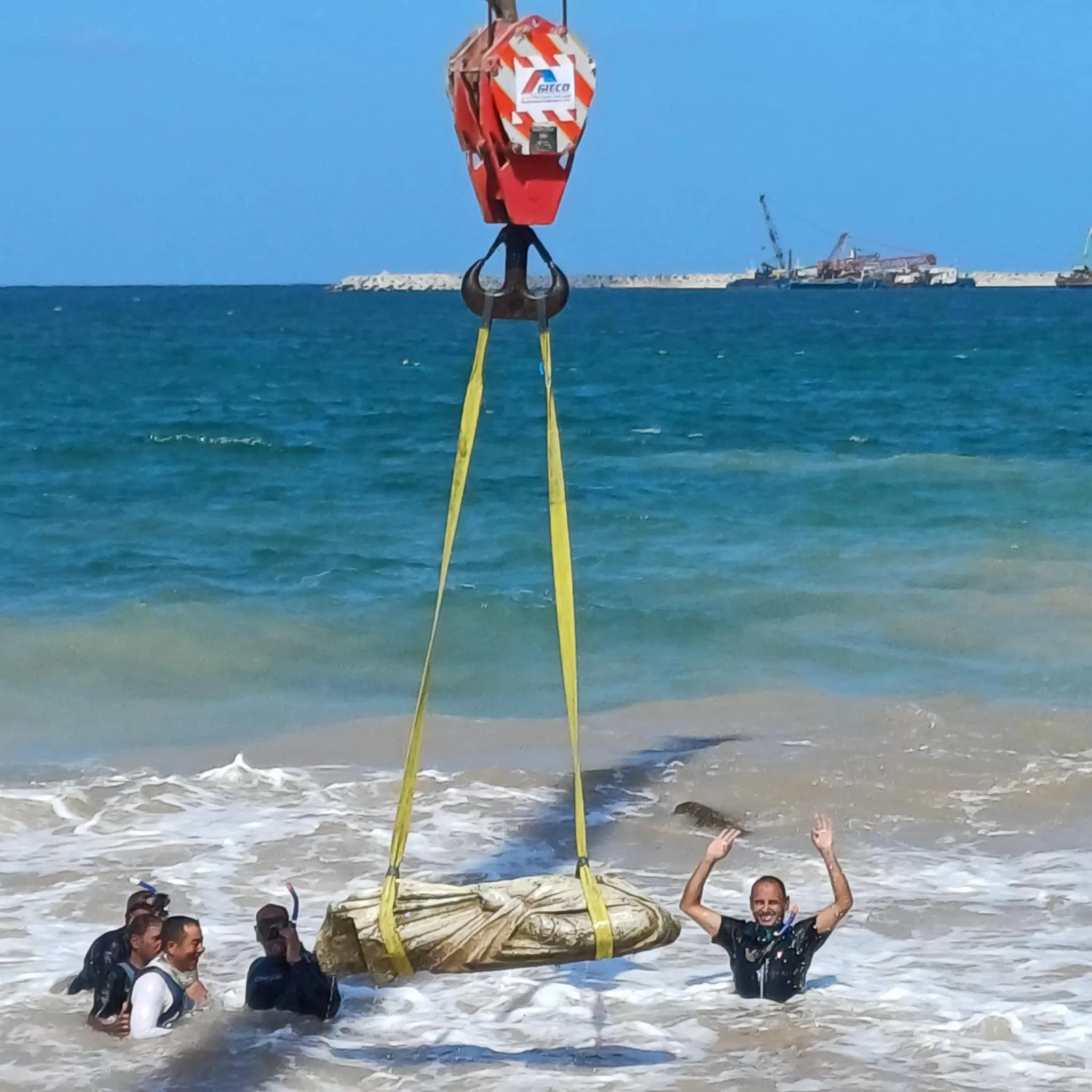
The Ministry of Tourism and Antiquities has unveiled four archaeological artefacts that were retrieved from the Mediterranean waters off Abu Qir Bay in Alexandria.
The retrieval of the artefacts marked Egypt’s first underwater recovery in 16 years. An announcement in this regard coincided with the International Day for the Preservation of Underwater Cultural Heritage, an annual event celebrated on August 20 and 21. In Egypt, the event is marked with a special series of events and exhibitions across Alexandria.
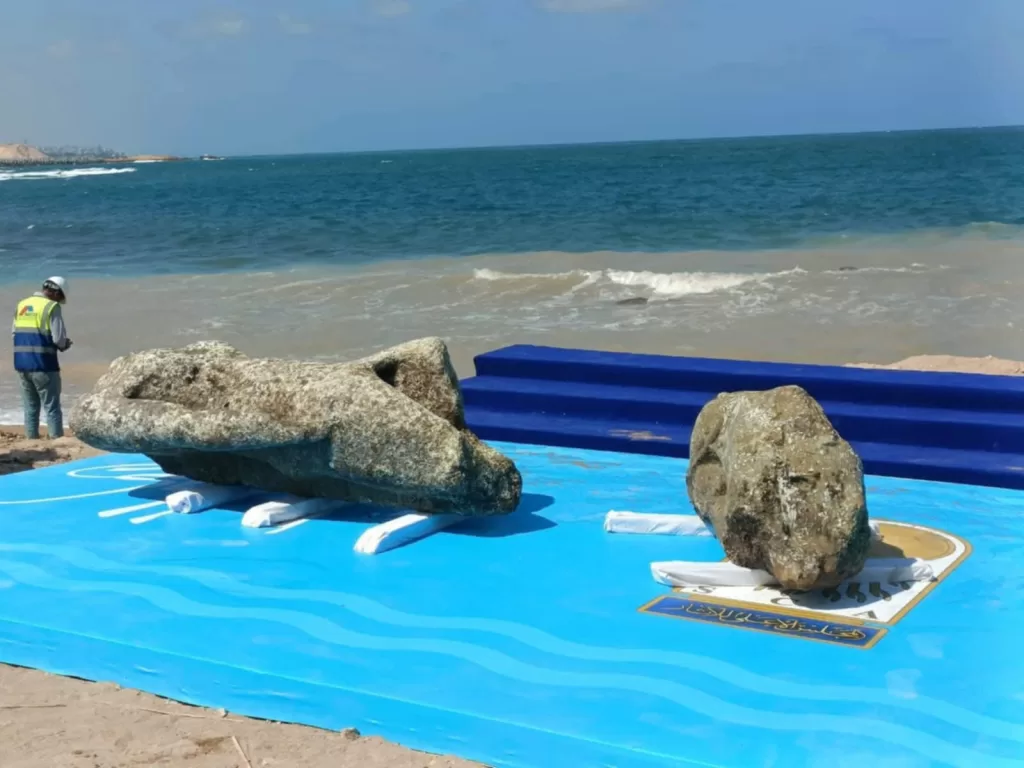
The artefacts, extracted on Thursday, included three incomplete statues: a quartz sphinx bearing the cartouche of Ramses II, a late Ptolemaic royal granite statue, and a white marble statue of a Roman nobleman. They also included an Olynthian millstone, the first of its kind ever to be discovered in Egypt.
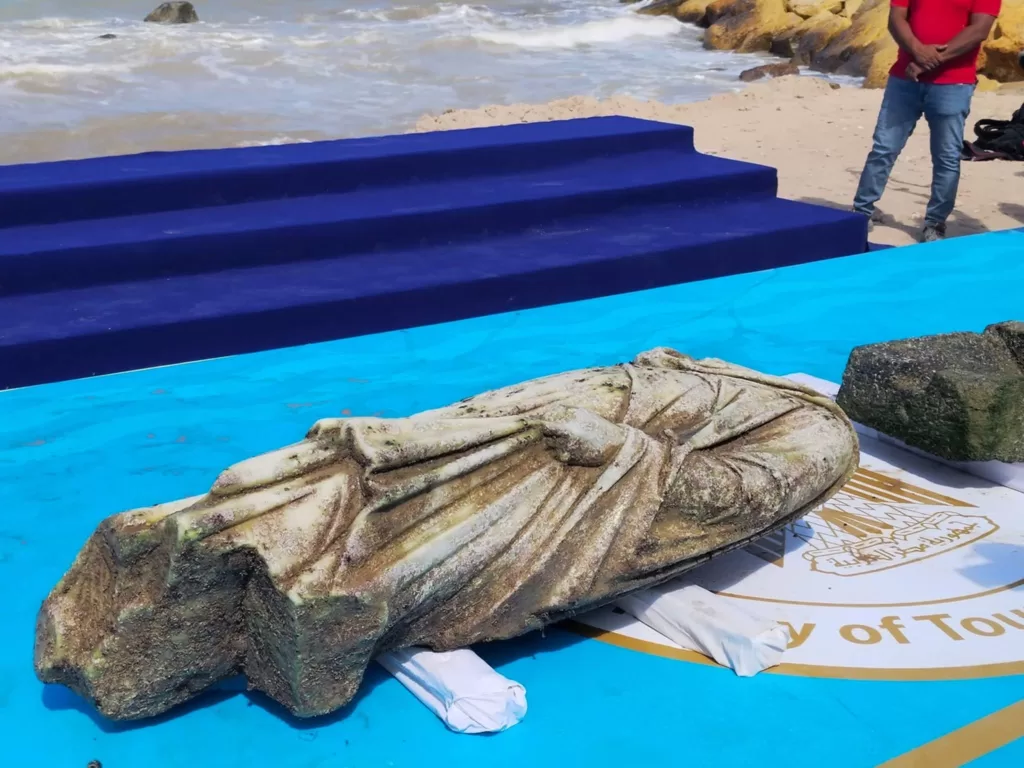
Most of the statues found in the area were damaged, likely due to earthquakes or natural disasters that caused their submersion, according to Secretary-General of the Supreme Council of Antiquities Mohamed Ismail Khaled.
Excavations began on land near Abu Qir Port in 2023 before extending into the sea, where the remains of an ancient city were uncovered. More finds, including a sunken ship, are expected to be announced soon. Abu Qir Bay is home to the legendary submerged cities of Heracleion and Canopus, both lost after devastating earthquakes and tidal waves in antiquity.
In 2021, archaeologists discovered the remains of a warship that sank in the 2nd century BC in the same area. Surveys indicate the site represents a full urban settlement with temples, cisterns, port quays, and fish-breeding basins from the Roman period.
Egypt last lifted underwater artefacts in 2009, when the 9-tonne, 2.25-meter-high gate tower of the Temple of Isis was recovered from Alexandria’s eastern harbour near Qaitbay Citadel. Khaled noted that under the 2001 UNESCO Convention, Egypt avoids removing underwater heritage unless necessary to protect it from damage.
Alongside the recovery, Minister of Tourism and Antiquities Sherif Fathy inaugurated a temporary exhibition, titled Secrets of the Sunken City, in the Alexandria National Museum. The display features 86 artefacts from Canopus and Heracleion, offering insight into daily life, religious practices, and funerary traditions of the Ptolemaic and Roman eras.
Minister Fathy revealed that Egypt may construct an underwater museum.
He cited, however, a number of challenges, including cost, visibility, and climate change. The minister also referred to Alexandria’s cultural value and the government’s plans to integrate the city more deeply into tourism programmes alongside the popular North Coast. The local tourism sector continues to expand, with 15.8 million visitors recorded last year.
Alexandria Governor Ahmed Khaled hailed the exhibition as a cultural milestone that strengthens the city’s role as a historic hub linking the East and the West, moving it closer to becoming an “open-air museum” that reflects Egypt’s enduring heritage.

