



What draws you to the cinema? Is it a beloved star, a compelling storyline, or breath-taking visuals?
Whatever your answer is, the film industry is undergoing an unexpected transformation.
Imagine seeing Humphrey Bogart, who passed away in 1957, starring in a new movie in 2025. Or a modern remake of Casablanca (1942), all thanks to artificial intelligence.
As AI is involved in every digital aspect of our lives, filmmakers have long recognised its potential, developing AI models to achieve what was once impossible.
Today, AI platforms like ScriptBook, Synthesia, DeepBrain AI, HeyGen, and Pictory can generate story ideas, write scripts and dialogue, design characters, and even suggest scenes.
They can replace real actors with digital characters and create entire soundtracks, all at a significantly lower cost. It is possible that in the future, we will see movies made entirely by AI.
For a long time, cinema has explored the frontiers of technology and AI, often delving into our fears about the implications of these tools.
These films are not just about robots and futuristic gadgets. They are rather about how the instrumentswe create might eventually replace us.
The Matrix (1999), directed by Lilly and Lana Wachowski, and starring Keanu Reeves, is a case in point.
Computer programmer Thomas Anderson, known online as “Neo,” uncovers the truth about the Matrix, a virtual world created by sentient machines to enslave humans and harvest their energy.
Humans are implanted with cybernetic devices, forcing them to live within this simulated reality.
After taking a red pill that frees him, Neo discovers that he is living in approximately 2199, embroiled in a war between machines and humanity.
Another film exploring the profound goals of AI is Steven Spielberg’s A.I. Artificial Intelligence (2001), starring William Hurt and Jude Law.
Set in a future where human-like intelligence has been achieved, a private company creates a robot with feelings: a child named David (Haley Joel Osment).
Adopted by a family whose biological child is ill, David forms a deep bond with his mother, Monica (Frances O’Connor).
However, when Monica’s son recovers, David is abandoned. He then embarks on a quest to become human and return to his mother.
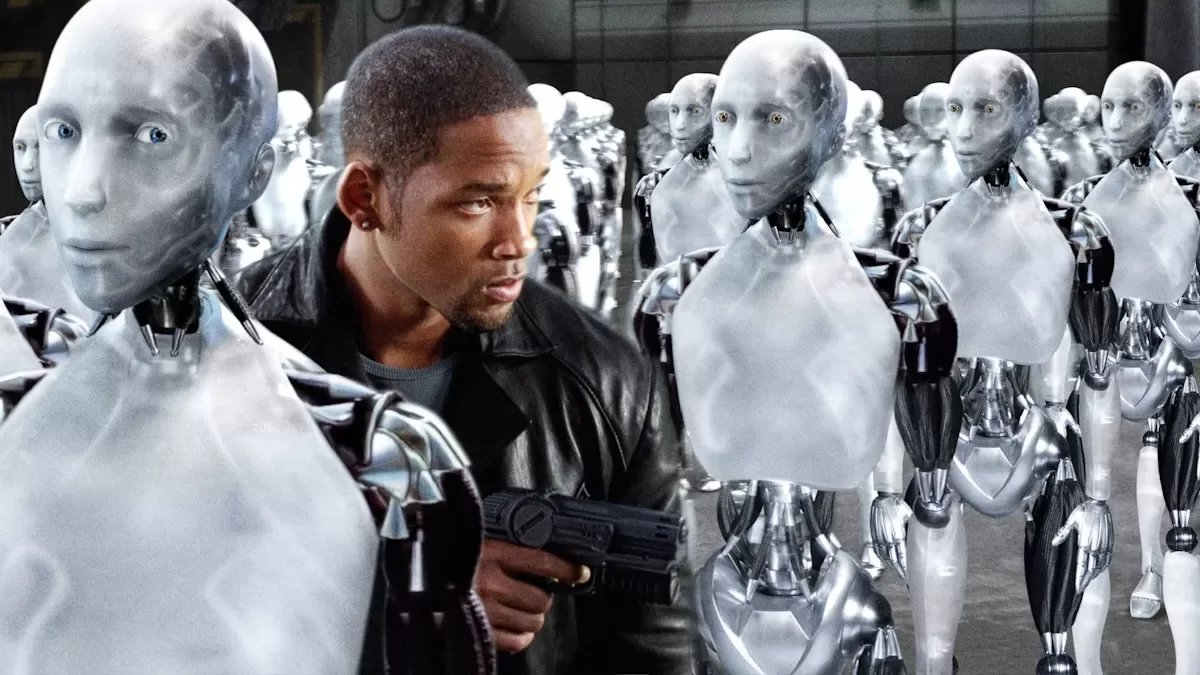
I, Robot (2004), directed by Alex Proyas and starring Will Smith and Bridget Moynahan, also takes place in a technologically advanced future filled with super-powered robots designed to assist humans.
When Officer Del Spooner investigates the murder of a robot expert, he discovers a robot, Sonny, is involved.
This revelation destabilises the relationship between humans and robots, leading Del to investigate further and protect humanity’s fate while also seeking reconciliation with the machines.
Also, Her (2013), directed by Spike Jonze and starring Joaquin Phoenix and Scarlett Johansson, tells the story of Theodore, a lonely man in the midst of a divorce. He purchases the new OS1 operating system, the world’s smartest, and quickly finds himself drawn to Samantha, its female voice. Their relationship deepens, and they fall in love.
Theodore grapples with the complexities of loving an entity that does not exist in the real world, while Samantha’s advanced intelligence assists him in ways no human could.
These movies, and many others, explore how AI can far exceed our expectations. What was once a futuristic fantasy has now become a rapidly unfolding reality!
This technology is redefining every facet of filmmaking, especially as it saves significant money and time.
So, while filmmakers make movies about AI, it is very possible that in the near future, we can see movies made entirely by AI about the same filmmakers or others.

