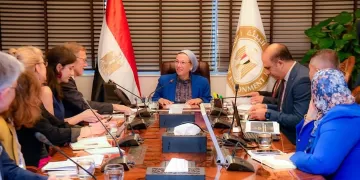
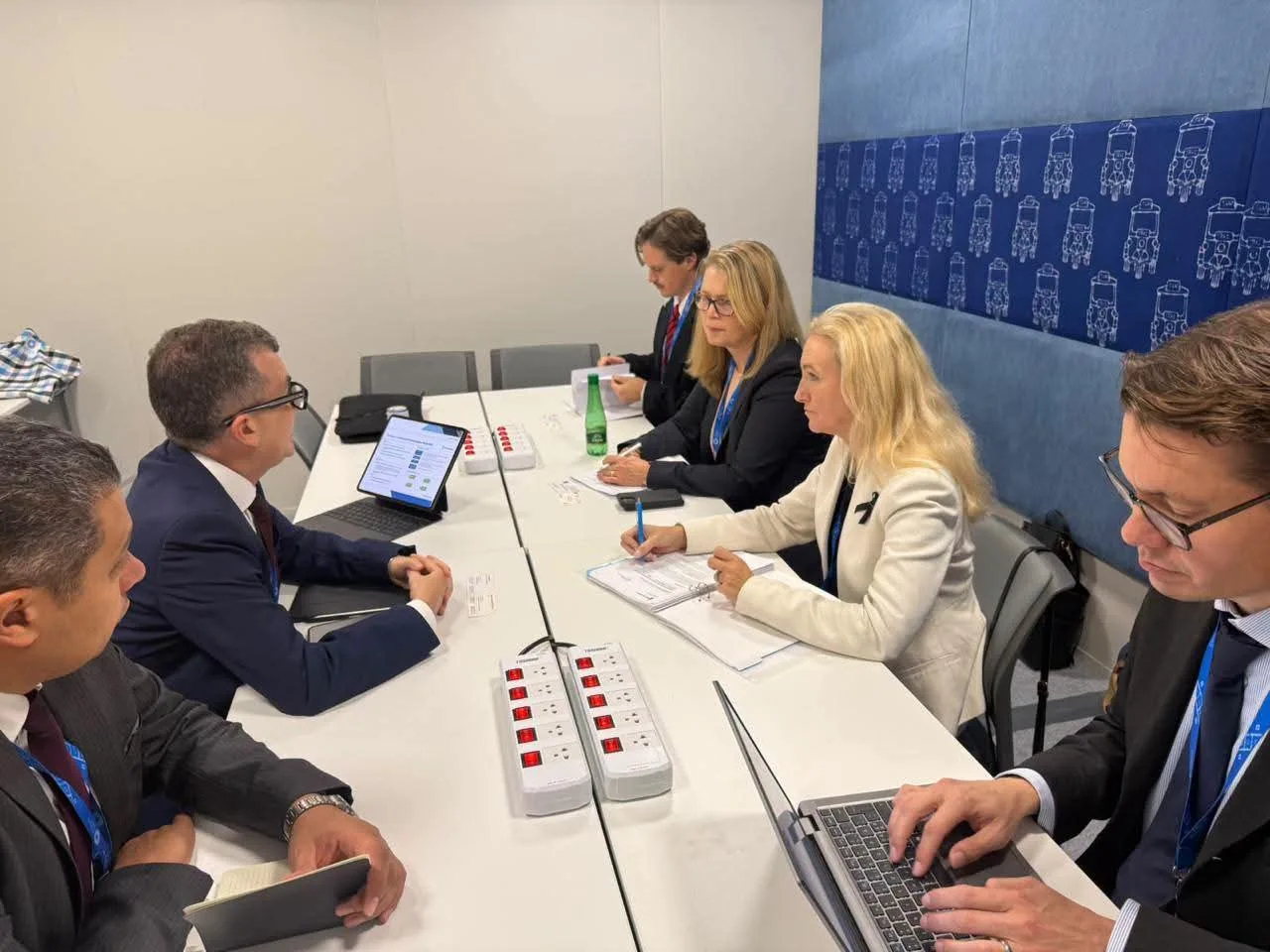





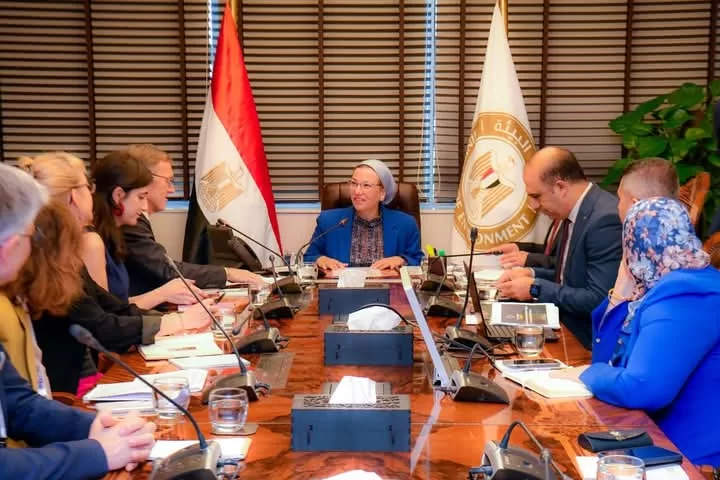
Minister of Environment Yasmine Fouad met with a delegation from MEDEF International (French Business Confederation) comprising representatives from major French companies interested in expanding green investments in Egypt.
The delegation was led by Wouter van Wersch, the Executive Vice President International of Airbus and head of the French business mission, currently visiting here.
Fouad praised the long-standing co-operation between Egypt and France, especially in environmental and climate matters.
She highlighted Egypt’s leadership role in global environmental agreements such as the Paris Agreement (2015) and COP14 on biodiversity. Egypt has shifted its environmental narrative in recent years by integrating environmental goals into economic and social development plans, according to her. Notably, in 2019, Egypt’s cabinet adopted green sustainability criteria for public investment, with the goal of reaching 100% green projects in the national budget by 2030, she said.
She also discussed how the issue of climate change led to restructuring the National Council on Climate Change under the Prime Minister’s leadership. This resulted in the National Climate Strategy 2050 and updates to Egypt’s Nationally Determined Contributions (NDCs), including nature-based solutions and coral reef conservation, she said. These align with Egypt’s call in 2018 for synergy among the three Rio Conventions: climate, biodiversity, and desertification, she added.
As a country responsible for less than 1% of global emissions, Egypt prioritizes climate adaptation, particularly in water and food security, the minister said. The government has prepared a national climate investment strategy focused on water and agriculture, encouraging private and banking sector involvement to reduce investment risks, she further said. Two new strategies are also in development: the National Circular Economy Strategy and the Blue Economy Strategy, in preparation for Egypt’s hosting of the Barcelona Convention on marine pollution, according to her.
Fouad noted that tourism, a key economic sector, depends heavily on natural resources. She highlighted that initiatives like coral reef preservation have been launched in partnership with the private sector to promote sustainable tourism. Additionally, Egypt is working to establish a Nature Fund with local banks to support eco-tourism and enable private investment in protected areas, she said.
In the waste management sector, Egypt has passed its first waste management law based on circular economy principles and private sector participation, she said. The Environment Ministry’s Waste Management Regulatory Authority is responsible for setting procedures, contracts, and technology standards, according to her. A successful example was getting cement companies to adopt alternative fuels, reducing reliance on coal, she said.
Fouad highlighted investment opportunities in sustainable aviation fuel (SAF), with a feasibility study completed by the ministries of environment, petroleum, and civil aviation using used cooking oil as feedstock.
The industrial sector has also shifted toward environmental compliance, supported by the Industrial Pollution Control Program, she told the French delegation. The program’s new phase, titled Green Sustainable Industry (GSI), offers soft loans for both polluting industries and those pursuing greener operations, she said.
Additional cooperation opportunities include recycling construction and demolition waste, with Egypt’s first pilot project in New Cairo and a major waste management city being developed in 10th of Ramadan City with the World Bank, according to her. This facility will manage municipal, medical, industrial, and construction waste in East Cairo and Qalyubia and will be operated by the private sector, she said.
The minister also mentioned investment prospects in eco-friendly design, the sustainable textiles initiative “Waste to Good Taste” launched at COP27, and environmental consulting opportunities, particularly for strategic environmental impact assessments along Egypt’s southern Red Sea and northern coasts.
On carbon neutrality in the auto industry, Egypt has plans to manufacture both conventional and electric vehicles, promote low-emission fuels, and expand electric public transport, which has already exceeded emission reduction targets in the national climate plan, she stated.
Fouad referred to the Central Bank of Egypt’s green finance initiatives, requiring national banks to create sustainability units, aligning financial practices with the state’s green transition goals. She also mentioned the National Bioeconomy Strategy and efforts to reduce single-use plastic and implement extended producer responsibility policies.
The French business delegation expressed strong interest in investing in Egypt’s green transition and praised the supportive political and investment environment. The delegation members said they are eager to collaborate on projects related to green hydrogen, carbon neutrality, and ecosystem balance.
Both sides agreed to hold virtual meetings with French companies to explore concrete investment opportunities in environmental projects.
The visiting delegation included companies specializing in green building, low-carbon construction materials, environmental consulting, eco-friendly airports, recycling industries, and renewable energy.

