

Egyptian President Abdel Fattah El Sisi has given directives the government to finalise plans of action regarding the national project for human development, stressing that human capital is such a true wealth that deserves developing it and investing in it.
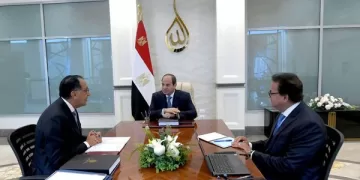
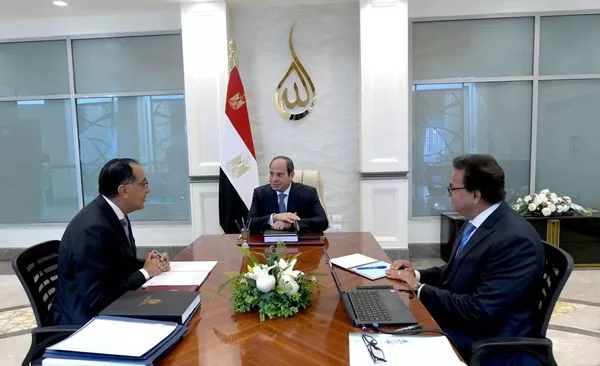
The human development project was the main topic of review in a meeting that President Sisi called with Prime Minister Moustafa Madbouli and Minister of Health and Population Khaled Abdel-Ghaffar on Sunday.
During a meeting, President Sisi was briefed on the central aspects of the project which combines a chain of initiatives especially the sectors of health, education, culture and sports, Presidency Spokesman Ahmed Fahmy said.
The briefing, he said, stressed the project’s aim of bolstering investment in human capital through a comprehensive programme focused on human development and deepening the Egyptian identity. In carrying out the project, integration is observed between various state bodies, the civil society and the private sector.
Such broad partnering in implementing this project is meant to enable all segments of the public and all age groups to benefit from the resources of the state in a fair and efficient way, thereby improving the quality of life for citizens in all governorates.
In this context, President Sisi called for finalising the executive plans on all axes of the project, stressing that human capital is Egypt’s true wealth; hence the necessity of developing it and investing in it, Spokesman Fahmy said.
The relevant presidential directives highlighted the need for boosting coordination and complementation between all state bodies across all governorates in order to achieve the targets of the initiative and enable citizens to feel the positive returns of the initiative at the earliest.
Signalling a new beginning for efforts to build the human being the project spans many sectors, especially including those of health, education, culture and sports, and the creation of new job opportunities through collaborative action and coordination between all state agencies, civil society, and the private sector.
Additionally, President Sisi reaffirmed the importance of boosting coordination and integration between all state institutions across the country to meet the initiative’s goals. “Citizens should feel the positive impact of that project as promptly as possible,” the president said.
Also reviewed during the meeting were the developments in the health sector, including the renovation of Nasser Institute (Nile Medical City), the project to establish central laboratories in Badr City, and the refurbishment of Dar El-Salam Cancer Centre in collaboration with Gustave Roussy Institute, with the aim of transforming it into a regional centre of excellence, the spokesman said.
The current status of the Universal Health Insurance System was also considered during the meeting. In this regard, the President gave directives for speeding up the construction and development of 30 hospitals and 500 medical units and centres in the second-phase governorates – Damietta, Minya, Kafr el-Sheikh, North Sinai and Matrouh.
During the meeting, Minister of Health Khaled Abdel-Ghaffar reviewed the progress of studies related to the Medical Capital City project. The project aims to achieve a leap in the quality of medical services in Egypt and the region through advanced methods and reliance on artificial intelligence (AI) techniques, the presidency spokesman said.
Discussions also covered government efforts to upgrade investment in the health sector by facilitating stimulant packages for investors, endorsing business incentives and encouraging partnership with the private sector, Fahmy said.
The government is considering the drawing up of incentives for the development of existing and projected medical care facilities, in addition to promoting coordination between the Universal Health Insurance System and the private sector, with the goal of providing better healthcare services to citizens across the country.
Government efforts pertaining to the localisation of the pharmaceutical industry and attracting investments in the manufacturing of medicines and medical supplies were discussed during the meeting, Spokesman Fahmy said.
Regarding the progress of action on the presidential health initiatives, President Sisi gave directives for the creation of medical care centres for elderly patients and those with special needs, the spokesman said.
The president also called for the government to extend health insurance coverage to 8.5 million beneficiaries of the Takaful and Karama programme, as well as seasonal workers in the construction and building sectors. Such expansion would cost the state budget nearly LE10 billion annually, in addition to exploring the possibility of including more categories of informal worker groups in the programme in the future.


Discussion about this post