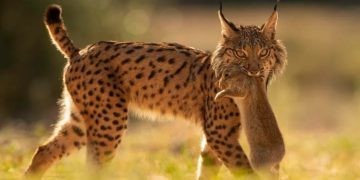




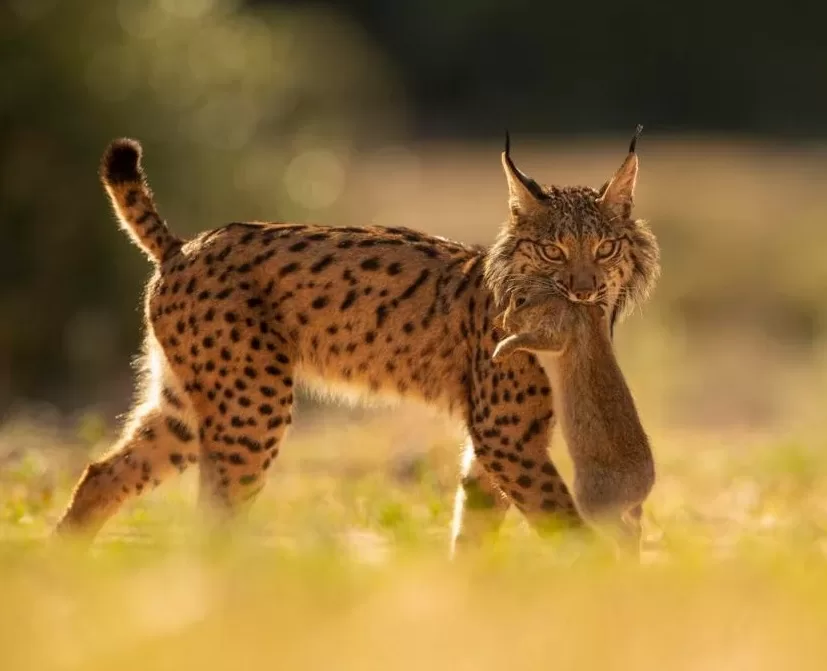
MADRID — Things are looking up for the Iberian lynx. Just over two decades ago, the pointy-eared wild cat was on the brink of extinction, but the International Union for Conservation of Nature said that it’s no longer an endangered species.
Successful conservation efforts mean that the animal, native to Spain and Portugal, is now barely a vulnerable species, according to the latest version of the IUCN Red List.
In 2001, there were only 62 mature Iberian lynx – medium-sized, mottled brown cats with characteristic pointed ears and a pair of beard-like tufts of facial hair – on the Iberian Peninsula.
The species’ disappearance was closely linked to that of its main prey, the European rabbit, as well as habitat degradation and human activity.
Alarms went off and breeding, reintroduction and protection projects were started, as well as efforts to restore habitats like dense woodland, Mediterranean scrublands and pastures.
More than two decades later, in 2022, nature reserves in southern Spain and Portugal contained 648 adult specimens. The latest census, from last year, shows that there are more than 2,000 adults and juveniles, the IUCN said.
“It´s a really huge success, an exponential increase in the population size,” Craig Hilton-Taylor, head of the IUCN Red list unit, told The Associated Press.
One of the keys to their recovery has been the attention given to the rabbit population, which had been affected by changes in agricultural production. Their recovery has led to a steady increase in the lynx population, Hilton-Taylor said according to AP.
“The greatest recovery of a cat species ever achieved through conservation (…) is the result of committed collaboration between public bodies, scientific institutions, NGOs, private companies, and community members including local landowners, farmers, gamekeepers and hunters,” Francisco Javier Salcedo Ortiz, who coordinates the EU-funded LIFE Lynx-Connect project, said in a statement.
IUCN has also worked with local communities to raise awareness of the importance of the Iberian lynx in the ecosystem, which helped reduce animal deaths due poaching and roadkill. In addition, farmers receive compensation if the cats kill any of their livestock, Hilton-Taylor said.
Since 2010, more than 400 Iberian lynx have been reintroduced to parts of Portugal and Spain, and now they occupy at least 3,320 square kilometers, an increase from 449 square kilometers in 2005.
“We have to consider every single thing before releasing a lynx, and every four years or so we revise the protocols,” said Ramon Perez de Ayala, the World Wildlife Fund’s Spain species project manager. WWF is one of the NGOs involved in the project.
While the latest Red List update offers hope for other species in the same situation, the lynx isn´t out of danger just yet, says Hilton-Taylor.
The biggest uncertainty is what will happens to rabbits, an animal vulnerable to virus outbreaks, as well as other diseases that could be transmitted by domestic animals.
“We also worried about issues with climate change, how the habitat will respond to climate change, especially the increasing impact of fires, as we´ve seen in the Mediterranean in the last year or two,” said Hilton-Taylor.


Discussion about this post