



By Sarah Saad
The state has thus been working as hard as ever over the past years to develop the existing agricultural areas, and in the meantime reclaim further land in the desert, in addition to investing in greenhouse farming. This aims to increase production and meet the needs of the local market, and achieve self-sufficiency, and food security, in addition to purposes, amid soaring global prices.
The agricultural sector in Egypt represents 15 per cent of the country’s GDP, and accounts for 23 per cent of the national workforce. Exports of agricultural crops, and processed items reached $9 billion during 2023, ranking as the second largest source of foreign currencies.
Among the promising leading agricultural projects is the Egypt’s Future for Sustainable Development mega project, the first in projects of the New Delta Project, aiming to achieve self-sufficiency of agricultural produce and export the surplus.
The vital national project has been shown high interest from the political leadership, at a time when the world is going through major crises affecting global food prices for the shortage of some agricultural items.
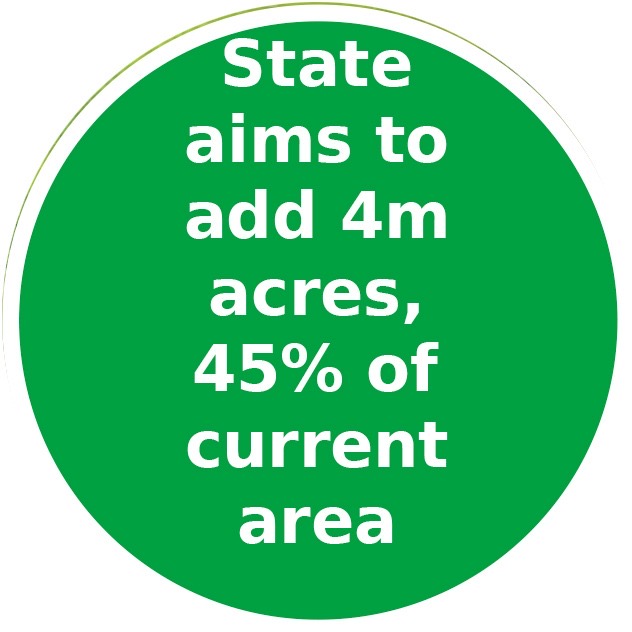
The Egypt’s Future Authority for Sustainable Development Authority plans to reclaim 1.6 million feddans by 2025, and 4.5 million feddans by 2027. This will count for up to 45 per cent of the present agricultural areas.
In 2017, the authority began reclamation projects in small areas with modern irrigation methods and precision agriculture technology.
The project aims to provide up to 10,000 direct jobs and more than 360,000 indirect ones. Job opportunities are expected to increase during the coming seasons
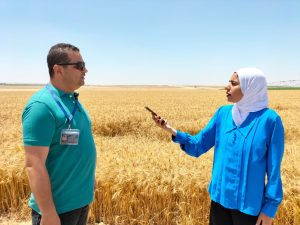
During a tour for the Egyptian Gazette at the New Delta Project, Executive Director of Egypt’s Future Authority Colonel Bahaa El-Ghannam, explained that the agency’s projects are integrated, covering agriculture, manufacturing, and animal production.
According to authority chief, up to 800,000 feddans have been reclaimed by 2024, compared to 30,000 feddans, and 60,000 feddans in 2018 and 2023, respectively
Al-Ghannam reviewed a number of projects, including the Egypt’s Future 1, which started in 2022, responding to directives by President Abdel Fattah El Sisi, with 277 km of open canals and irrigation systems reclaim a thousand acres.
Future Project 2 includes surface irrigation through the Al-Hamam Canal, in addition to recycling agricultural drainage water to reclaim 405,000 feddans.
He pointed out that the second phase, which extends from the Rasheed Branch in the south of the Mostaqbal Misr project, will include integrated activities, agricultural, manufacturing, and marketing.
As for the greenhouse project in the Dabaa axis, it has been prompted by the need for agricultural diversity and integration in the New Delta. Work in implementing the project began at an area of 405,000 feddans, by planting 690 greenhouses using Egyptian and Spanish technology.
Agricultural projects nationwide also include the Sanabel Sono, in Aswan, where work started in mid-2023.
Al-Ghannam pointed to the Dakhla-Al Owainat project, which is based on investing in the country’s resources of vast arable deserts, where the cultivation of 15,000 acres was achieved as a first phase, with a challenge of completing the second phase which covers cultivation of 200,000 feddans.
Al-Ghannam also referred to other national projects of the New Delta, in the governorates of Minya and Beni Suef
The authority has been working on three agricultural projects in North and Central Sinai and Al-Mahsama, totaling 600,000 feddans; 100,000 in North Sinai, and 400,000 in Central Sinai, and 100,000 in Al-Mahsama, along the road by the Suez Canal. Work is being carried out in cooperation with a number of investors.
Meanwhile, Al-Ghannam pointed to the authority’s expansion in animal production projects, with current farms’ capacities of 18,000 heads of livestock, 11,000 of milk cows, and 4,500 heads of sheep.
The authority is also implementing more animal production over stages aiming to achieve self-sufficiency of meat for the local market.
The New Delta is divided into sectors, according to the type of soil and degree of salinity and water, including Raad 7, which the Egyptian Gazette inspected and interviewed some engineers and farmers working there.
Engineer Shaheen Hamed, Director of the Agricultural Department at the Egypt’s Future Authority for Sustainable Development, explained that the project is based primarily on providing the needs of the local market, in addition to export purposes.
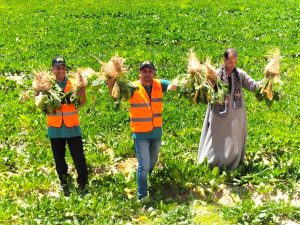
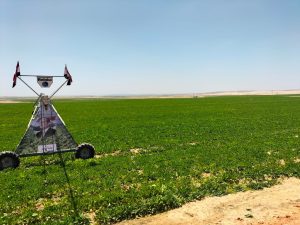
For his part, engineer Mohamed Gomaa, director of the field sector, stressed during the Gazette tour of the bean and potato fields, the co-operation with private sector companies and investors and to bridge the gap between import and local consumption, as beans are a strategic crop.
that is grown through the latest agricultural mechanization to provide the largest possible amount of water while maintaining the agricultural quality of crops and soil and increasing productivity per acre.
Muhammad Khalaf, one of the project’s labour suppliers, explained that the project provides many direct and indirect job opportunities for workers.


Discussion about this post