





By Sherif Attar
In a world of ever-changing ambiguity and uncertainty, executives have to face two challenges: excellent performance and people development. Where many managers think those endeavours are “competing”, this author believes they are “completing”. GET DOWN TO BUSINESS argues.
Strengthening Your “Weakest Link”
No matter what you do, there is often scope for boosting overall performance. A great way of doing this is to identify and eliminate “bottlenecks,” or things that are holding you back. One approach to do this is to use the Theory of Constraints (TOC).
Understanding the Theory
“A chain is only as strong as its weakest link,” and this is what the Theory of Constraints reflects. Created by Dr. Eli Goldratt and published in his 1984 book “The Goal”, the theory suggests that organisational performance is dictated by constraints that prevent an organisation from reaching its goals. Constraints can involve people, supplies, information, equipment, or even policies, and they can be internal or external.
The theory says that every system has at least one constraint – the system’s “weakest link.” The theory also says that a system can have only one constraint at a time, and that other areas of weakness are “non-constraints” until they become the weakest link.
You use the theory by identifying your constraint and changing ways to overcome it. The theory was originally used successfully in manufacturing, but you can use it in a variety of situations. It’s most useful with important or frequently-used processes.
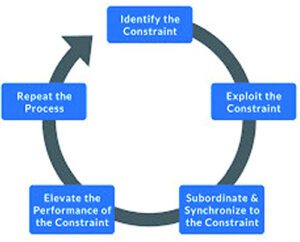
Goldratt identified a five-step process for applying the theory:
1. Identify the constraint.
2. Exploit the constraint.
3. Subordinate everything else to the constraint.
4. Elevate the constraint.
5. Go back to step 1.
Applying the Theory
Step 1: Identify the Constraint
Identify your weakest link – the factor holding you back the most. Check the processes that you use regularly. Are they efficient, or are there bottlenecks – people lack skills or training, or you lack capacity in a key area?
Use tools like Flow Charts or Storyboarding to map out your processes and identify issues. Brainstorm constraints with team members, and use the 5 Whys Technique and Root Cause Analysis.
Constraints may be physical or intangible factors, such as ineffective communication, restrictive company policies, or even poor team morale. According to the theory, a system can only have one constraint at a time. So, you need to decide which factor is your weakest link. If this isn’t obvious, use Pareto Analysis to identify the constraint.
Step 2: Manage the Constraint
Ask what small changes can you make to increase efficiency, without committing to potentially expensive changes? (Goldratt calls this “exploiting the constraint.”)Your solutions will vary depending on your team, your goals, and the constraint. For example, it might involve modifying lunch breaks or vacation time to make workflow more efficient, or train team members.
Step 3: Evaluate Performance
Now review how your system is performing with the simple fixes you’ve put into place. Is the constraint still causing a bottleneck? If it is, you need to do whatever you can to solve the issue. (Goldratt calls this “elevating the constraint.”) For instance, do you need to invest in new equipment, outsource certain tasks, or take on more staff?
Brainstorm possible solutions with your team, and use the Five Whys and Cause and Effect Analysis to identify the real issues. Once you’ve identified possible solutions, use decision-making tools, such as Grid Analysis and Cost/Benefit Analysis to help you choose the best solution.
Step 4: Start Over
Once you’ve eliminated the constraint, you can move back to step 1 and identify another constraint.
For questions or suggestions, please send your comments.
Sherif Attar, an independent management consultant/trainer and organisation development authority, delivers seminars in the US, Europe, Middle East and the Far East.


Discussion about this post