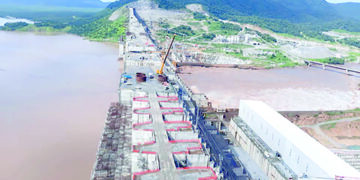





Of the 60 billion cubic metres of water that Egypt has at its disposal annually, 55 billion cubic metres comes from the River Nile. However, this country needs 114 billion cubic metres a year, Egyptian Minister of Irrigation Mohamed Abdel Ati revealed earlier this month.
The gap between supply and demand is being met by reusing agricultural drainage water and treating wastewater, the minister said.
We are importing food products that would otherwise consume 34 billion cubic metres of water annually to produce, the minister added.
The water sector is facing major challenges, topped by the unilateral measures taken by Ethiopia regarding the filling and operation of the Grand Ethiopian Renaissance Dam (GERD) and climate change.
Egypt, Sudan and Ethiopia have been embroiled in a dispute since May 2011 when Ethiopia started building the dam. Egypt voiced concern over its water share.
Since then, the three countries have met several times to hammer out a fair and binding agreement on the filling and operation of the dam to safeguard the water rights Egypt and Sudan. However, no final agreement has been reached due to Ethiopia’s intransigence and insistence on filling and operating the GERD.
Dr Ahmed Fawzi Diab, a professor of hydrology and water resources at the Desert Research Centre, says Egypt has relied on diplomacy with Ethiopia to find the way forward. Unfortunately, Ethiopia thwarts ongoing efforts by international
and African mediators to resolve the dispute. In fact, the Ethiopians appear determined to impose a fait accompli on the two downstream countries.
“Ethiopia’s insistence on completing the second filling stage bodes ill for Egypt and Sudan as it is acting irresponsibly, exposing the two downstream countries to great risks,” Diab told The Egyptian Gazette.
Diab went on to say that he is banking on government schemes to conserve and increase water resources as part of a national plan to diversify water resources from by 2037 at a cost of $50 billion.
One strategy is an LE80 billion project to clean and line canals and drains to prevent seepage. Another strategy is the construction and maintenance of 92 pumping and lifting stations. Meanwhile, farmers are being encouraged to use modern irrigation systems to reduce waste since traditional methods consume the largest proportion of Nile water.
The construction desalination plants is also part of the government plan to meet growing water demand.
According to a government statement two months ago, fourteen desalination plants are being built in Egypt with a total capacity of 476,000 cubic metres per day at a cost of LE9.7 billion.
When built, the plants will bring Egypt’s tally to 90 desalination stations with a total capacity of 1.3 million cubic metres per day.
In July 2020, Ethiopia unilaterally carried out the first phase of the filling process with 4.9 billion cubic metres. The second phase of filling, which is expected to reach 13 billion cubic metres, was started this month. The dam lake can hold 75 billion cubic metres, while Egypt’s annual share of Nile water is 55 billion cubic metres. Some 85 per cent of the waterflow to the Aswan High Dam reservoir (Lake Nasser) comes from the Blue Nile, where the Ethiopian dam is being built, while 15 per cent comes from the White Nile, Diab said.
“Egypt has paid billions to meet its future needs for water and reduce the damage that the GERD construction and the storage of 75 billion cubic metres of water behind it could cause,” Diab told this newspaper.
“These projects will supply Egypt with a large amount of water, as shortages of up to 12 billion cubic metres – equally divided between Egypt and Sudan – are expected as a direct result of filling the GERD,” he added.
However, Diab warned that despite costly projects to diversify water resources, heightened risks in the event of drought in successive years and if Ethiopia insists on the same storage plan without a legally-binding agreement.
“Losing one billion cubic metres of water would 200,000 families without a livelihood,” he said.


Discussion about this post